Ascent of Mount Rose
Ascent of Monte Rosa: Take up the challenge and reach the highest peaks of the Alps!
They traveled with us
Frequently Asked Questions
Do you have questions? We have the answers!
Why choose Monte Rosa for your next mountain holiday?
Mount Rose is:
- The second highest mountain range in the Alps, after Mont Blanc
- A border destination between Switzerland (Valais) and Italy (Piedmont), with magnificent glacial panoramas
- A land of legendary mountaineering, with several peaks over 4000m
- A paradise for glacier hiking, high-altitude trekking, and ski touring
- A 4-season destination, depending on your desires: summer for trekking, winter for ski mountaineering, spring for classic mountaineering...
What are the advantages of the Monte Rosa massif in winter?
As soon as the snow arrives, Monte Rosa becomes one of the great winter playgrounds of the Alps. Thanks to its high altitude, the snow cover is generally excellent until spring, and the possibilities are endless:
- Alpine skiing: enjoy renowned areas like Zermatt–Cervinia–Valtournenche, offering hundreds of kilometers of slopes, accessible to all levels.
- Ski touring: explore the wild routes on the Italian side (Gressoney, Alagna, Macugnaga) or Swiss side (Zermatt, Saas-Fee), independently or with a guide.
- Freeride: the Alagna Valsesia valley is a world reference for off-piste skiing, with legendary descents.
- Heliskiing: for the more adventurous, some local agencies offer heliskiing days with drops on otherwise inaccessible peaks.
- Snowshoeing: explore the plateaus and forests of the Aosta Valley at a contemplative pace, with views of the great faces of the massif.
What are the advantages of the Monte Rosa massif in summer?
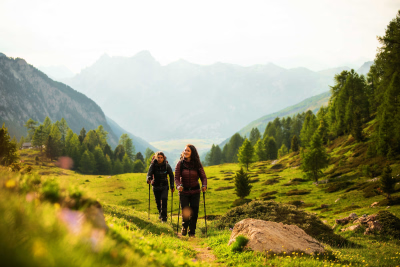
As soon as the snow melts, the Monte Rosa massif opens its doors to enthusiasts of challenging climbs and panoramic trails. Summer there is synonymous with freedom, high-altitude silence, and lunar landscapes where eternal ice meets flowering meadows.
Among the must-do summer activities:
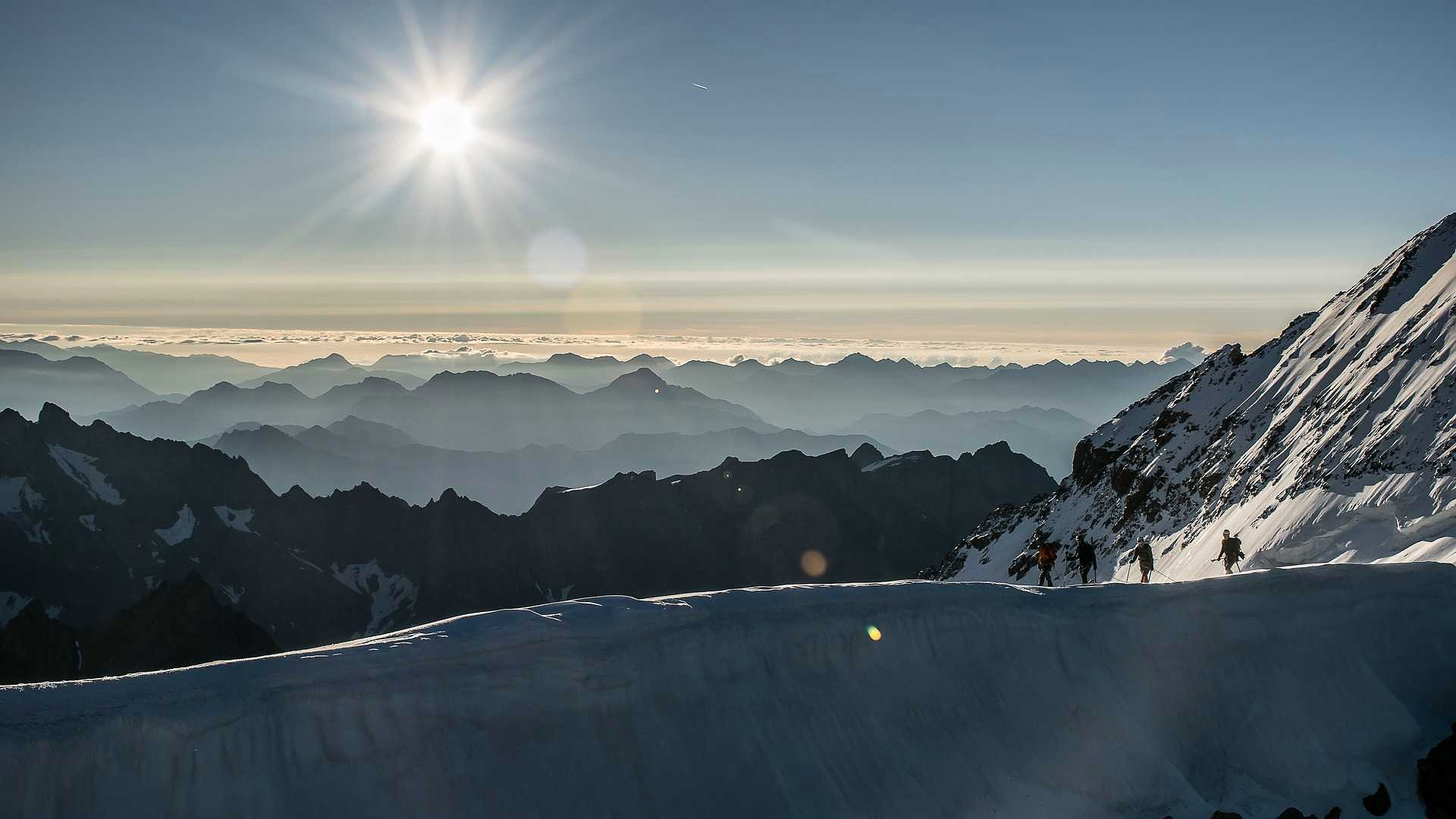
- Mountaineering: tackle the iconic 4000-meter peaks of the massif, such as the Dufourspitze, the Lyskamm, or the Castor. Several routes are accessible to those with prior high-mountain experience.
- Glacier trekking: set off on safe routes to discover the glaciers of Zermatt, the crossing to the Margherita refuge or the ridges of the Breithorn.
- Tour of Monte Rosa: a magical loop between Italy and Switzerland, ideal for 7 to 10 days, combining nights in mountain huts, charming villages and high-altitude passes.
- Via Ferrata: for lovers of verticality in an accessible way, equipped routes allow you to experience the sensations of climbing in complete safety.
Why choose a stay in Monte Rosa with Decathlon Travel?
- Professional supervision: certified guides and tour leaders
- "Low-carbon" holidays: shared transport, accommodation in mountain huts, routes without ski lifts
- Accessible equipment: partnership with Decathlon stores for advice, testing or rental
- Friendly atmosphere & safety: small groups, supportive environment and daily briefings
- Complete immersion: a human, cultural and physical experience at the heart of the alpine world
How to get to Monte Rosa by train?
Choose an eco-friendly and comfortable option by traveling by train !
- From Paris, you can take a TGV to Lausanne, Brig, or Milan, then continue to:
- Zermatt (Switzerland) via Visp and the Matterhorn Gotthard Bahn (scenic train).
- Gressoney-La-Trinité / Staffal (Italy) via Milan → Chivasso → Pont-Saint-Martin, then regional bus or taxi.
Tip: Check connections on platforms like SNCF Connect, SBB (for Switzerland) or Trenitalia (for Italy). Bus transfers in the valleys are frequent during peak season.
How to get to Monte Rosa by car?
If you are travelling by car from France, several routes are available depending on your starting point:
To reach the Italian side (Staffal – Gressoney-La-Trinité)
- Join the A5 motorway towards Aosta – Turin
- Going out in Pont-Saint-Martin
- Follow the SR44 towards Gressoney-Saint-Jean → Gressoney-La-Trinité → Staffal (departure station for Mont-Rose)
To access the Swiss side (Zermatt or Saas Fee)
- Crossing the Great St. Bernard Tunnel or passing through Martigny (Switzerland)
- For Zermatt: park in Täsch (gas station), then take the shuttle train to the town centre (Zermatt is a car-free resort)
Tip: Remember to check weather conditions and the opening status of mountain passes (especially in winter). Some routes may be closed or require special equipment (chains, snow tires).
Learn more about Monte Rosa before you leave
Monte Rosa is not just about its peaks: it is also a land of history and strong alpine identity.
- The name “Mont-Rose” does not come from its pinkish hue at dawn, as one might believe, but from the word “roëse” in Valdôtain dialect, which means “glacier”.
- The mountain range is home to a unique culture: that of the Walsers, a people of Germanic origin who have lived in the Alpine valleys since the 13th century. Their heritage is reflected in the typical wood and stone architecture, local dialects, costumes, and festivals.
- The region has also seen pioneers of mountaineering: the first ascents date back to the 19th century. The famous Margherita Hut, at 4,554 m on the Gnifetti Peak, is the highest in Europe and is named after Queen Margherita of Savoy, who inaugurated it in 1893.
This living heritage gives each stay a human, historical and emotional dimension.
Our tips and advice for a stress-free trip to Monte Rosa
Before leaving:
- Check the local weather (storm, wind, avalanche…)
- Check route conditions and refuge opening times.
- Always carry a GPS track or a topographic map
- Prepare for altitude acclimatization: rest, stay hydrated, and avoid sudden exertion during the first few days above 2,500 m.
For mountaineering or ski touring:
- Hire a UIAGM certified mountain guide
- Equip yourself properly: crampons, ice axe, rope, harness, helmet (mountaineering) or avalanche transceiver, shovel, probe, suitable skis (ski touring)
- Never go alone in glacial or high-altitude terrain
Regarding insurance:
Purchase travel insurance covering mountain sports, including:
- Helicopter rescue costs
- Repatriation
- Medical assistance at altitude
In summary: A stay in Monte Rosa is an unforgettable adventure – but it requires preparation!