Exceptional mountaineering: the ascent of the 4000m peak of Monte Rosa
In summary
-
Sports
-
Duration5 days
-
LevelAdvance
-
DestinationMonte Rosa Massif - France / Italy
-
AgeFrom the age of 18
-
CO₂-Emissions28.38 kg CO2
-
Type of stayIn a group
-
Languages
 French
In a few words
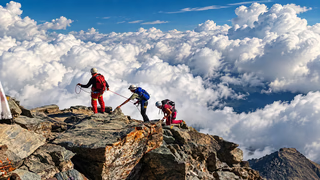
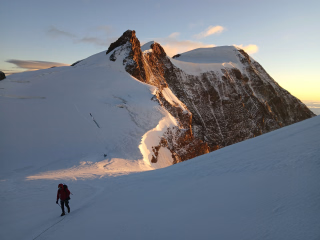
🏔️ This 5-day mountaineering course invites you to explore the Monte Rosa massif , with its peaks over 4,000 meters high, straddling Italy and Switzerland . The second highest massif in the Alps, it offers exceptional panoramic views of the entire Alpine range. From the alpine village of Zermatt , at the foot of the Matterhorn , you'll quickly ascend to altitude thanks to the ski lifts . You'll traverse the massif's glaciers and climb magnificent peaks before reaching the Margherita Hut , perched at 4,554 meters . You'll spend a unique night in Europe's highest mountain hut , under the stars, before descending the Swiss side to conclude this unforgettable high-mountain adventure .
The highlights
-
Climbing mythical peaks at over 4000m altitude
-
An experienced guide for 3 participants, a personalized experience
-
The discovery of the Monte Rosa massif between Italy and Switzerland
Photos


Sport
Level
Mountaineering
In figures
Mountaineering
- Average duration/day: 5h
- Average distance/day: 10 km
- Average daily elevation gain: 870 m
- Average daily descent: 870 m
- Maximum altitude: 4634 m
- Exposed Passages: Yes
Management
French
The ascent is supervised by a high mountain guide for a group of 3 participants , who will provide the technical elements necessary for the smooth running of the stay.
The guide may need to modify the program to ensure safety depending on the mountain weather conditions or the physical condition of the participants.
Program
-
Zermatt - Breithorn - Val d'Ayas Guides Refuge
- Activity Mountaineering
- Duration of the activity 6h
- Distance 10 km
- Positive elevation gain 800 m
- Negative elevation 400 m
- Maximum altitude 4165 m
- Exposed passages Yes
- Accommodation Refuge
- Breakfast not included
- Lunch included
- Dinner included
📍Meet early in the morning at the Matterhorn Glacier Paradise cable car station in Zermatt . The guide will take the time to explain the trek and check your equipment together. You will then take the cable car , which will take you to vast snowy slopes that you will climb to reach the Breithorn (4165 m). From the summit, you can admire the surrounding mountain range and the route for the coming days. You will then descend at a leisurely pace on the Italian side to reach the Val d'Ayas Guides' Hut (3394 m), where you will spend the night.
Day 1 -
Val d'Ayas Guides' Refuge - Castor - Quintino Sella Refuge
- Activity Mountaineering
- Duration of the activity 5h
- Distance 7 km
- Positive elevation gain 850 m
- Negative elevation 650 m
- Maximum altitude 4228 m
- Exposed passages Yes
- Accommodation Refuge
- Breakfast included
- Lunch included
- Dinner included
🏔️ For this second day of the course , you will ascend the glacial plateau to reach the summit of Castor (4228m). You will then continue your route along the East ridge to Col Félik , before arriving at the Quintino Sella refuge .
Day 2 -
Refuge Quintino Sella - Liskamm - Refuge Citta di Mantova
- Activity Mountaineering
- Duration of the activity 5h
- Distance 12 km
- Positive elevation gain 1100 m
- Negative elevation 1300 m
- Maximum altitude 4272 m
- Exposed passages Yes
- Accommodation Refuge
- Breakfast included
- Lunch included
- Dinner included
This morning, you will traverse glacial terrain to climb a key section of this route, the Nez du Liskamm (4272 m). You will then reach the beautiful Pyramide Vincent (4215 m) after an easy ascent, before enjoying a peaceful and pleasant descent to the Citta di Mantova refuge (3500 m).
Day 3 -
Citta di Mantova Refuge - Pointe Gnifetti - Margherita Hut
- Activity Mountaineering
- Duration of the activity 5h
- Distance 8 km
- Positive elevation gain 1200 m
- Negative elevation 200 m
- Maximum altitude 4554 m
- Exposed passages Yes
- Accommodation Refuge
- Breakfast included
- Lunch included
- Dinner included
You'll ascend steep glacial slopes from the refuge before setting down your packs for a short but challenging climb to the summit of Corno Nero (4322 m). Continuing your trek, you'll traverse another nearby peak, Ludwighöhe (4342 m). Finally, you'll finish your day with a final ascent to reach your ultimate destination, the Margherita Hut , located at the summit of Pointe Gnifetti (4554 m).
✨ A night under the stars in a unique high-altitude atmosphere awaits you!
Day 4 -
Margherita Hut - Zumsteinspitze - Zermatt
- Activity Mountaineering
- Duration of the activity 4h
- Distance 11 km
- Positive elevation gain 400 m
- Negative elevation 1800 m
- Maximum altitude 4634 m
- Exposed passages Yes
- Breakfast included
- Lunch included
- Dinner not included
On this final day of your course, you'll embark on an easy climb to the summit of the Zumsteinspitze (4563 m). From there, you'll be able to admire the magnificent Dufourspitze (4634 m), the highest peak in the Monte Rosa massif and the second highest in the Alps. After fully enjoying the view, you'll begin your descent, passing the Monte Rosa Hut (2883 m), before boarding the cogwheel train back to Zermatt.
An evaluation of this internship will be carried out, then you will say goodbye in the middle of the afternoon.
Day 5
Accommodation
Nights spent in mountain huts will be in friendly dormitories , where blankets are provided for your comfort. Just bring a sleeping bag liner.
Slippers will be provided, so you won't need to worry about shoes for the refuge. A simple and pleasant setting to fully enjoy your mountain adventure.
Access
Go to the starting point
🚂 From Paris: take a TGV train to Lausanne (approximately 3 hours 40 minutes), then an InterCity train to Visp. From Visp, take the Matterhorn Gotthard Bahn regional train to Zermatt.
🚂 From Geneva: a direct train connects Geneva to Visp (approximately 2.5 hours). Then, take the regional train to Zermatt (approximately 1 hour).
🚘 From Paris: take the A6 motorway towards Switzerland, then the A9 in Switzerland to Täsch.
🚘 From Geneva: take the A1 motorway to Lausanne, then the A9 to Täsch.
Zermatt is a car-free town . You will therefore need to travel to Täsch , where you will find the Matterhorn Terminal Täsch, a large car park. From there, train shuttles (the Zermatt Shuttle) depart every 20 minutes and take you to Zermatt in 12 minutes.
Price details
The price includes
- Supervision by a UIAGM high-mountain guide
- Accommodation in mountain huts and dormitories for 4 to 8 people
- Full board
- The technical organization of the circuit
- The collective equipment
- The ski lifts
The price does not include
- Transportation to/from the meeting point to the separation point
- Individual technical equipment (crampons, ice axe, harness, helmet, mountaineering boots, backpack, poles...)
- Drinks (a bottle of water costs between €5 and €10 in the refuge)
- Personal expenses
Options
- Flex fare and insurance
Practical information
Specific formalities
Specifics
Before your departure, check with the embassy or consulate regarding the entry and stay requirements for your destination country. You can also find this information on the France Diplomatie website ( https://www.diplomatie.gouv.fr/fr/dossiers-pays/ ).
In the case of flights with stopovers operated by different airlines, also check the entry requirements of the countries you are transiting through.
It is your responsibility to ensure you are in compliance, particularly regarding the validity of your identity documents (for example, some countries require your passport to be valid for at least six months after your return) , visa requirements, necessary vaccinations, and health recommendations. And don't forget to consider any customs restrictions and other potential requirements of your destination or transit country.
ℹ️ Information may change up to the departure date, remember to regularly check official websites.
Equipment
Equipment provided on site
- The group equipment (ropes) is provided
- Slippers (Crocs) and blankets/duvets are available in the shelters.
Equipment to bring
- High-altitude mountaineering boots with rigid soles and crampon compatibility are mandatory: trekking-type shoes are not sufficient.
- A comfortable 40/50 liter mountaineering backpack: it must have attachments for crampons, ice axe and helmet
- An ice axe, crampons, a harness equipped with a locking carabiner (note: carabiners cannot be rented; you will need to buy them if you don't have any), a helmet
- One or two telescopic ski poles (depending on your preferences): we highly recommend them, especially for downhill runs.
- A water bottle/thermos of at least 1.5 liters
- A headlamp, with spare batteries and bulbs
- A pocket knife
- A rain cover for your bag (not mandatory)
- 1 waterproof pouch containing your money, ID, insurance/assistance contract and emergency phone numbers
- A pair of gaiters
- A sheet like a sleeping bag
- A Ziploc bag with your medication and toiletries
- A small tube of SPF 50 sunscreen (face and lips)
Clothing to bring
- Cap
- Hat or cap for sun protection and/or scarf
- Glacier sunglasses (category 4 protection) + ski goggles
- A balaclava-type balaclava covering the entire head (very useful in very cold weather)
- 1 pair of very warm mittens
- 1 pair of fleece or wool gloves
- 1 pair of glove liners
- 2 or 3 breathable, long-sleeved technical base layers
- Breathable technical base layer (carline, lightweight fleece...)
- Thick fleece jacket
- Down jacket or vest (not mandatory but appreciated in case of extreme cold during the climb)
- 1 windproof, waterproof and breathable Gore-Tex type jacket
- 1 pair of comfortable mountain pants for approach trails
- 1 pair of Gore-Tex type windproof trousers for glacier travel
- 1 pair of breathable technical tights
- Socks: 3 thin pairs and 2 thicker pairs
- 1 night outfit for the evening of Day 3 at the Tour chalet + toiletries
- A few hand and/or foot warmers can be useful for those who get cold easily during the ascent to the summit.
Keep in mind that temperatures drop considerably with altitude and wind chill. Therefore, always pack warm clothing.