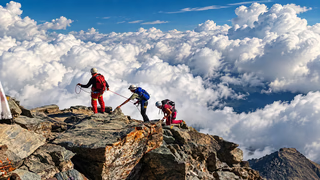
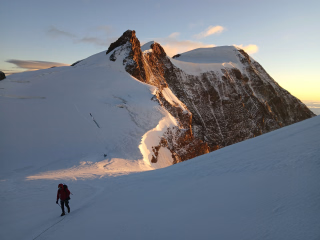
From Monte Rosa to Mont Blanc, mountaineering on the roof of Europe
In summary
-
Sports
-
Duration7 days
-
LevelAdvance
-
DestinationMonte Rosa Massif - France / Italy
-
AgeFrom the age of 18
-
CO₂-Emissions26.66 kg CO2
-
Type of stayIn a group
-
Languages
 French
 English
In a few words
Mont Blanc is both a legendary mountain and a formidable peak in mountaineering. Climbing it is an ambitious project, and we believe it's essential to give yourself the best possible chance of success. We therefore offer a training course to prepare you for this ascent, allowing you to acclimatize and familiarize yourself with the terrain alongside your guide . After two days of acclimatization in the Monte Rosa massif , followed by a rest day , you will set off to climb Mont Blanc over three days . This format is specifically designed to distribute the effort , promote better adaptation to altitude , and manage the elevation gain .
IMPORTANT :
This program is suitable for mountaineers with a solid foundation in crampon use and glacier travel techniques : at least one prior experience climbing a 4,000-meter peak (e.g., Gran Paradiso or a summit in the Monte Rosa massif) or a specific glacier preparation course is required. Bookings open in November/December for the following summer, so we advise you to start planning this climb well in advance.
Specific cancellation fees:
Cancellation fees will be increased by €150 per person. This corresponds to the non-refundable deposit paid to the mountain huts on the normal route of Mont Blanc.
Postponement / modification of internship / weather: €120 per person.
The highlights
-
Ensuring proper acclimatization in the high mountains
-
Benefit from a personalized learning path: 1 guide for 2 participants
-
Explore another glacial massif, Monte Rosa, which rises to over 4,000m in altitude.
Photos


Sport
Level
Mountaineering
The expert's opinion
ATTENTION: Coaching is only available in PRIVATE format, so registration is for one person or for two people who know each other.
This program is designed for people with prior mountaineering experience who have summited glacial peaks using crampons (for example: Gran Paradiso, Dôme des Écrins, Tacul, Dômes de Miage...). Participants must also arrive in good physical condition and have taken steps to acclimatize beforehand to maximize their chances of reaching the summit and to avoid altitude sickness: for example, plan to hike in the mountains with significant elevation gain and sleep in mountain huts at altitude.
During the course, you will take part in progressively more difficult races: a way to train and acclimatize in preparation for the final ascent of Mont Blanc.
The training focuses on completing long glacier traverses that require good fitness, technical skill, and concentration. Some short sections are steep (55°), sometimes icy, and demand proficiency in using an ice axe and crampons.
You will be traveling on a high mountain route, you must be aware of the dangers associated with this activity and this race (crevasses, serac falls, rockfalls, avalanches, very low temperatures).
In figures
Trekking
- Average duration/day: 5h
- Average distance/day: 4 km
- Average daily elevation gain: 1000 m
- Average daily descent: 300 m
- Maximum altitude: 4215 m
- Exposed Passages: Yes
Mountaineering
- Average duration/day: 7h
- Average distance/day: 8 km
- Average daily elevation gain: 855 m
- Average daily descent: 951 m
- Maximum altitude: 4816 m
- Exposed Passages: Yes
Management
French
English
Danilo and his team
Experienced mountain guides Danilo and his team accompany you on all types of terrain: mountaineering, multi-pitch climbs, ski touring, and high-altitude treks. Passionate and meticulous, they prioritize safety, progress, and enjoyment on every outing. With them, every climb becomes a shared and authentic adventure in the heart of the most beautiful mountains in the Alps.
Program
-
TRAINING IN THE MONT ROSE MASSIF - Champoluc → Mezzalama Refuge (3,036 m)
- Transportation Car - 00h30 - 4km
- Activity Trekking
- Duration of the activity 5h
- Distance 4 km
- Positive elevation gain 1000 m
- Negative elevation 300 m
- Maximum altitude 4215 m
- Exposed passages Yes
- Accommodation Refuge
- Breakfast included
- Lunch not included
- Dinner included
Meet at 7:30 am in Champoluc , at the foot of Monte Rosa , at the village café. You will park your cars in the free parking lot below the hamlet of Saint Jacques. After equipment checks , a 4x4 transfer will take you to the Piani di Verra Superiori at 2,300 meters, the starting point for the approach hike. The trail climbs to the Mezzalama refuge , located at 3,036 meters. This first day involves approximately 1,000 meters of elevation gain over four to five hours of ascent. It's an ideal warm-up before tackling the 4,000-meter peaks of Monte Rosa, in a truly high-mountain environment. In the afternoon, with the guide, you will participate in an ice climbing course to improve your cramponing skills before the ascent of Pollux the following day. We will spend the night at the Mezzalama refuge to begin acclimatizing to the altitude gently, ensuring a good night's sleep on the first day of the course.
The program is provided as a guideline and may be modified depending on weather conditions or the group's physical condition. The guide may suggest alternatives, such as an ice climbing school day or the ascent of another peak in the area.
Day 1 -
ASCENSION OF POLLUX - Mezzalama (3,036 m) → Pollux (4,091 m) → Guide d’Ayas (3,420 m)
- Transportation Bicycle - 01h - 2km
- Activity Mountaineering
- Duration of the activity 8h
- Distance 7 km
- Positive elevation gain 1050 m
- Negative elevation 700 m
- Maximum altitude 4091 m
- Exposed passages Yes
- Accommodation Refuge
- Breakfast included
- Lunch not included
- Dinner included
The second day is dedicated to the ascent of Pollux , an iconic peak reaching 4,091 meters. At dawn, the climb begins with a rocky step before reaching the fixed cable section at around 3,980 meters. This technical section opens onto the magnificent snow-covered ridge that leads directly to the summit of Pollux. The panoramic view is exceptional, encompassing the entire Monte Rosa massif . This ascent involves approximately 1,050 meters of elevation gain and 700 meters of descent, for a full day of 7 to 8 hours, with return and overnight stay at the Guides d'Ayas refuge (Lambronecca hut, at 3,420 m). Depending on the weather and the participants' fatigue levels, the guide may conduct an ice climbing session in the afternoon to further develop cramponing and rope handling skills.
The program is provided as a guideline and may be modified depending on weather conditions or the group's physical condition. The guide may suggest alternatives, such as an ice climbing school day or the ascent of another peak in the area.
Day 2 -
Ascent of the Beaver (4,228 m) - return to the Val d'Ayas
- Activity Mountaineering
- Duration of the activity 7h
- Distance 11 km
- Positive elevation gain 825 m
- Negative elevation 1550 m
- Maximum altitude 4228 m
- Exposed passages Yes
- Breakfast not included
- Lunch not included
- Dinner not included
On the third day, the objective is Castor, another major peak of Monte Rosa, reaching 4,228 meters. After an early start, the ascent begins on the Verra Glacier before reaching the base of the northwest face. This glacial slope, ranging from 45 to 50 degrees, is traversed in long zigzags until reaching the thin and elegant summit ridge, which leads to the top of Castor. The descent then continues towards the Quintino Sella refuge, where a break allows for rest and refueling, before reaching the Bettaforca pass to catch the cable car back down to Frachey. In total, this day represents approximately 825 meters of ascent and 1,550 meters of descent, over a duration of 7 to 8 hours.
This mountaineering course on Monte Rosa, including the ascent of Pollux and Castor, is a unique experience that combines the discovery of two peaks over 4,000 meters high with total immersion in the high mountains. It also provides excellent technical and physical preparation for later attempting the ascent of Mont Blanc as part of a comprehensive Mont Blanc course.
Overnight stay in accommodation of your choice.
Day 3 -
Rest day
- Breakfast not included
- Lunch not included
- Dinner not included
After two days at altitude, this day will be dedicated to rest before the final ascent of Mont Blanc . You are free to arrange your own accommodation as you see fit.
Day 4 -
HIKE TO THE TÊTE ROUSSE REFUGE - Les Houces/Saint Gervais le Fayet → refuge (3167 m)
- Transportation TER / Metro / Tram - 01h - 12km
- Activity Mountaineering
- Duration of the activity 4h
- Distance 3 km
- Positive elevation gain 700 m
- Maximum altitude 3167 m
- Exposed passages Yes
- Accommodation Refuge
- Breakfast included
- Lunch not included
- Dinner included
Meet at 12:30 in Les Houces (Chamonix) or Saint Gervais le Fayet with the mountain guide , to take the Bellevue cable car and then the cog railway. or take the Mont Blanc Tramway directly to the Nid d'Aigle at 2,300 m . From there, a 3-4 hour hike will take you to the Tête Rousse glacier . Dinner and overnight stay at the Tête Rousse refuge, at 3,167 m.
The program is provided as a guideline and may be modified depending on weather conditions or the group's physical condition. The guide may suggest alternatives, such as an ice climbing school day or the ascent of another peak in the area.
Day 5 -
MONT BLANC SUMMIT: Tête Rousse - Aiguille and Dôme du Goûter - Summit - Refuge du Goûter
- Activity Mountaineering
- Duration of the activity 10h
- Distance 10 km
- Positive elevation gain 1700 m
- Negative elevation 1005 m
- Maximum altitude 4816 m
- Exposed passages Yes
- Accommodation Refuge
- Breakfast included
- Lunch not included
- Dinner included
The departure from the Tête Rousse refuge will be very early to cross the glacier of the same name and reach the Goûter couloir . The ascent continues over rocky terrain to the Aiguille du Goûter , then to the Goûter refuge for a short break. Next, you will climb the Dôme du Goûter to the Cabane Vallot , before tackling the famous Arête des Bosses , which is more or less technical depending on the conditions. The second slope, technically easier, will be made difficult by fatigue and altitude.
You'll need all your motivation to climb the final ridge leading to the summit of Mont Blanc . At the top, you'll enjoy breathtaking views of the Western Alps , take photos, and savor this moment of collective achievement. After the descent, you'll spend the night at the Goûter refuge , at 3,835 meters , enjoying the exceptional view.
Please note : depending on availability, you may sleep at the Goûter refuge or at Tête Rousse . Dinner and overnight stay at the Goûter refuge.
The program is provided as a guideline and may be modified depending on weather conditions or the group's physical condition. The guide may suggest alternatives, such as an ice climbing school day or the ascent of another peak in the area.
Day 6 -
DESCENT: Goûter Refuge/Tête Rousse - Nid d'Aigle - Les Houces (Chamonix valley)
- Transportation 01h - 14km
- Activity Mountaineering
- Duration of the activity 7h
- Distance 5 km
- Negative elevation 1500 m
- Maximum altitude 3838 m
- Exposed passages Yes
- Breakfast not included
- Lunch not included
- Dinner not included
Starting from the Gouter refuge , you will descend the Aiguille du Gouter at dawn, taking advantage of the overnight freeze to minimize the risk of rockfall. You will quickly reach the Tête Rousse refuge , then continue your descent along the same path taken 48 hours earlier, towards the Nid d'Aigle .
From there, you will take the Mont Blanc Tramway to reach Les Houches or Saint Gervais Le Fayet , where you can celebrate your successful ascent of the roof of Europe.
The program is provided as a guideline and may be modified depending on weather conditions or the group's physical condition. The guide may suggest alternatives, such as an ice climbing school day or the ascent of another peak in the area.
Day 7
Note
The agency or the guide may modify the program if they deem it necessary due to the weather, mountain conditions, or if the participants do not have the necessary physical or technical level to complete the climb and ensure the safety of all participants.
Indeed, bad weather is often the reason for failure when climbing Mont Blanc: poor visibility, strong winds, precipitation... all these factors can lead the guide to abandon or abandon the climb, for your safety. We try our best to anticipate weather conditions: forecasts beyond three days provide trends but don't allow us to accurately predict what the actual conditions will be like on the ground. That's why we ask you to trust your guide and the agency, who, if the weather is uncertain, will make the final decision at the last minute whether or not to attempt the climb.
If mountain conditions or weather conditions do not allow the ascent to be carried out as planned, an alternative program will be offered if possible and the price readjusted.
On the other hand, if the decision is made to attempt the ascent and the group does not reach the summit for various reasons (bad weather, poor mountain conditions, fatigue or illness of one of the participants...), no refund or compensation is provided.
Accommodation
Nights in mountain huts on days 1 , 4 , and 5 are included in the price. Nights on rest days ( days 2 and 3 ) are not included, to allow you the freedom to choose the accommodation and location that suits you best in the region.
Advice :
- On day 2 , you descend from Monte Rosa into the Gressoney valley, and the next day you go to Chamonix.
- For the night of day 3 , it is advisable to stay near Chamonix or to stay there directly.
Price details
The price includes
- The supervision of the UIAGM High Mountain Guide (supervision only in private format, either 1 person / or 2 people who know each other)
- The equipment of collective equipment
- The ski lift ticket required for the program
- Half board: breakfasts and dinners
- Dormitory accommodation in a mountain refuge
The price does not include
- Personal technical equipment: crampons, ice axe and harness (rental available at the cable car departure point)
- Lunch at the mountain huts, as well as full board on days 2 and 3.
- Accommodation for days 2 and 3
- Drinks and personal expenses
Options
- Flex fare and insurance
Practical information
Specific formalities
Specifics
Before your departure, check with the embassy or consulate regarding the entry and stay requirements for your destination country. You can also find this information on the France Diplomatie website ( https://www.diplomatie.gouv.fr/fr/dossiers-pays/ ).
In the case of flights with stopovers operated by different airlines, also check the entry requirements of the countries you are transiting through.
It is your responsibility to ensure you are in compliance, particularly regarding the validity of your identity documents (for example, some countries require your passport to be valid for at least six months after your return) , visa requirements, necessary vaccinations, and health recommendations. And don't forget to consider any customs restrictions and other potential requirements of your destination or transit country.
ℹ️ Information may change up to the departure date, remember to regularly check official websites.
Equipment
Equipment to bring
- Gore-Tex mountaineering boots of very good quality
- Crampons and ice axe
- Harness
- 40L backpack
- Walking sticks
- Mountaineering helmet
- Carabiners
- gaiters
- Meat bag
- Cap
- Neck warmer or Buff
- Two pairs of warm winter gloves or mittens
- Headlamp
- Water bottle and thermos
- Sunscreen
- Sunglasses and ski goggles
Clothing to bring
- Thermal and breathable t-shirt (merino wool recommended)
- Thermal and breathable tights (merino wool recommended)
- Warm socks
- Warm and breathable technical fleece
- Windproof and warm mountaineering pants
- Warm down jacket
- High-quality Gore-Tex jacket or similar, waterproof and windproof
- Gore-Tex overtrousers or equivalent