Ascent of Monte Rosa in five days of mountaineering with a private guide
In summary
-
Sports
-
Duration5 days
-
LevelAdvance
-
DestinationItaly / Monte Rosa Massif - France
-
AgeFrom 18 - 90 years
-
CO₂-Emissions25.39 kg CO2
-
Type of stayIndependent traveler
-
Languages
 French
In a few words
A private and unique mountaineering course in the heart of the Monte Rosa massif, between Italy and Switzerland, designed for high mountain enthusiasts in search of an exclusive experience.
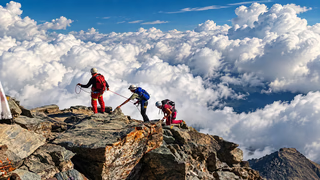
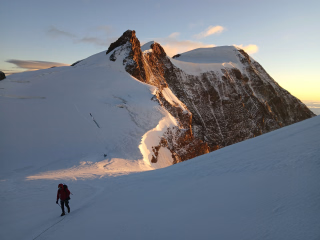
This 5-day trip, reserved exclusively for your group (with friends, as a couple or as a family), takes you on the trail of iconic peaks reaching over 4000 meters in altitude, in an exceptional glacial setting.
From Zermatt, a mythical village nestled at the foot of the Matterhorn, you reach the heights thanks to the ski lifts before setting foot on the great alpine glaciers.
The trek takes you from summit to summit, in a magnificent mineral atmosphere, up to the impressive Margherita hut perched at 4554 meters, the highest guarded refuge in Europe .
A night at altitude under a starry sky crowns this intense adventure, before a gradual return to the valley.
This private course is designed for motivated mountaineers seeking breathtaking panoramas, technical advancement, and a true journey into the heart of the Alps. Led by a dedicated guide, it guarantees a personalized progression at the pace of your group.
The highlights
-
The magnificent atmosphere of the 4000m peaks of Valais
-
Private stay
-
Third highest peak in the Alps
Photos


Sport
Level
Mountaineering
In figures
Mountaineering
- Average duration/day: 5h
- Average distance/day: 10 km
- Average daily elevation gain: 870 m
- Average daily descent: 870 m
- Maximum altitude: 4634 m
- Exposed Passages: Yes
Management
French
An experienced and passionate guide will be by your side to supervise you and help you discover each step in complete serenity.
Price for a solo departure with a guide: €4790
Price for 2 people with a guide: €2850 per person
Program
-
Ascent of the Breithorn and crossing to Italy
- Activity Mountaineering
- Duration of the activity 6h
- Distance 10 km
- Positive elevation gain 800 m
- Negative elevation 400 m
- Maximum altitude 4165 m
- Exposed passages Yes
- Accommodation Refuge
- Breakfast not included
- Lunch included
- Dinner included
Meet early in the morning at the Matterhorn Glacier Paradise cable car station in Zermatt. Before departure, your guide will present the trek and conduct a thorough equipment check . Once ready, you'll take the cable car up to the vast, snow-covered slopes overlooking the region. From there, you'll begin the ascent of the Breithorn (4165m), an accessible peak offering panoramic views of the Alps and the route for the following days. The descent, on the Italian side, is gentle and leads to the Val d'Ayas Guides' Hut (3394m), where you'll spend the night at high altitude.
Day 1 -
Glacial crossing towards Castor and Col Félik
- Activity Mountaineering
- Duration of the activity 5h
- Distance 7 km
- Positive elevation gain 850 m
- Negative elevation 650 m
- Maximum altitude 4228 m
- Exposed passages Yes
- Accommodation Refuge
- Breakfast included
- Lunch included
- Dinner included
An early start will take you up the glacial plateau towards Castor (4228m), one of the iconic peaks of the massif. The ascent takes place in an open landscape, offering beautiful views of the surrounding peaks. Once at the summit, you will continue along the East ridge , towards Col Félik . The route remains exposed and panoramic all the way to the Quintino Sella refuge , perched at 3585m, where you will spend the night.
Day 2 -
Liskamm Nose and descent towards the Italian side
- Activity Mountaineering
- Duration of the activity 5h
- Distance 12 km
- Positive elevation gain 1100 m
- Negative elevation 1300 m
- Maximum altitude 4272 m
- Exposed passages Yes
- Accommodation Refuge
- Breakfast included
- Lunch included
- Dinner included
This morning, you'll traverse glacial terrain to reach a key section of the route: the Liskamm Nose (4272m). This section requires attention and precision. Once past it, you'll continue with a gentler ascent to the Vincent Pyramid (4215m), an elegant and easily accessible summit. The day ends with a pleasant descent to the Città di Mantova refuge (3500m), where you'll spend the night in a more serene setting.
Day 3 -
Summits in succession up to the Gnifetti Peak
- Activity Mountaineering
- Duration of the activity 5h
- Distance 8 km
- Positive elevation gain 1200 m
- Negative elevation 200 m
- Maximum altitude 4554 m
- Exposed passages Yes
- Accommodation Refuge
- Breakfast included
- Lunch included
- Dinner included
From the refuge, you'll climb wide glacial slopes before leaving your packs for the short but sustained ascent of Corno Nero (4322m). The effort continues with the traverse of the nearby Ludwighöhe (4342m). At the end of the day, a final climb will take you to the Gnifetti Peak (4554m), home to the Margherita Hut , the highest mountain hut in Europe. You'll spend the night there in a unique high-altitude atmosphere , with breathtaking views of the surrounding peaks.
Day 4 -
Ascent of the Zumsteinspitze and return to Zermatt
- Activity Mountaineering
- Duration of the activity 4h
- Distance 11 km
- Positive elevation gain 400 m
- Negative elevation 1800 m
- Maximum altitude 4634 m
- Exposed passages Yes
- Breakfast included
- Lunch included
- Dinner not included
On this final day, you will undertake an accessible climb to the Zumsteinspitze (4563m), the highest point of the trip. From the summit, you will enjoy a sweeping panorama of the Alps, with the majestic Dufourspitze (4634m), the highest peak in the Monte Rosa massif , in your sights . After this contemplative break, you will begin the descent towards the Monte Rosa Hut (2883m), before boarding the cogwheel train back to Zermatt . The trip will conclude with a brief debriefing in the mid-afternoon, before we say our goodbyes.
Day 5
Note
This program may be modified at the guide's discretion if mountain conditions, weather, or the participants' physical condition require it, and in the interest of safety. For safety reasons and to ensure a consistent level of difficulty corresponding to that advertised, the guides and organizers reserve the right to discontinue your participation if your technical skill level and/or physical fitness do not meet the required standards.
Under no circumstances will this interruption give rise to a refund or payment of compensation.
Accommodation
Nights in the mountain hut are spent in dormitories. Blankets are provided, but it is recommended to bring a sleeping bag liner. Only bring essential toiletries. Slippers are provided, so there is no need to bring special indoor footwear.
Access
Go to the starting point
Zermatt is a car-free resort . Private vehicles are not permitted beyond Täsch , located 5 km from Zermatt. You will need to park your vehicle there and take a shuttle bus to Zermatt.
- From Paris : Approximately 8 hours 30 minutes by car (approximately 800 km). Take the A6 to Mâcon, then the A40 towards Geneva, continue towards Martigny (Switzerland) via the A9, then follow the signs for Täsch.
- From Lyon : Approximately 5 hours 30 minutes by car (approximately 450 km). Take the A40 towards Geneva, then follow the signs to Martigny and Täsch.
- From Geneva : Approximately 3 hours 30 minutes drive (approximately 230 km). Take the A9 towards Martigny, then follow the signs for Täsch.
- From Milan : Approximately 3 hours 30 minutes drive (approximately 250 km). Take the A26 towards Gravellona Toce, then follow the signs to the Simplon Pass and Täsch.
Zermatt is a car-free resort. Visitors must park their vehicles in Täsch , located approximately 5 km from Zermatt. From Täsch, a frequent shuttle train service connects to Zermatt in about 12 minutes. Paid parking is available in Täsch.
Price details
The price includes
- Accommodation in mountain huts from day 1 to day 4 in shared dormitories
- Full board from lunch on Day 1 to lunch on Day 5
- Guided by a UIAGM high-mountain guide
- Shared equipment
- Ski lifts
The price does not include
- Transportation to and from the meeting and departure point
- Individual technical equipment
- Insurance (cancellation, repatriation, etc.)
- Water in the shelters
- Personal expenses (snacks, drinks, souvenirs...)
Options
- Flex fare and insurance
Practical information
Specific formalities
Specifics
Before your departure, check with the embassy or consulate regarding the entry and stay requirements for your destination country. You can also find this information on the France Diplomatie website ( https://www.diplomatie.gouv.fr/fr/dossiers-pays/ ).
In the case of flights with stopovers operated by different airlines, also check the entry requirements of the countries you are transiting through.
It is your responsibility to ensure you are in compliance, particularly regarding the validity of your identity documents (for example, some countries require your passport to be valid for at least six months after your return) , visa requirements, necessary vaccinations, and health recommendations. And don't forget to consider any customs restrictions and other potential requirements of your destination or transit country.
ℹ️ Information may change up to the departure date, remember to regularly check official websites.
Equipment
Equipment provided on site
- The group equipment (ropes) is provided
- Slippers and blankets/duvets are available in the mountain huts.
Equipment to bring
- High-altitude mountaineering boots with rigid soles and crampon compatibility are mandatory: trekking-type shoes are not sufficient.
- A comfortable 40/50 liter mountaineering backpack: it must have attachments for crampons, ice axe and helmet
- An ice axe, crampons, a harness equipped with a locking carabiner (note that carabiners cannot be rented; you will need to buy them if you don't already have them), a helmet
- One or two telescopic ski poles (depending on your preferences): we highly recommend them, especially for downhill runs.
- A water bottle/thermos of at least 1.5 liters
- A headlamp, with spare batteries and bulbs
- A pocket knife
- A rain cover for the bag (not mandatory)
- 1 waterproof pouch with your money, identity documents (and if possible, blood type/contact lens wearer information, etc.), insurance/assistance contract and emergency telephone numbers
- A pair of gaiters (not available for rent)
- A sleeping bag liner (mandatory, and there are blankets in the refuge): a sleeping bag is unnecessary
- A Ziploc bag with medication and toiletries: there's generally no running water in the mountain huts, so bring some alcohol-free wipes if you wish.
- A small tube of SPF 50 sunscreen (face and lips)
Clothing to bring
- Cap
- Hat or cap
- Glacier sunglasses (category 4 protection) + ski goggles
- A balaclava (a type of hood that covers the entire head, very useful in very cold weather)
- 1 pair of very warm mittens
- 1 pair of glove liners
- 2 or 3 breathable, long-sleeved technical base layers
- Down jacket or vest (not mandatory but appreciated if it's very cold on summit day).
- 1 windproof, waterproof and breathable jacket
- 1 pair of comfortable mountain pants for approach trails
- 1 pair of Gore-Tex type windproof trousers when you are on a glacier
- 1 pair of breathable technical tights
- Socks
This list is a guideline and should be adapted to the day's weather conditions. In the high mountains, temperatures drop rapidly with altitude and wind. Therefore, you should always pack warm clothing, even if it's mild in the valley.