Snowman Trek: the most legendary trail in the Himalayas
In summary
-
Sports
-
Duration32 days
-
LevelExpert
-
DestinationNepal / Kathmandu
-
AgeFrom the age of 18
-
CO₂-Emissions4341.45 kg CO2
-
Type of stayIn a group
-
Languages
 French
 English
In a few words
The highlights
-
Crossing some of the most isolated Himalayan regions in the world
-
Spectacular views of Bhutan's highest peaks
-
An exceptional guide for a unique and unforgettable experience
Photos





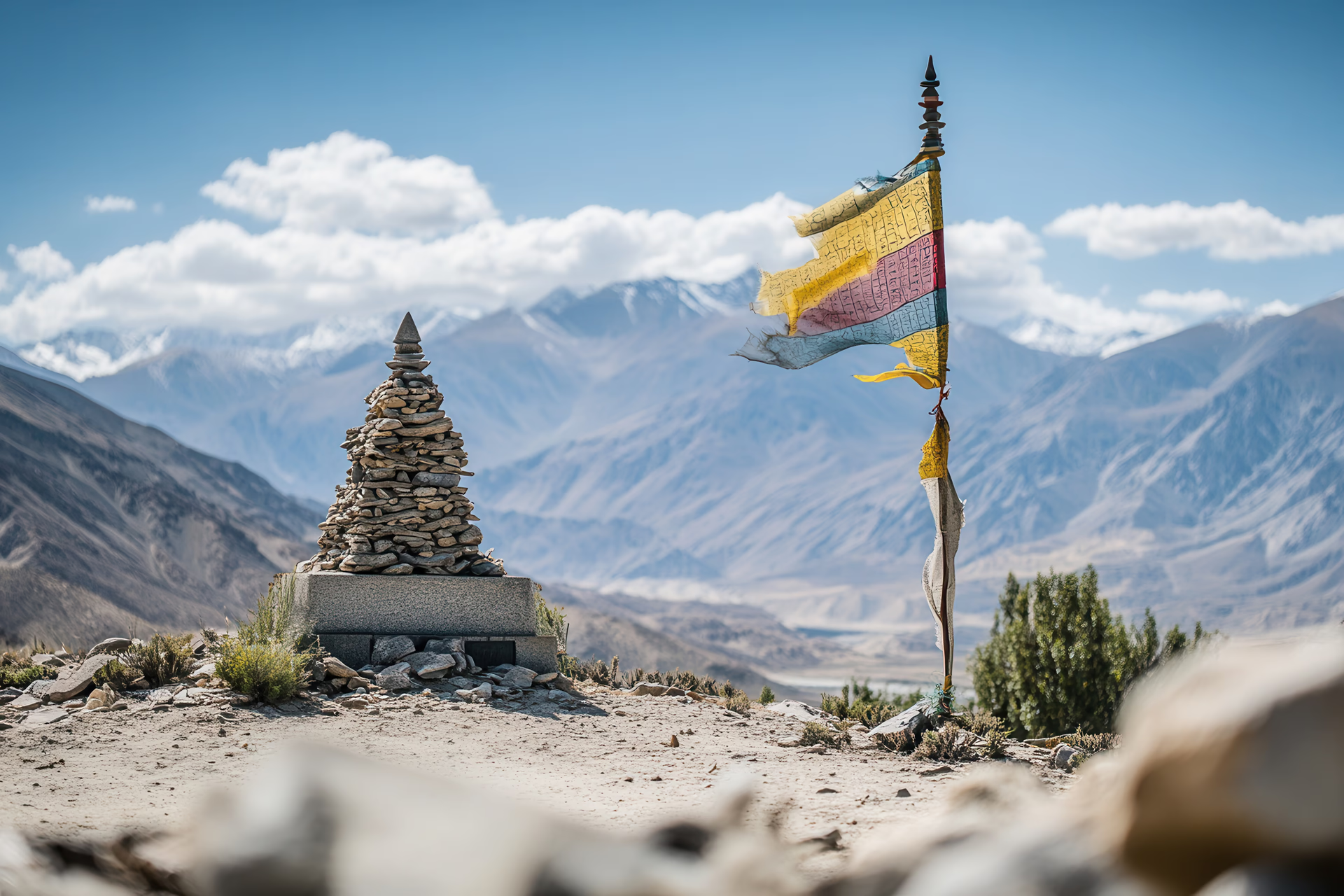
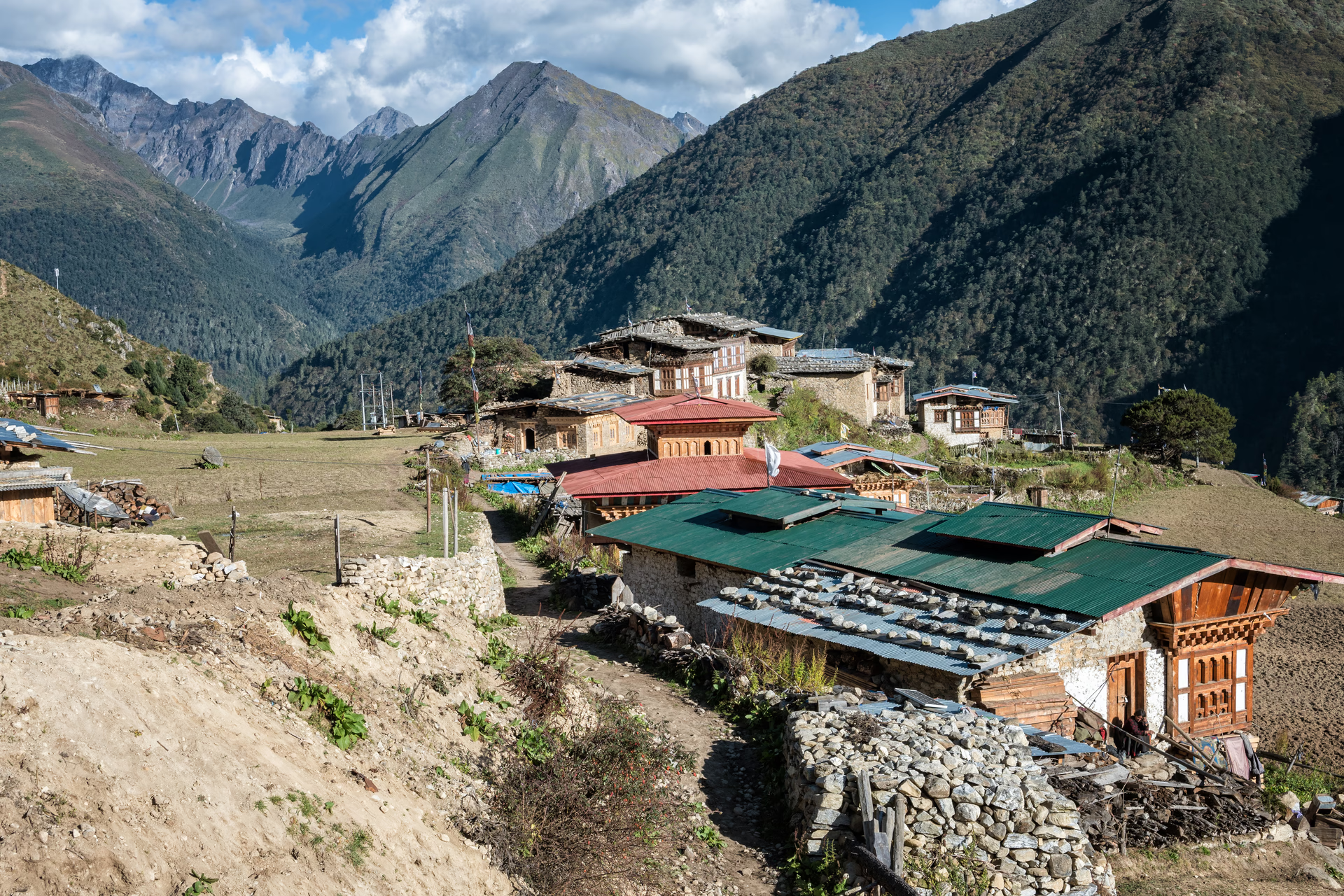
Sport
Level
Hiking / Trekking
The expert's opinion
Level: 5/5 – Very challenging
This exceptional trek is reserved for highly experienced hikers in excellent physical condition, ready to face a long-term challenge. With nearly 300 km to cover, 11 passes to cross above 4,500 m (up to 5,320 m), nights spent in tents sometimes above 5,000 m, and the absence of any possibility of outside resupply, the Snowman Trek is recognized as one of the most demanding in the world.
The journey is undertaken in total immersion, with all logistics carried on board (guides, cook, pack animals), without any outside support for several weeks. The isolation, altitude, duration, and sometimes extreme conditions demand rigorous preparation, a high capacity for adaptation, and strong mental resilience. A challenging, extraordinary adventure for those who truly want to push their limits.
---
INFORMATION ON HIGH ALTITUDE AND ACUTE MOUNTAIN SICKNESS:
Trips involving nights above 3000 meters altitude are suitable for people in very good health, with appropriate physical condition.
High mountains are a unique environment, often harsh on the body (cold, dryness, sun, hypoxia, etc.). Among the various altitude-related illnesses, the symptoms of Acute Mountain Sickness (AMS) must be recognized and never underestimated. These are signs of too rapid an ascent: your body hasn't had time to adapt to the lack of oxygen (see doctor).
In figures
Hiking
- Average duration/day: 6h
- Average daily elevation gain: 563 m
- Average daily descent: 430 m
Management
French
English
Upon your arrival in Kathmandu, you will be greeted by our local representative.
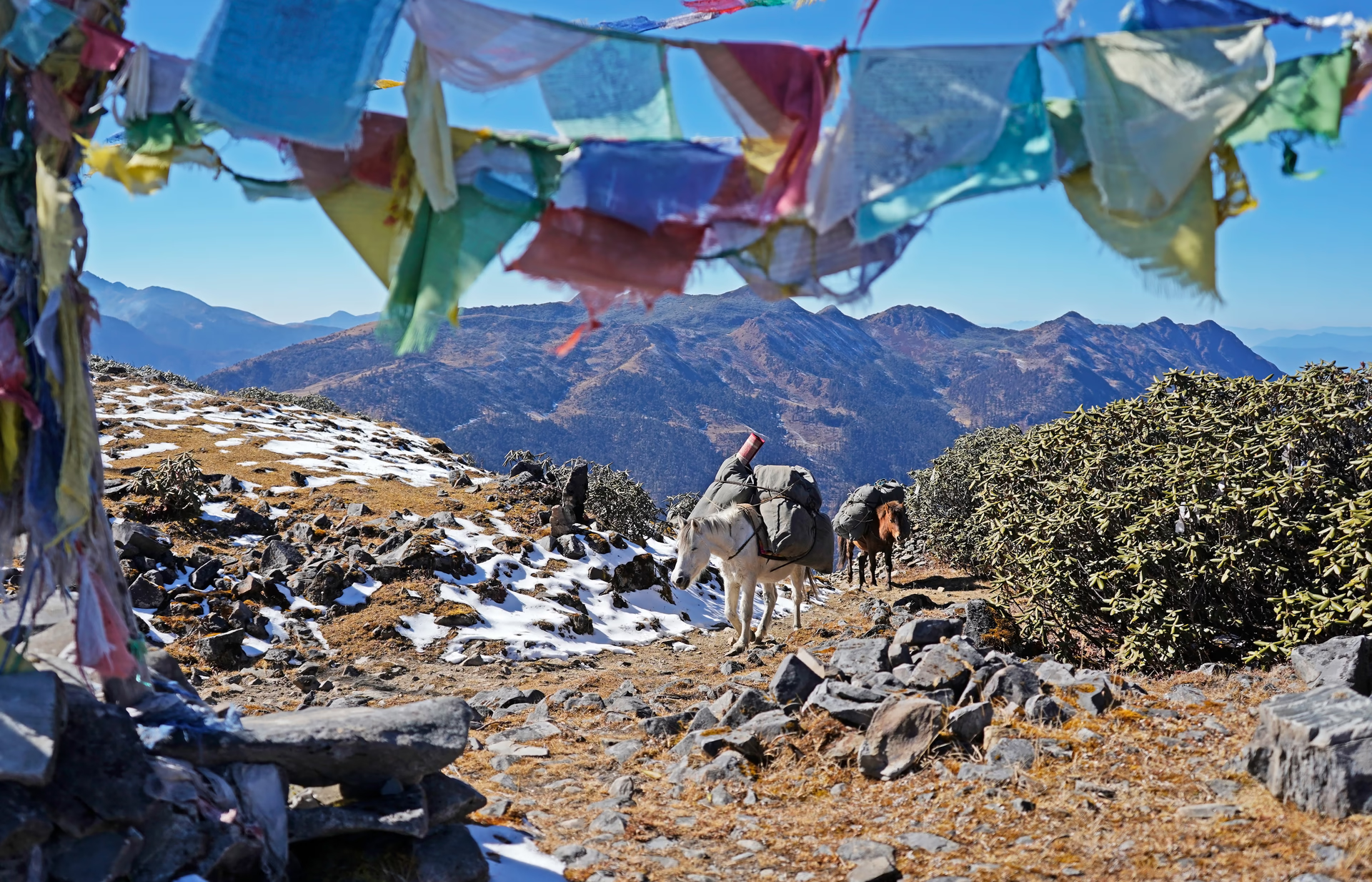
In Bhutan, the trip is led by a passionate and experienced French-speaking Bhutanese guide, assisted by a full local team: cook, kitchen helpers, camp managers, and yak or packhorse drivers for carrying supplies. All are seasoned in high-altitude trekking and ensure your comfort, safety, and the success of this extraordinary adventure.
Based in Bhutan for many years, our local partner agency guarantees you a successful trekking experience, thanks to perfectly honed logistics and adventure guides 100% committed to helping you discover the wildest and most unusual corners of the Himalayas.
Program
-
Departure from France
- Transportation Plane - 12h - 7000km
- Breakfast not included
- Lunch not included
- Dinner not included
Flight to Kathmandu.Day 1 -
First steps in Kathmandu
- Breakfast not included
- Lunch not included
- Dinner not included
We land in Kathmandu, nestled between the peaks and the dust of the world. Stepping out of the airport, we're enveloped by the vibrant energy of Nepal: honking horns, smiles, and the scents of incense and spices. We check into our hotel, then have some free time to recover from the flight or simply soak up the atmosphere of this city, a blend of tradition and organized chaos. The journey truly begins here, in this crossroads for adventurers heading into the highlands.Day 2 -
Flight Kathmandu - Paro
- Transportation Plane - 01h30 - 200km
- Accommodation 2-star hotel
- Breakfast included
- Lunch not included
- Dinner included
This morning, we embark on a spectacular flight to Paro. If the sky is clear, the Himalayan peaks will be visible, including perhaps Everest or Kanchenjunga. Upon arrival, we complete immigration formalities before meeting our local guide, who will accompany us throughout this Bhutanese adventure. After a relaxing break at the hotel and a welcome refreshment, we set off to discover the valley's first treasures. We visit the National Museum, housed in the former watchtower of Ta Dzong, where a superb collection of ancient artifacts tells the story of the country. Then, we head to Ringpung Dzong, an imposing fortified monastery housing monks and administrative offices. We walk down to the old wooden suspension bridge, where our vehicle awaits. In the late afternoon, we strolled through the narrow streets of Paro: craft shops, the aroma of dried chilies, serene faces… Bhutan welcomed us with open arms. Overnight in Paro.Day 3 -
Paro – Excursion to Taktsang (Tiger’s Nest) – Shana (2,580 m): start of the trek
- Transportation Car - 02h - 110km
- Activity Hiking
- Duration of the activity 5h30
- Positive elevation gain 900 m
- Accommodation Bivouac / Tent
- Breakfast included
- Lunch included
- Dinner included
We arrive in Ramthangka, the starting point of our trek to one of Bhutan's most sacred sites: Taktsang Monastery, perched at an altitude of over 3,000 meters. Legend has it that Guru Rinpoche meditated here in the 8th century, and the temple was expanded in the 17th century by Zhabdrung, a key figure in the unification of Bhutan. We ascend through the forest, enjoying a well-deserved tea break at the panoramic café overlooking this sanctuary clinging to the cliffside. Arriving at the site is a powerful moment, imbued with spirituality and silence. After lunch, we descend leisurely back to the valley, then drive to Shana, the starting point of our grand trek. A two-hour drive takes us to the camp, nestled in the heart of a still-unspoiled but already promising natural landscape. Tonight, our first night in tents. We are ready to venture into the highlands. Overnight in a camp in Shana.Day 4 -
Sharna Zampa – Thangthangkha (3610m)
- Activity Hiking
- Duration of the activity 7h30
- Positive elevation gain 770 m
- Negative elevation 10 m
- Accommodation Bivouac / Tent
- Breakfast included
- Lunch included
- Dinner included
We begin our first real day of trekking. After meeting our escort team and packhorses, we set off at a leisurely pace along the Pa Chu River, in the heart of a deep, wooded valley. The trail winds through a dense forest of pine, oak, and spruce, punctuated by regular ascents and descents. We walk at the rhythm of the current, crossing bridges and footbridges, until we reach a clearing for a hot lunch, served after crossing a bridge on the left bank of the river. Gradually, the valley narrows, and the path becomes a small trail that eventually opens onto a high-altitude meadow. If the sky is clear, we catch our first glimpse of the majestic silhouette of Mount Jomolhari, our companion for the days to come. Overnight in camp at Thangthangkha.Day 5 -
Thangthangkha – Jangothang (4080m)
- Activity Hiking
- Duration of the activity 5h30
- Positive elevation gain 480 m
- Accommodation Bivouac / Tent
- Breakfast included
- Lunch included
- Dinner included
We continue our ascent through the Paro Chhu Valley, which gradually widens into vast alpine meadows. The forest becomes sparse, replaced by low-lying vegetation. Here and there, a few isolated houses remind us that even at this altitude, life persists. Along the way, we pass a military checkpoint, evidence that we are moving towards increasingly remote lands. Our gaze is drawn to the snow-capped peaks surrounding us, foreshadowing the challenges ahead. Late in the morning, we reach Jangothang, a legendary campsite on the trek, undoubtedly one of the most beautiful in the Himalayas. Before us, Jomolhari reveals itself in all its splendor. It is here that we spend the night, in a magnificent setting. Overnight camping at Jangothang.Day 6 -
Jangothang, acclimatization in the face of giants
- Accommodation Bivouac / Tent
- Breakfast included
- Lunch included
- Dinner included
Today, we remain in Jangothang for a well-deserved acclimatization day in one of Bhutan's most beautiful natural amphitheaters. Several options are available: We can embark on a day hike into the higher elevations to admire stunning alpine lakes and enjoy spectacular views of the Jomolhari and Jichu Drake peaks. With a bit of luck, we might spot the blue sheep (bharals) that inhabit the surrounding slopes. Those who prefer a more leisurely exploration can stroll around the camp towards Tosoh, or simply soak in the tranquility and beauty of the place. Our bodies gradually adapt to the altitude, while our minds are uplifted by the vastness of the Himalayas. Overnight in camp at Jangothang.Day 7 -
Jangothang – Lingshi (4010m)
- Activity Hiking
- Duration of the activity 6h30
- Negative elevation 870 m
- Accommodation Bivouac / Tent
- Breakfast included
- Lunch included
- Dinner included
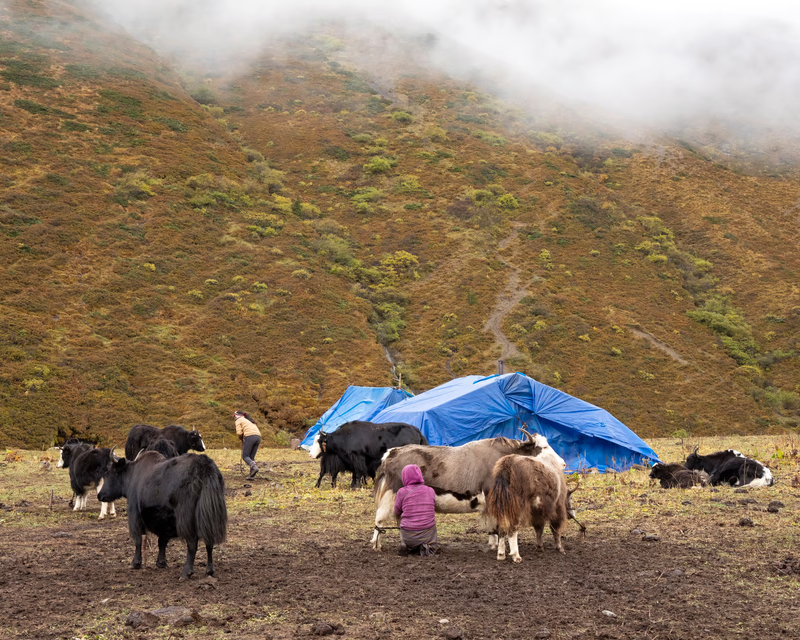
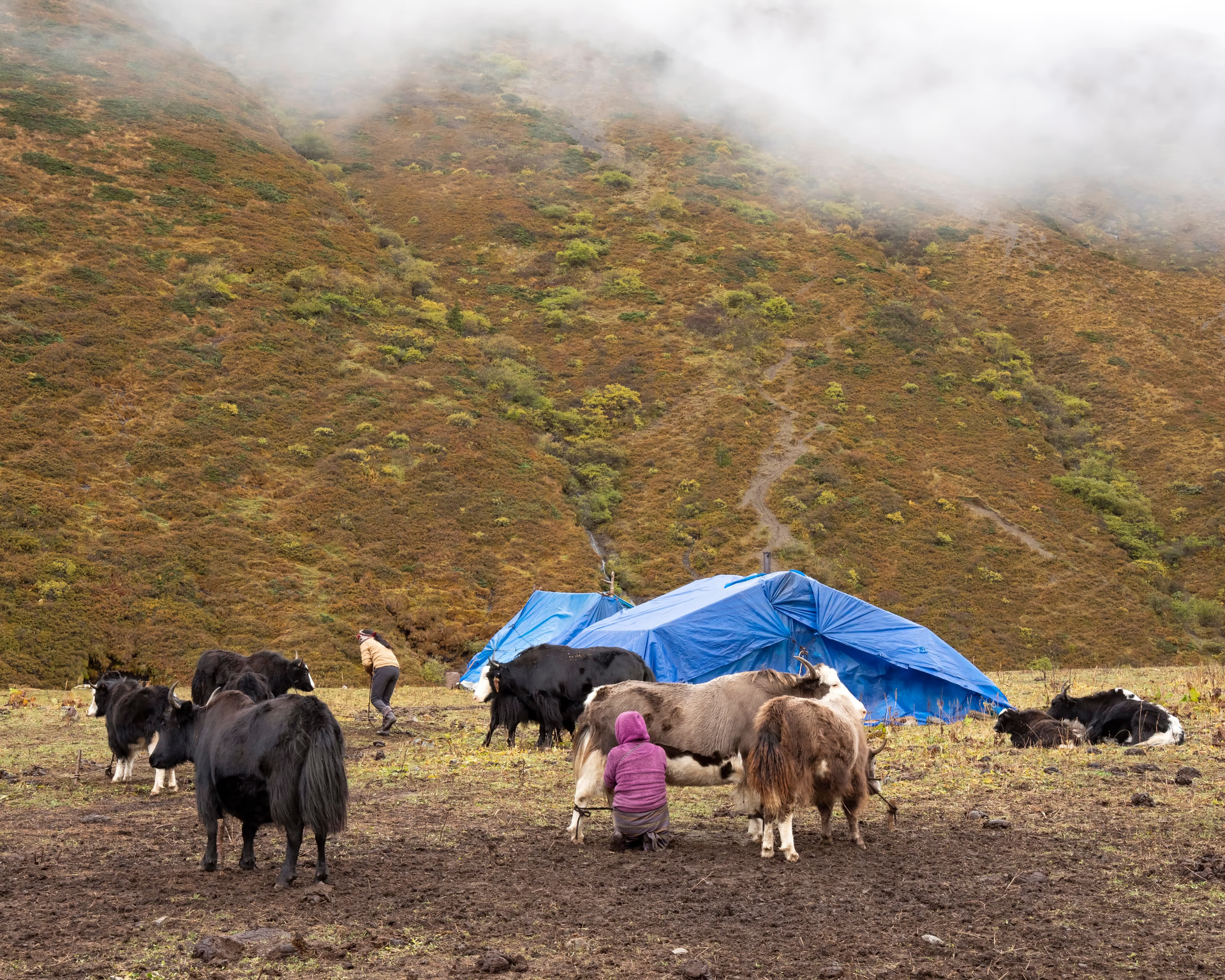
We leave Jangothang camp in crystal-clear light. The trail climbs rapidly, then continues along the mountainside to the Nyilila Pass at 4,870 meters. Our breath comes in shorter bursts, but the reward is immense: up there, a breathtaking panorama unfolds, encompassing the peaks of Jomolhari, Jichu Drake, and Tsherimgang, all over 7,000 meters. The descent is gradual. We pass through the camps of nomadic herders in yak-wool tents, testaments to a harsh but free life. Then the U-shaped Lingshi Valley opens up, wild and rocky, dominated by its perched dzong and the glaciers that shimmer to the north. Overnight in a camp at Lingshi.Day 8 -
Lingshi – Chebisa – Dulung (4160m)
- Activity Hiking
- Duration of the activity 8h30
- Positive elevation gain 280 m
- Negative elevation 680 m
- Accommodation Bivouac / Tent
- Breakfast included
- Lunch included
- Dinner included
We leave Lingshi at daybreak, under the silent gaze of its perched dzong, an ancient sentinel between heaven and earth. The trail climbs gently, offering superb views of the glacial valleys and surrounding mountains. We traverse a beautiful alpine forest of oak and hemlock, dotted with small, isolated hamlets and encounters with yak herders. Our footsteps echo in a peaceful, almost timeless atmosphere. After passing through Chebisa, a charming village nestled in the mountains, we begin the ascent to the Gambu La pass (4,430 m). Up there, a new landscape unfolds before us, with previously unknown peaks on the horizon. We then descend through rhododendron bushes to reach our camp at Dulung (4,160 m), nestled in a mountain fold. A tranquil end to the day, facing the immensity of the landscape. Overnight in camp at Dulung.Day 9 -
Dulung – Robluthang (4160 m)
- Activity Hiking
- Duration of the activity 6h30
- Positive elevation gain 940 m
- Negative elevation 1150 m
- Accommodation Bivouac / Tent
- Breakfast included
- Lunch included
- Dinner included
We leave Dulung bathed in the soft light of the setting sun, ready for another day of rich contrasts. The trail climbs gently at first, then ascends to the Jhari La pass (4,748 m), offering breathtaking views of icy valleys and rugged mountains. Below, we reach the grasslands of Tashi Jaithang, home to the takin, the strange half-cow, half-goat animal and national emblem of Bhutan. With a bit of luck, we might spot some in their natural habitat. Legend has it that this unusual mammal was created by the saint Drukpa Kuenlay, who combined the remains of a goat and cow meal to bring it back to life. The result? A unique, powerful, and elusive creature. After traversing grassy valleys and yak pastures, we reach Robluthang, our campsite for the night, nestled in a stark, high-mountain landscape. Overnight camping at Robluthang.Day 10 -
Robluthang – Limithang (4140m)
- Activity Hiking
- Duration of the activity 6h30
- Positive elevation gain 850 m
- Negative elevation 870 m
- Accommodation Bivouac / Tent
- Breakfast included
- Lunch included
- Dinner included
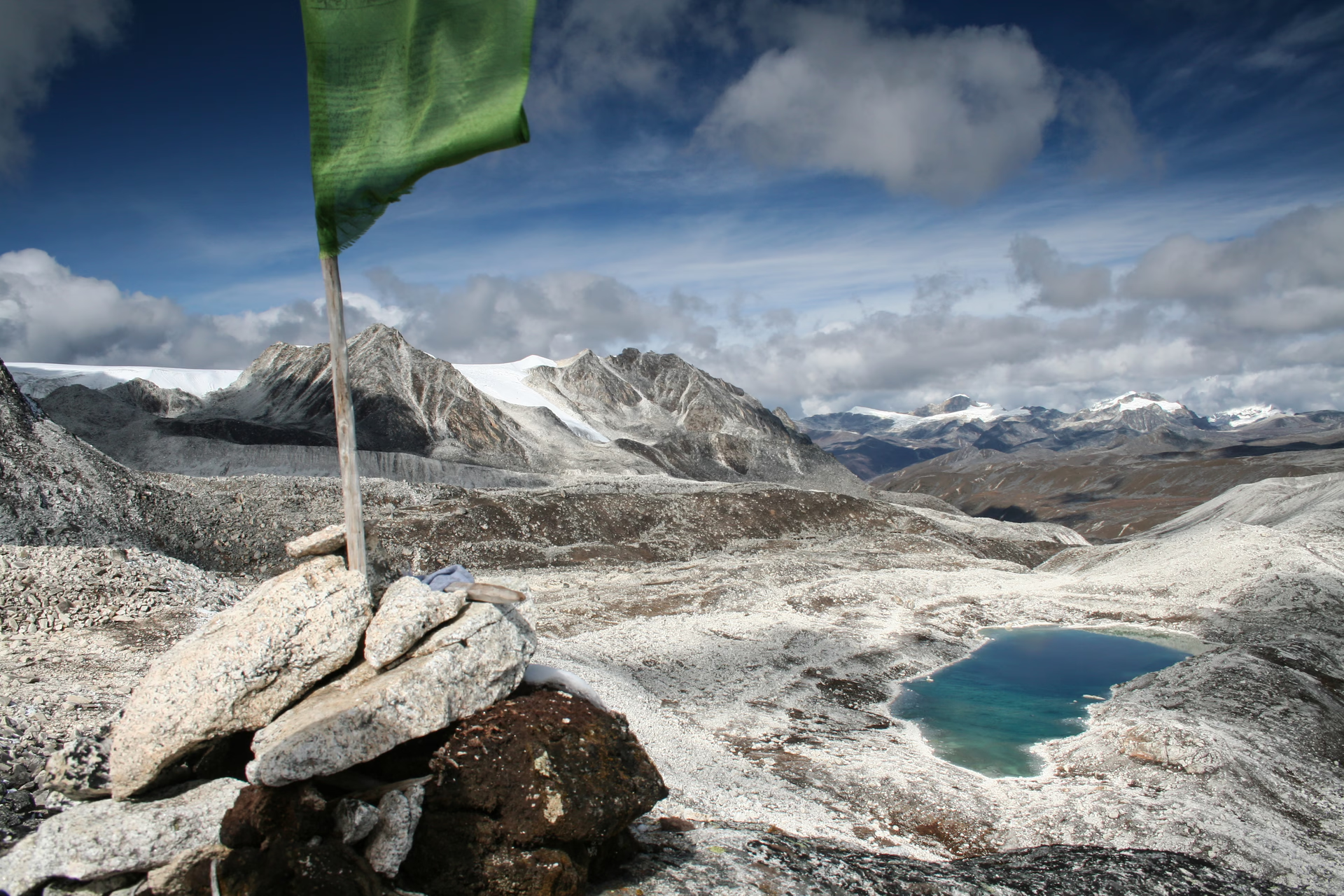
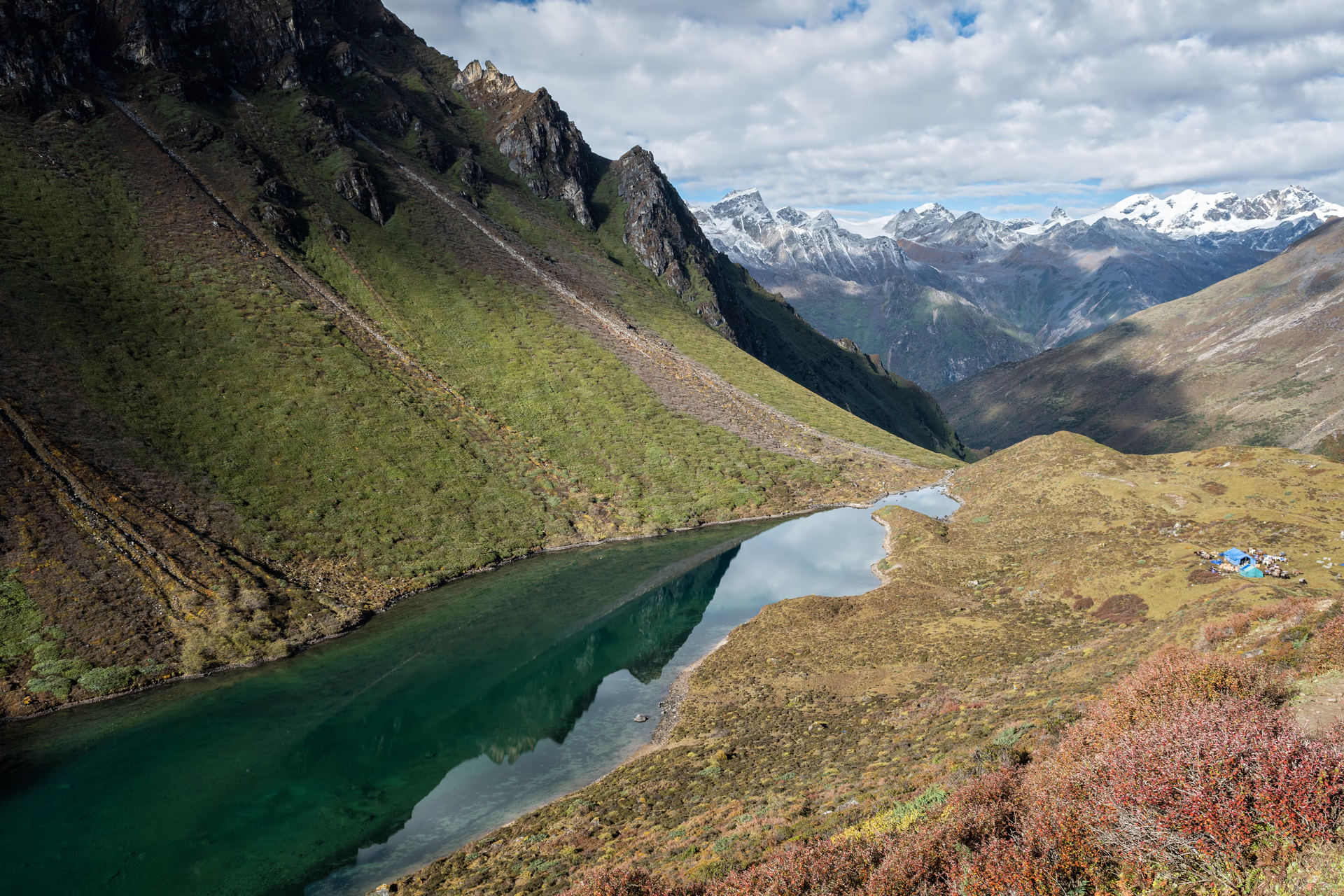
We leave Robluthang for an intense day in the high mountains. The trail climbs gently at first, then becomes rockier, before tackling a sustained ascent of about an hour to the Sinche La pass, the highest point of the day at 5,005 meters. Up there, it's a realm of stone, silence, and peaks. The view opens onto glacial valleys and moraine walls, witnesses to the glacier's ancient movements. Below, a milky blue glacial lake stretches at the foot of the cliffs, contrasting with the dark rocks and the whiteness of the eternal snows. We then descend gradually through this mineral landscape, cross the Kango Chhu River, and reach the Limithang campsite, nestled in a wide clearing. In the background, the imposing silhouette of Gangchhenta, the "Great Black Peak," watches over us. Overnight in camp at Limithang.Day 11 -
Limithang – Laya (3840m)
- Activity Hiking
- Duration of the activity 4h30
- Positive elevation gain 60 m
- Negative elevation 340 m
- Accommodation Bivouac / Tent
- Breakfast included
- Lunch included
- Dinner included
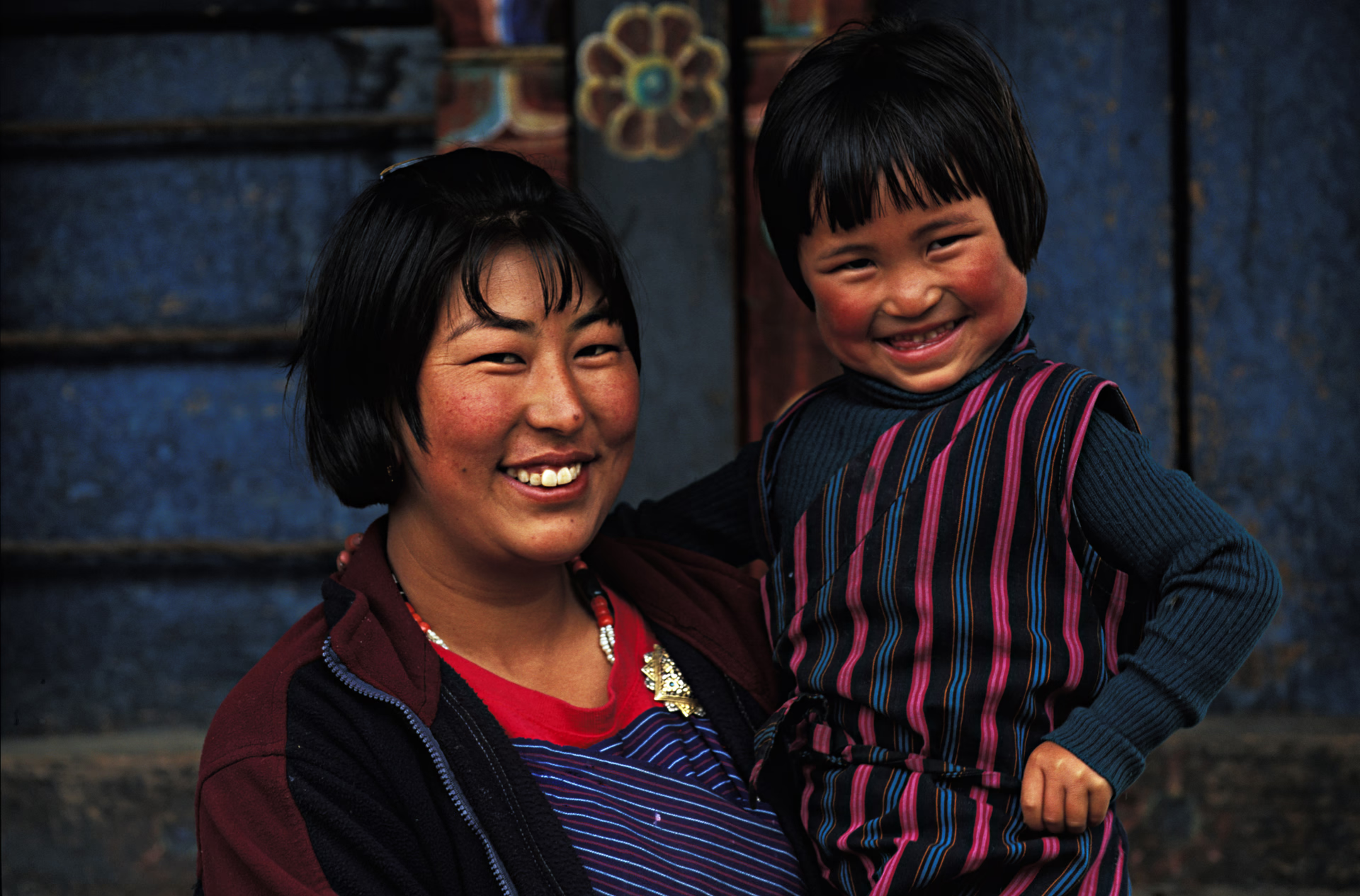
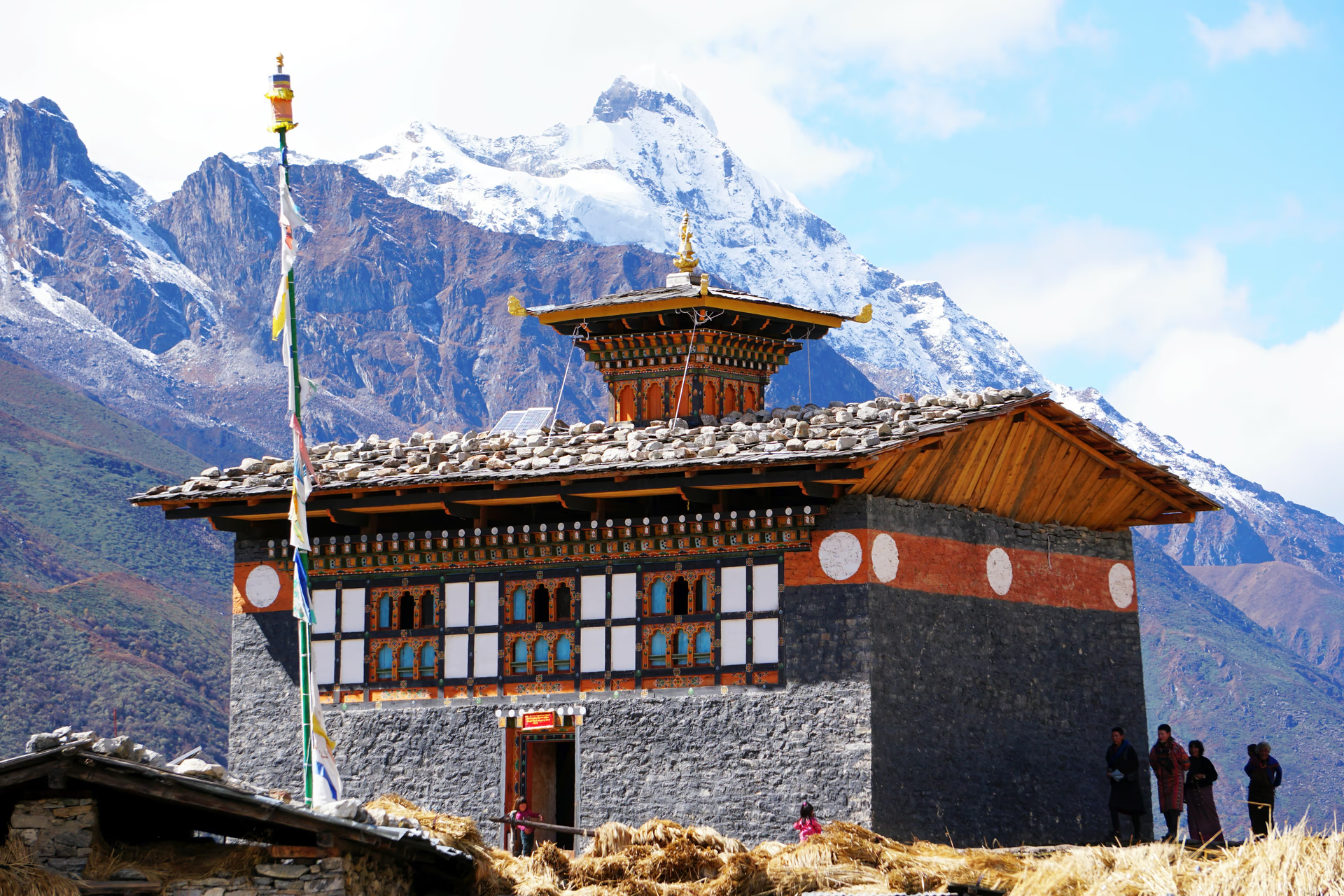
We leave Limithang and the imposing presence of Gangchhenta behind, beginning a gentle descent through a narrow valley, bordered by steep cliffs and a rushing river. Gradually, vegetation reclaims its territory: the rock gives way to thick, humid, and mysterious forests, before opening onto the first houses of Laya, an isolated village perched at 3,840 meters. We arrive from the west, greeted by the smiles of the inhabitants in traditional dress. Here, faces bear the marks of the altitude, and ways of life remain simple, proud, and deeply rooted. Masagang looms on the horizon, a silent guardian of the valley. We set up camp near the village. The evening unfolds at the rhythm of the place, in a peaceful atmosphere, between the sounds of the wind and the crackling of the fire. Overnight camping in Laya.Day 12 -
A break in Laya, a meeting at altitude
- Accommodation Bivouac / Tent
- Breakfast included
- Lunch included
- Dinner included
Today, we're staying in Laya for a day of acclimatization and meeting new people. This perched village, one of the highest in Bhutan, lives in harmony with the elements, far from the hustle and bustle of the world. We stroll through the narrow streets, encountering curious children, women in traditional dress, and laden yaks coming down from the high pastures. Here, time seems suspended, its rhythm dictated by the seasons and prayers. The welcome is genuine. Over a cup of tea or a glass of chang (local alcohol), we share a moment with the locals. The mountains bring hearts together. This break also allows us to recharge our batteries before the next mountain pass crossing. We spend the night at the same campsite in Laya.Day 13 -
Laya – Rhoduphu (4160 m)
- Activity Hiking
- Duration of the activity 6h30
- Positive elevation gain 1030 m
- Negative elevation 750 m
- Accommodation Bivouac / Tent
- Breakfast included
- Lunch included
- Dinner included
We leave Laya at dawn, the valley still asleep behind us. A short descent leads us to a military camp, then we follow the river, tracing its course through the heart of a lush, vibrant forest. Gradually, the trail climbs. We leave the canopy behind, emerging into rhododendron bushes and the first high-altitude meadows. The air becomes crisper, the landscapes more open, our steps slower. After lunch, we continue our steady ascent to Rhoduphu (4,160 m), where we set up camp near the Rhodu Chhu River, in the peaceful setting of high valleys. The atmosphere is silent, almost solemn. We sense that we are approaching a new, mineral world. Overnight in camp at Rhoduphu.Day 14 -
Rhoduphu – Nerethang (4900m)
- Activity Hiking
- Duration of the activity 5h30
- Positive elevation gain 740 m
- Accommodation Bivouac / Tent
- Breakfast included
- Lunch included
- Dinner included
We set off from Rhoduphu at dawn, following the river along a gentle stretch, ideal for warming up. After about thirty minutes, the climb begins, steady and sustained, leading to a vast open valley at 4,600 meters. Gradually, the colors fade, and vegetation becomes sparse. The trail continues its ascent towards the Tsomo La pass (4,900 m), the gateway to the lunar highlands of Lunana. From the summit, the view is breathtaking: Jomolhari, Jichu Drake, and the ridges forming the Tibetan border stand out clearly. The feeling of isolation is absolute. We then cross a vast, silent, arid plateau, suspended around 5,000 meters. The Narethang campsite awaits us at the foot of Gangla Karchung (6,395 m), which rises above us like a sentinel frozen in ice. Overnight camping at Narethang.Day 15 -
Narethang – Tarina (3970m)
- Activity Hiking
- Duration of the activity 5h30
- Positive elevation gain 740 m
- Accommodation Bivouac / Tent
- Breakfast included
- Lunch included
- Dinner included
We leave camp at daybreak for a final climb to the Gangla Karchung La pass (5,120 m). Up there, the view stretches out over a sea of snow-capped peaks: Jekangphu Gang, Tsenda Kang, Tseri Gang, all rising above 7,000 meters. The atmosphere is powerful, almost surreal. The descent then begins along a vast glacial moraine, between scattered rocks and low vegetation. Further on, we discover a striking sight: an enormous glacier flowing down to a turquoise lake nestled at its base. This is one of those lakes formed by an ice dam, infamous for having collapsed in the 1960s and causing destructive floods as far away as Punakha. The trail continues its long descent through a dense rhododendron forest to the gentler, more verdant Tarina Valley. The contrast with the previous days is striking. Night spent camping in Tarina.Day 16 -
Tarina – Woche (3910m)
- Activity Hiking
- Duration of the activity 6h30
- Positive elevation gain 270 m
- Negative elevation 330 m
- Accommodation Bivouac / Tent
- Breakfast included
- Lunch included
- Dinner included
We depart from the Tarina Valley via a trail that gently descends through a coniferous forest, accompanied by the murmur of the Pho Chhu, the long glacial river that meanders below. Along the way, we pass spectacular waterfalls cascading from the cliffs before the trail climbs back up to a ridge. Up there, the horizon opens onto new mountain ranges, gentler but just as majestic. We then descend to Woche, an isolated hamlet of a few traditional houses. This is the first village in Lunana after several days in the stark, mineral world of the high altitudes. A gradual return to human presence in a still magnificent environment. Overnight camping in Woche.Day 17 -
Woche – Lhedi (3700m)
- Activity Hiking
- Duration of the activity 6h30
- Positive elevation gain 980 m
- Negative elevation 1190 m
- Accommodation Bivouac / Tent
- Breakfast included
- Lunch included
- Dinner included
From Woche, the trail winds through a forest of juniper and fir trees, bathed in the morning light. Gradually, we gain altitude, making our way through rhododendron bushes. The air becomes crisper as we approach the Keche La pass (4,650 m), seemingly suspended between sky and peaks. From the summit, the view is spectacular. Once again, the Himalayas envelop us in their silent majesty. We then begin a long descent towards the river. Along the way, we pass through a small traditional village, perched opposite Table Mountain, an impressive wall of ice and rock that dominates the entire valley. We then follow the river to Lhedi, an isolated village with a school and a small health post—a rare sign of infrastructure in this remote region. Overnight camping in Lhedi.Day 18 -
Lhedi – Thanza (4150m)
- Activity Hiking
- Duration of the activity 7h30
- Positive elevation gain 450 m
- Accommodation Bivouac / Tent
- Breakfast included
- Lunch included
- Dinner included
Following the river, we slowly ascend the valley from Lhedi. The landscape gradually opens up, and if the weather permits, Table Mountain (7,100 m) appears in the distance, rising like an immense wall of snow and ice. Late in the morning, we pass through Chozo (4,090 m), a small village where a working dzong still stands, a rare sign of permanent settlement at this altitude. The villages become increasingly scattered, as if suspended in the Himalayan silence. At the end of the day, we reach Thanza, an emblematic village of Lunana, nestled opposite Table Mountain, which rises imposingly and hypnotically in the background. Some groups prefer to set up camp in Thoencha, a short walk away, in a more open setting. Overnight camping in Thanza or Thoencha.Day 19 -
Thanza, between sky and ice
- Accommodation Bivouac / Tent
- Breakfast included
- Lunch included
- Dinner included
Today, we're staying in Thanza for a well-deserved rest day in the heart of the highlands. Here, time slows down, actions become simple, and the mountains envelop us in silence. Everyone chooses their own pace: some set off to explore the surrounding area on foot, climbing a nearby ridge to admire the high-altitude lakes and snow-capped peaks, while others prefer to stroll through the village, meeting its curious and discreet inhabitants. This break is also necessary to allow for the logistical organization of the rest of the trek: changing the yaks, resupplying, and checking equipment. We are now far from everything, in one of the most remote corners of Bhutan. Overnight at the same camp in Thanza.Day 20 -
Thanza – Dangey (4230m)
- Activity Hiking
- Duration of the activity 3h30
- Positive elevation gain 80 m
- Accommodation Bivouac / Tent
- Breakfast included
- Lunch included
- Dinner included
We set off from Thanza for a shorter but precious day, a gentle transition into the days ahead. The trail climbs gradually to a massive boulder that overlooks the entire valley. From here, the view encompasses Thanza, Toencha, the village of Chozo, and the surrounding peaks. We then continue our trek, without any particular difficulty, through high-altitude meadows and open valleys, to the Dangey campsite, perched at 4,230 meters. The atmosphere is peaceful, the landscape stretches out, bathed in the low afternoon light. Tonight, we sleep under the stars in one of Bhutan's most remote valleys. Overnight in the Dangey campsite.Day 21 -
Dangey – Tshochena (4970m)
- Activity Hiking
- Duration of the activity 5h30
- Positive elevation gain 980 m
- Negative elevation 240 m
- Accommodation Bivouac / Tent
- Breakfast included
- Lunch included
- Dinner included
The trail first crosses a stream, then climbs gently through alpine meadows. Gradually, the verdant pastures give way to a stark, rocky landscape. The atmosphere becomes more austere, almost lunar. After several hours of climbing, we reach the Jaze La pass (5,150 m). Up there, the panorama is breathtaking: snow-capped peaks, hidden valleys, and small high-altitude lakes dot the horizon. The descent takes us through this high mountain landscape to Lake Tshochena, where we set up camp for the night at nearly 5,000 meters. The place is calm, powerful, timeless. Overnight camping at Tshochena.Day 22 -
Tshochena – Jichu Dramo (5050m)
- Activity Hiking
- Duration of the activity 4h30
- Positive elevation gain 230 m
- Negative elevation 150 m
- Accommodation Bivouac / Tent
- Breakfast included
- Lunch included
- Dinner included
Having barely left Lake Tshochena, we follow its blue-green shores in the stillness of dawn. The trail then climbs gently to a ridge at 5,100 meters, offering a 360° view of the surrounding mountains. We continue across rolling terrain, between hanging lakes and persistent snowfields, before crossing another pass: Loju La (5,140 m). The atmosphere is stark, mineral, almost surreal. A final passage at 5,100 m leads us into a vast glacial valley, before a gradual descent to our campsite at Jichu Dramo, nestled in a fold of the landscape at over 5,000 meters. Overnight in camp at Jichu Dramo.Day 23 -
Jichu Dramo – Chukarpo (4300m)
- Activity Hiking
- Duration of the activity 5h30
- Positive elevation gain 320 m
- Negative elevation 730 m
- Accommodation Bivouac / Tent
- Breakfast included
- Lunch included
- Dinner included
The trail climbs steeply from the very first steps, winding through a glacial moraine. The ascent is steady, the air thinner, but the motivation is strong: we're climbing towards the highest point of the entire trek. After several hours of effort, we reach the Rinchen Zoe La pass (5,320 m). It's a powerful moment: all around, the mountains stretch as far as the eye can see, including the mythical Gangkar Puensum, never before climbed by man. The Rinchen Zoe ridge (5,650 m) dominates the pass to the west, like a rocky rampart. The descent that follows is spectacular: glacial valley, high-altitude lakes, moraines, crystal-clear rivers. Gradually, plant life reappears: the first trees in days, tall grasses, birdsong. In the late afternoon, we reach our camp at Chukarpo (4,600 m), in a setting that is both rugged and peaceful. Overnight camping in Chukarpo.Day 24 -
Chukarpo – Thampe Tsho (4300m)
- Activity Hiking
- Duration of the activity 5h30
- Positive elevation gain 400 m
- Negative elevation 700 m
- Accommodation Bivouac / Tent
- Breakfast included
- Lunch included
- Dinner included
The trail follows the Thamphe Chhu River, which we follow through a narrow valley. The pace is gentler this morning, almost contemplative, as we pass the yak herders' huts at Gala Pang Chhu, nestled in the tall grass. After this peaceful descent, the path suddenly changes character and climbs steeply towards Thampe Tsho, a magnificent turquoise lake nestled in a high-altitude basin. The effort is intense, but reaching the water's edge is magical: silence, reflections, the purity of the moment. We set up camp on its shores, surrounded by austere ridges and jagged peaks. The landscape is raw, powerful, untouched. Overnight camping at Thampe Tsho.Day 25 -
Thampe Tsho – Maurothang (3610m)
- Activity Hiking
- Duration of the activity 5h
- Positive elevation gain 330 m
- Negative elevation 1020 m
- Accommodation Bivouac / Tent
- Breakfast included
- Lunch included
- Dinner included
From Thampe Tsho Lake, the trail climbs steeply up the mountainside. We soon reach Thampe La (4,600 m), the last pass of our trek. From here, we watch for the furtive movements of the blue sheep (bharals) on the rocky slopes, our last high-altitude companions. The descent leads us to the sacred Om Tsho Lake, nestled between the cliffs, then continues alongside a waterfall before reaching a second small lake, barely a hundred meters lower. The scenery changes abruptly: the mountain opens up, the slope steepens, and vegetation returns. The trail then plunges down towards the Nikka Chhu River, crossing a mixed forest of pine and deciduous trees. We reach Maurothang, a peaceful clearing bordered by the river, where a few shepherds' huts remind us that the altitude here is already more forgiving. Overnight camping at Maurothang.Day 26 -
Maurothang – Sephu – Phobjikha – End of the trek
- Activity Hiking
- Duration of the activity 5h30
- Positive elevation gain 990 m
- Accommodation Bivouac / Tent
- Breakfast included
- Lunch included
- Dinner included
The trail gradually levels off. We follow the Nikka Chhu River, which guides us through open grasslands and isolated villages. Here, yaks give way to packhorses: the animals don't descend any further, a sign that the valley is calling us. The landscapes change before our very eyes. The highlands give way to lush vegetation, forests reappear, and human voices can be heard once more. After a final crossing of grassland, we reach the road at Sephu, where a vehicle awaits us. A new adventure then begins, this time on four wheels, to reach the unspoiled Phobjikha Valley. In the late afternoon, we visit Gangtey Gompa Monastery, one of the oldest in Bhutan, perched above fields and forests. The trek is over, but the emotion remains vivid. Overnight in a hotel in Phobjikha.Day 27 -
Phobjikha – Punakha
- Transportation Minibus - 02h - 73km
- Accommodation 2-star hotel
- Breakfast included
- Lunch included
- Dinner included
We leave the peaceful grasslands of Phobjikha, rich in history and legend, and head towards the subtropical valley of Punakha. The road winds its way through forests, villages, and terraced rice paddies. Along the way, the Chime Lhakhang, the monastery of the "Divine Madman," invites us for an unusual break: dedicated to fertility, it is one of the country's most beloved pilgrimage sites. Upon arrival in Punakha, the atmosphere changes: warmer, greener, more vibrant. We visit Punakha Dzong, a masterpiece of Bhutanese architecture built in the 17th century at the confluence of the Pho Chu (male) and Mo Chu (female) rivers. The wooden galleries, murals, and open spaces invite contemplation. At the end of the day, a walk across the 200-meter suspension bridge offers a final, magical view of the fortress illuminated by the soft light of dawn. Overnight in a hotel in Punakha.Day 28 -
Punakha – Thimphu
- Transportation Minibus - 02h30 - 74km
- Accommodation 2-star hotel
- Breakfast included
- Lunch included
- Dinner included
This morning, the road takes us to Thimphu, the capital of Bhutan, via the sacred Dochula Pass (3,150 m). If the weather is clear, we'll enjoy a breathtaking panoramic view of the country's highest peaks, framed by the 108 chortens of the pass, standing like prayers turned towards the sky. Upon arriving in Thimphu, we discover a remarkable city: modern yet without traffic lights, bustling yet peaceful, where traditions permeate every detail of daily life. The afternoon's itinerary includes: Kuensel Phodrang, the immense Buddha statue overlooking the entire valley; the Craft Bazaar, a market showcasing Bhutanese craftsmanship; and Tashichhoe Dzong, an imposing fortress housing the king's offices, the throne room, and the national clergy. A final evening in the city before taking to the skies again. Overnight in a hotel in Thimphu.Day 29 -
Thimphu - Paro - Kathmandu
- Transportation Minibus - 01h30 - 82km
- Accommodation 2-star hotel
- Breakfast included
- Lunch not included
- Dinner not included
Early this morning, we left Thimphu for Paro Airport, enjoying a final flight through the forested valleys of Bhutan. A last whispered prayer, a final prayer flag fluttering in the breeze. The return flight to Kathmandu, weather permitting, offers a final farewell to the Himalayan giants, our companions these past few weeks. In Kathmandu, we checked into our hotel.Day 30 -
Kathmandu
- Accommodation 2-star hotel
- Breakfast included
- Lunch not included
- Dinner not included
A free day in the Nepalese capital. From the hotel, you can explore the Thamel tourist district, the old city, and Durbar Square, with its UNESCO World Heritage-listed historical monuments, on foot. The historical sites of the Kathmandu Valley are also accessible by taxi.Day 31 -
Arrival in France
- Transportation Plane - 12h - 7000km
- Breakfast not included
- Lunch not included
- Dinner not included
Flight to Paris. Arrival expected later today.Day 32
Note
Accommodation
Access
Go to the starting point
INTERNATIONAL TRANSPORT:
For Nepal, we use scheduled flights departing from Paris. You will primarily fly with Emirates and Qatar Airways. Depending on availability at the time of your booking, we may also offer flights with other airlines.
We pre-purchase a stock of flights departing from Paris on these different airlines in order to guarantee you the best fares and availability for as long as possible. Departures from certain provincial cities are possible upon request and subject to an additional charge.
IMPORTANT: This information is for guidance only. Depending on availability at the time of your booking, the airlines may differ from those listed above.
Price details
The price includes
- Flights Paris / Kathmandu / Paris (regular flights)
- Flights Kathmandu / Paro / Kathmandu
- Guided by a French-speaking Bhutanese guide
- The Bhutanese visa
- Local transfers
- Accommodation in hotels and tent camping
- Entrance fees for all museums and monuments
- Full board, except for lunches and dinners in Kathmandu
The price does not include
- Personal expenses.
- The drinks.
- Tips for local teams (see section "Tips").
- Meals not listed as included in the program.
Options
- Flex fare and insurance
Practical information
Specific formalities
Specifics
Before your departure, check with the embassy or consulate regarding the entry and stay requirements for your destination country. You can also find this information on the France Diplomatie website ( https://www.diplomatie.gouv.fr/fr/dossiers-pays/ ).
In the case of flights with stopovers operated by different airlines, also check the entry requirements of the countries you are transiting through.
It is your responsibility to ensure you are in compliance, particularly regarding the validity of your identity documents (for example, some countries require your passport to be valid for at least six months after your return) , visa requirements, necessary vaccinations, and health recommendations. And don't forget to consider any customs restrictions and other potential requirements of your destination or transit country.
ℹ️ Information may change up to the departure date, remember to regularly check official websites.
Equipment
Equipment provided on site
Equipment to bring
Clothing to bring
Please bring appropriate mountain walking gear suitable for varying temperatures (30°C at low altitudes, -20°C possible above 5000m!).