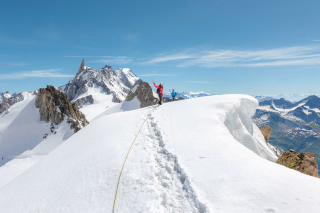
2-day acclimatization and ascent of Mont Blanc
In summary
-
Sports
-
Duration5 days
-
LevelExpert
-
DestinationGrand Paradis / Mont Blanc Massif - France
-
AgeFrom the age of 18
-
CO₂-Emissions30.59 kg CO2
-
Type of stayIn a group
-
Languages
 French
In a few words
If you've already climbed a 4000m peak, have high-mountain experience, and are looking for a course that includes acclimatization before attempting the ascent, this course is for you . It's designed to help you reach the summit of Mont Blanc, including two days of acclimatization . This allows you to acclimatize and review basic techniques through snow and ice climbing lessons, BUT it should not be your first time climbing. The ascent of Mont Blanc is then made via the Normal Route. After a night's rest in Chamonix, the ascent of Mont Blanc takes place over the following three days via a gradual climb (Dôme du Goûter, Arête des Bosses). Your efforts will be rewarded with a magical summit and an unforgettable adventure with your guide.
The highlights
-
Ascent of Mont Blanc via the Bosses ridge, a legendary route
-
Acclimatization in the Chamonix valley
-
Snow and ice schools to review the basics in real-world conditions
Photos


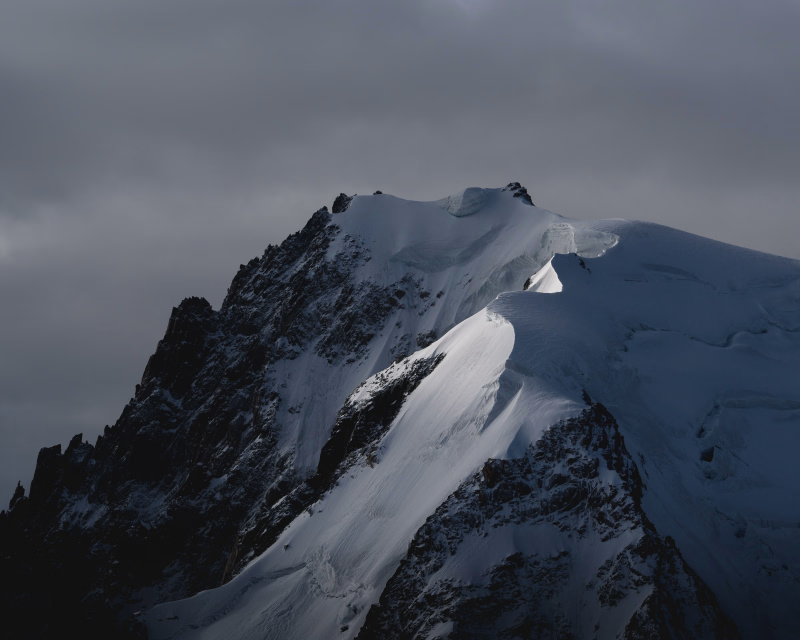
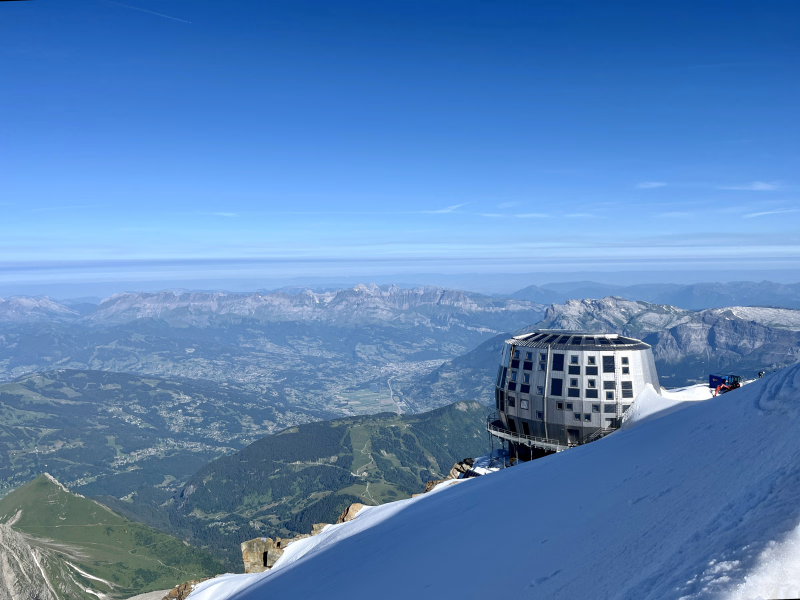


Sport
Level
Mountaineering
In figures
Mountaineering
- Average distance/day: 7 km
- Average daily elevation gain: 836 m
- Average daily descent: 766 m
- Maximum altitude: 4806 m
- Exposed Passages: Yes
Management
French
The trip is supervised by a high mountain guide for a group of 4 participants, who will provide the technical elements necessary for the smooth running of the trip.
For the ascent of Mont Blanc on days 4 to 5, one guide for every 2 participants is provided.
Program
-
Welcome and departure for the first day of ice and snow school
- Transportation Car - 00h30 - 15km
- Activity Mountaineering
- Duration of the activity 0h05
- Distance 5 km
- Positive elevation gain 750 m
- Maximum altitude 2732 m
- Accommodation Refuge
- Breakfast not included
- Lunch included
- Dinner included
This morning, you'll meet your guide at the equipment rental shop: fitting of individual equipment, briefing . Departure towards the village of Le Tour, then ski lifts (if open) to the Col de Balme to reach the Albert 1er refuge (2702 m) . Snow and ice school in the afternoon near the refuge.
Overnight stay at altitude for acclimatization.
Day 1 -
Ascent of Tête Blanche and/or Col Supérieur du Tour
- Activity Mountaineering
- Distance 10 km
- Positive elevation gain 930 m
- Negative elevation 1430 m
- Maximum altitude 3429 m
- Exposed passages Yes
- Accommodation Refuge
- Breakfast included
- Lunch included
- Dinner included
Starting from the Albert 1er refuge , we put on our crampons for the ascent of Tête Blanche (the highest peak at 3429 meters ). This summit will allow us to practice some rope techniques and review the basics of the practice.
Return to the Tour in the early afternoon.
Settle into the gîte and rest. The guide will gather you to inform you of the rest of the program (weather and conditions) and will form the rope teams for Mont Blanc .
Day 2 -
Mont Blanc Tramway, Eagle's Nest, Tête Rousse Refuge
- Activity Mountaineering
- Duration of the activity 0h03
- Positive elevation gain 800 m
- Maximum altitude 3167 m
- Accommodation Refuge
- Breakfast included
- Lunch included
- Dinner included
The first easy stage of our Mont Blanc ascent: we set off late morning to reach the village of Les Houches. The support guides join the group, and the rope teams are formed for the climb . We take the cable car to Bellevue and then the Mont Blanc tramway to the Nid d'Aigle. The first section is easy, following the Rognes ridge and a quick traverse on the north face, before we emerge onto a snowy plateau at the end of which lies the Tête Rousse refuge. The afternoon is dedicated to rest and acclimatization , enjoying the magnificent view of the north face of the Bionnassay.
(In the event that weather and/or safety conditions do not allow the initial program to be carried out, a modification will be made and a replacement program will be put in place, for example the ascent of Monte Rosa or Gran Paradiso.)
Day 3 -
Ascent of Mont Blanc and overnight stay at the Goûter refuge
- Activity Mountaineering
- Distance 5 km
- Positive elevation gain 1700 m
- Negative elevation 1000 m
- Maximum altitude 4806 m
- Exposed passages Yes
- Accommodation Refuge
- Breakfast included
- Lunch included
- Dinner included
This ascent is made via the rocky face of the Aiguille du Goûter. A wide couloir at the bottom of the slope is exposed to rockfall, so it is very important to follow the guide's instructions carefully .
The rest of the ascent follows a gently sloping spur with sections equipped with cables or ropes: these require the use of hands and at times feel almost like rock climbing. As night falls, the sense of time disappears, and we soon reach the Dôme du Goûter at 4304m . We are at the Vallot bivouac-refuge, which is unguarded and theoretically serves as a shelter for climbers in difficulty. It is often here that the sun joins us, bringing with it a renewed vigor. The summit draws nearer, the Bosses ridge begins, and for a few hours we will be suspended between sky and earth on a magnificent and sometimes airy ridge. The guide will then ask you to ensure that the rope is taut. Finally, after one last hump, the ridge widens, and the summit appears, vast and welcoming. Welcome to 4806m!
Day 4 -
Back in the Chamonix valley
- Activity Mountaineering
- Distance 14 km
- Negative elevation 1400 m
- Maximum altitude 3835 m
- Exposed passages Yes
- Breakfast included
- Lunch not included
- Dinner not included
The descent follows the same route back to the Nid d'Aigle. We then take the Mont Blanc Tramway . Return to Les Houches by cable car, where we meet our vehicles. Lunch is either in Bellevue or Chamonix.
Day 5
Note
Success rates on Mont Blanc with a guide are around 50%: most failures are due to the weather. It's important to know that above 4,000 meters, wind or bad weather often makes the ascent impossible or too dangerous. We try our best to anticipate these factors and make the best decisions to help you reach the summit. But in all cases, our priority will always be safety. The high-mountain guide accompanying you knows Mont Blanc intimately and will be best placed to assess the feasibility of the climb.
As a last resort, he will decide whether or not to continue the climb. For this course, we confirm the possibility of attempting the climb three days before departure. However, it is possible that the weather may ultimately be different from what was forecast (unfortunately, a frequent occurrence in Chamonix). In this case, the guide may still decide to modify the program or cancel the attempt on the morning of departure.
Accommodation
Nights in mountain huts are spent in dormitories: blankets are provided, but you should bring a sleeping bag liner. Toiletries will be kept to a bare minimum. Slippers are available, so there's no need to bring shoes for the hut. After the days in Italy, the night is planned at the Alpine Club gîte in the village of Le Tour: the same principle as in the huts, with shared rooms and communal bathrooms on the same floor.
As the refuge reservation is non-transferable, no refund will be issued. If you cancel your stay without having purchased the flexible cancellation rate, the refuge will not be refunded (€60 per night).
Access
Go to the starting point
Paid parking in Chamonix
Price details
The price includes
- The technical organization of the internship
- Supervision by high-mountain guides: 1 guide for the group during preparation and 1 guide for 2 people during the ascent
- Half-board accommodation (dinner and breakfast) is provided throughout the stay, from midday on day 1 to midday on day 5, in mountain huts and gîtes.
- Lunch picnics during the five days of the training course
- The ski lifts necessary for the normal running of the program
The price does not include
- Transportation will be provided by participants' vehicles.
- The round trip to the Mont Blanc Tunnel
- Individual technical equipment
- Race snacks (cereal bars, dried fruit, chocolate bars and other snacks as you wish)
- Drinks (water, beer, cola, tea, coffee...) and personal expenses
- Anything not mentioned under 'the price includes'
- Equipment rental available (shoes, harness, helmet, crampons, ice axe, telescopic poles, backpack, headlamp, etc.)
If none of the participants have a vehicle to transport the group by carpooling, a private transfer will be offered at a price of €450 return for the whole group, payable on site.
Options
- Flex fare and insurance
Practical information
Specific formalities
Specifics
Before your departure, check with the embassy or consulate regarding the entry and stay requirements for your destination country. You can also find this information on the France Diplomatie website ( https://www.diplomatie.gouv.fr/fr/dossiers-pays/ ).
In the case of flights with stopovers operated by different airlines, also check the entry requirements of the countries you are transiting through.
It is your responsibility to ensure you are in compliance, particularly regarding the validity of your identity documents (for example, some countries require your passport to be valid for at least six months after your return) , visa requirements, necessary vaccinations, and health recommendations. And don't forget to consider any customs restrictions and other potential requirements of your destination or transit country.
ℹ️ Information may change up to the departure date, remember to regularly check official websites.
Please note that since the summer of 2021, all reservations in the mountain huts on the normal route of Mont Blanc (Tête Rousse Hut and Goûter Hut) are mandatory and non-transferable for the ascent. Reservations open in January for the following summer.
We therefore register participants subject to availability in the mountain huts when reservations open. We will confirm your Mont Blanc trip as soon as the hut reservations have been confirmed! Please wait for our confirmation at the beginning of the year before booking any additional nights or transportation to ensure you have the correct dates for your trip.
Equipment
Equipment provided on site
- The group equipment (ropes) is provided
- Slippers (Crocs) and blankets/duvets are available in the shelters.
Equipment to bring
- High-altitude mountaineering boots with rigid soles and crampon compatibility are mandatory (trekking type boots are not sufficient).
- A comfortable 40/50 liter mountaineering backpack: it must have attachments for crampons, ice axe and helmet
- An ice axe, crampons and a harness equipped with a screwgate carabiner (note that carabiners cannot be rented, you will need to buy them if you do not have any)
- A helmet
- One or two telescopic ski poles (depending on your preferences): we highly recommend them, especially for downhill runs.
- A water bottle/thermos of at least 1.5 liters
- A headlamp, with spare batteries and bulbs
- A pocket knife
- A rain cover for the bag (not mandatory)
- 1 waterproof pouch with your money, identity documents (and if possible, blood type/contact lens wearer information, etc.), insurance/assistance contract and emergency telephone numbers
- A pair of gaiters (not available for rent)
- A sleeping bag liner is mandatory , and there are blankets available in the refuge ( sleeping bag unnecessary ).
- A Ziploc bag with medication and toiletries (bare minimum: toothpaste + contact lens solution + hand sanitizer): there is generally no running water in the shelters, so bring some alcohol-free wipes if you wish (be mindful of the weight).
- A small tube of SPF 50 sunscreen (face and lips) + after-sun lotion
Clothing to bring
- Cap
- Hat (or cap) for sun protection and/or scarf
- Glacier sunglasses (category 4 protection) + ski goggles
- A balaclava (like a balaclava that covers the whole head) (very useful in very cold weather)
- 1 pair of very warm mittens
- 1 pair of fleece or wool gloves
- 1 pair of glove liners
- 2 or 3 breathable, long-sleeved technical base layers
- Breathable technical base layer (carline, lightweight fleece...)
- Thick fleece jacket
- Down jacket or vest (not mandatory but appreciated if it's very cold on summit day)
- 1 windproof, waterproof and breathable Gore-Tex type jacket
- 1 pair of comfortable mountain pants for approach trails
- 1 pair of Gore-Tex type windproof trousers when you are on a glacier
- 1 pair of breathable technical tights
- Socks: 3 thin pairs and 2 thicker pairs
- 1 night outfit for the evening of Day 3 at the Tour chalet + toiletries
- A few hand and/or foot warmers can prove useful for those who get cold easily on summit day.
This is a general list intended to cover all the weather conditions you might encounter in the high mountains. It should be adapted to the specific conditions expected during your stay. Always pack warm clothing, even when temperatures are high in the valley.