Tour of Mont Blanc on the northern section
In summary
-
Sports
-
Duration6 days
-
LevelConfirmed
-
DestinationMont Blanc Massif - France / Chamonix-Mont-Blanc
-
AgeFrom the age of 18
-
CO₂-Emissions50.01 kg CO2
-
Type of stayIn a group
-
Languages
 French
In a few words
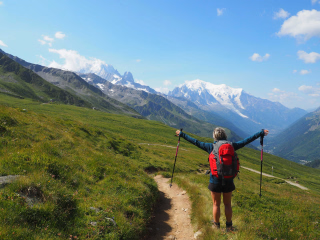
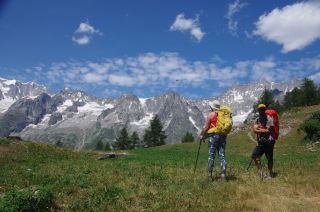
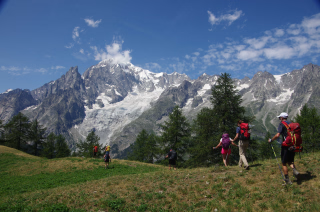
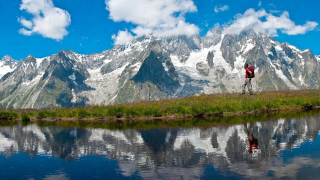
Hike the most beautiful trails of the northern section of the Tour du Mont Blanc, spanning three countries: Italy, Switzerland, and France , without having to worry about carrying your pack. This multi-day trek first immerses you in the wild Italian Val Ferret , at the foot of the impressive Brenva face. The route continues through the peaceful alpine pastures of the Swiss Val Ferret , between spruce forests and traditional hamlets, before reaching the panoramic balconies of the Aiguilles Rouges , offering breathtaking views of the Mont Blanc massif. Each stage has been designed to combine comfort and immersion , with nights spent in mountain huts or cozy guesthouses and daily luggage transfers . This lightweight format allows you to fully enjoy the most beautiful variations of the route , far from the beaten track, for an authentic hiking experience accessible to any reasonably fit walker.
The highlights
-
An essential route for any hiker's life
-
Luggage transport at each stage
-
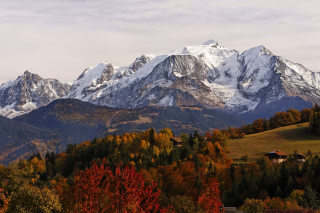
Spectacular panoramic views of the south face of Mont Blanc from the Aiguilles Rouges
Photos


Sport
Level
Hiking / Trekking
In figures
Hiking
- Average duration/day: 5h30
- Average distance/day: 17 km
- Average daily elevation gain: 832 m
- Average daily descent: 932 m
- Exposed Passages: Yes
Management
French
State-certified mountain guide, with perfect knowledge of the mountain range .
As a mountain professional, he is committed to:
- Manage the progress of your hike in the best possible way and in complete safety: choice of route, pace of progression, logistics, health, adaptation to weather hazards and snow conditions.
- To ensure the dynamics and cohesion of the group.
- To make it easier for you to approach the mountain environment and to passionately share its knowledge of nature with you.
- To be available and attentive to your needs.
Program
-
Chamonix - Courmayeur - Val Ferret
- Activity Hiking
- Duration of the activity 5h45
- Distance 17 km
- Positive elevation gain 880 m
- Negative elevation 880 m
- Accommodation Refuge
- Breakfast not included
- Lunch included
- Dinner included
Meet at Chamonix SNCF train station at 07 a.m. sharp.
Dress in hiking gear, with your backpack ready, water in your bottle, and your hiking boots on. Transfer to Italy via the Mont Blanc Tunnel to discover the tranquility of the Aosta Valley, far from the crowds of Chamonix. You will meet your guide at the Monte Bianco Refuge, along with the hikers completing the Tour du Mont Blanc, who set off four days earlier.
We descend to Courmayeur for a short visit. The hot climb through the sparse larches is rewarded at Pré de la Saxe (2000 m), a splendid viewpoint overlooking the Dent du Géant and the Grandes Jorasses. A nap is definitely in order.
We then descend into the Italian Val Ferret and reach Lavachey for the night. Depending on the weather conditions and the guide's choice, many variations are possible.
You can stay at the Elena Refuge (+200m, +1h). This will shorten your stage the next day.
Day 1 -
Val Ferret - La Fouly
- Activity Hiking
- Duration of the activity 6h15
- Distance 18 km
- Positive elevation gain 990 m
- Negative elevation 1040 m
- Accommodation Refuge
- Breakfast included
- Lunch included
- Dinner included
We begin the day with a leisurely ascent of the Italian Val Ferret and a visit to the Pré de Bar Glacier , a genuine demonstration glacier. Then it's time to tackle the climb to reach the Grand Col Ferret (2537 m), gateway to the Val Ferret . Ferret suisse and highest point of the hike. Near the Creux de la Chaudière , we face Mont Dolent, very symbolic, since it is at its summit that the three borders, Italian, Swiss and French, meet.
Night at La Fouly (1600 m).
Day 2 -
La Fouly - Champex
- Activity Hiking
- Duration of the activity 4h45
- Distance 17 km
- Positive elevation gain 630 m
- Negative elevation 600 m
- Accommodation Refuge
- Breakfast included
- Lunch included
- Dinner included
This more leisurely stage allows us to experience the gentle charm of the Swiss Valais. We descend into the Val Ferret, still largely agricultural, in search of its magnificent wooden granaries. The only real challenge of the day is the climb to Champex (1473 m) and its lake, an ideal spot for a nap. After that, all that remains is to reach the entrance of the Val d'Arpette to spend the night.
Day 3 -
Champex - Col de la Forclaz
- Activity Hiking
- Duration of the activity 4h
- Distance 13 km
- Positive elevation gain 760 m
- Negative elevation 860 m
- Accommodation Refuge
- Breakfast included
- Lunch included
- Dinner included
After a gentle descent through the forest, we begin the climb that leads us to the Bovine Alpine Pastures (1987 m). This is a balcony suspended above the Rhône Valley, an immersion in wide open spaces and horizons, from which we can see Martigny, the Valais region, and the Dents Blanches mountains. The climb ends at Collet Portalo (2049 m), before descending through larch trees to reach the Col de la Forclaz (1526 m).
Day 4 -
Col de la Forclaz - Le Tour
- Activity Hiking
- Duration of the activity 6h15
- Distance 17 km
- Positive elevation gain 900 m
- Negative elevation 1050 m
- Accommodation Refuge
- Breakfast included
- Lunch included
- Dinner included
After following the Bisse de Trient (a water supply channel carved into the rock), we climb the path leading to the Bergeries des Grands (2113 m), above the Trient Glacier. A balcony trail takes us to the Col de Balme (2191 m) where we cross back into France and the Chamonix Valley. Mont Blanc appears before us from the Chamonix side, the same side we saw nine days earlier. The descent offers stunning views of the Glacier du Tour and the Aiguille Verte.
Night in the village of Le Tour , at the foot of the glacier.
Day 5 -
The Tour - Chamonix
- Activity Hiking
- Duration of the activity 6h15
- Distance 15 km
- Positive elevation gain 830 m
- Negative elevation 1160 m
- Exposed passages Yes
- Breakfast included
- Lunch included
- Dinner not included
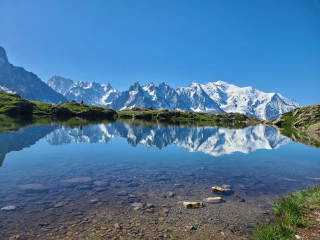
This final stage follows the Balcon des Aiguilles Rouges . We reach the Col des Montets, then our route climbs to one of the Lacs des Chésérys (2133 m), for a final rest away from the crowds at Lac Blanc. We finish the hike, still along the balcony trail, in a magnificent setting, facing the Aiguille Verte and the Drus.
Arrival at Chamonix SNCF train station is scheduled for around 5 p.m.
Day 6
Accommodation
Mountain refuges and guesthouses.
Access
Go to the starting point
Chamonix train station
Timetables available from SNCF at 36 35 or www.sncf-connect.com.
The airport is connected to the Swiss and European rail networks. The airport's SBB train station is directly accessible from the check-in and arrival levels. All trains stop at Geneva-Cornavin station (city center): 5 trains per hour during peak times, 7-minute journey time.
Trains to France depart from Geneva-Cornavin central station (city centre).
Tip: No fewer than 15 shuttle companies operate between Geneva Airport and Chamonix. They offer low-cost transfers that are more convenient and cheaper than the train. They serve all the sites in the Chamonix Valley.
www.chamonix.net/francais/transport/transfert
All parking options in Chamonix: www.chamonix.net/francais/transport/parking
Three car parks offer a flat rate: St Michel, Entrève and Mont-Blanc (approximately €77 for 10 days). Reservations are not possible.
Price details
The price includes
- Organization and supervision costs
- Full board
- Dormitory accommodation
- The ascent by the Bellevue cable car
- Luggage transport at each stage
The price does not include
- Wine during meals
- Drinks and personal expenses
- Personal equipment
- Buses and ski lifts used to shorten the stages
- Any shower tokens
- The room option (at an additional cost)
- Cancellation, assistance, repatriation, and trip interruption insurance
Options
- Extra night and half-board in the Chamonix valley - in a gîte (dormitory style) : CHF54.89 / person
- Extra night and breakfast in the Chamonix valley - in a gîte (dormitory style) : CHF36.59 / person
- Additional night and breakfast in the Chamonix valley - in a hotel (double room) : CHF77.76 / person
- Additional night and breakfast in the Chamonix valley - in a hotel (single room) : CHF114.35 / person
- Room supplement (mini-dormitories for 2 to 4 people) : CHF87.82 / person
- Flex fare and insurance
Practical information
Specific formalities
Specifics
During the hike, you must have the following documents in your possession:
- Valid identity card or passport.
- Your “AXA Assistance” travel insurance leaflet received when you registered (if you took out this insurance) or your personal insurance (contract number + telephone number).
Warning! Unlike in France, rescue services are very expensive in Switzerland. Check that you have search and rescue coverage with a sufficiently high limit. In particular, bank card insurance covers repatriation assistance, but basic bank card insurance (and some premium bank cards) does not include search and rescue coverage.
- Health insurance card.
- The "European Health Insurance Card" which certifies your rights to health insurance and allows you, during a temporary stay in Europe, to benefit from coverage of medically necessary care, whatever the reason for your trip and subject to complying with the formalities in force in the country of stay.
Italy is part of the Eurozone.
Euros are accepted almost everywhere in Switzerland.
Equipment
Equipment to bring
- 1 backpack of 35/40 litres with a flexible frame, equipped with a waist belt.
- A large plastic bag to protect the inside of the backpack.
- 1 pair of excellent quality sunglasses with side protection.
- A water bottle (1.5 liters minimum).
- 1 Opinel-type pocket knife.
- 1 small pouch (preferably waterproof) to put your money, identity card, health insurance card and assistance contract in.
- Toiletries (opt for the essentials, small sizes, samples and travel kits).
- 1 quick-drying bath towel.
- Earplugs or ear pads (optional).
- Toilet paper.
- Sunscreen + lip balm.
- Airtight plastic container (minimum capacity 0.5 l) + cup + cutlery.
- 1 headlamp or flashlight.
- 1 survival blanket.
- A pair of poles is recommended.
Clothing to bring
The principles:
- For the upper body, the 3-layer principle allows you to manage almost all situations:
- A long-sleeved undershirt made of breathable material (hollow fiber).
- A warm fleece fur jacket.
- A windproof, waterproof and breathable Gore-Tex type jacket.
- When hiking in calm, sunny weather, a base layer may be sufficient. In rain, snow, or wind, simply add a waterproof jacket. In very cold weather or during breaks, a fleece jacket is an essential addition.
- Choose clothes that dry quickly, so avoid cotton. Opt for wool, silk, and synthetic fibers that will keep you dry and warm for as long as possible.
- Remember to dress warmly before you get cold, but especially to remove layers before you get too hot. Sweat is a hiker's enemy, as it dampens clothing that quickly becomes icy during breaks. Therefore, it's very rare to undertake a climb wearing a fleece jacket.
The ideal list: (to be adapted according to the hike and the season)
- 1 sun hat or cap.
- 1 scarf.
- Short-sleeved T-shirts in breathable material preferred (1 for 2 to 3 days of walking).
- 1 long-sleeved undershirt in breathable material or a shirt.
- 1 fleece fur jacket.
- 1 windproof, waterproof and breathable Gore-Tex type jacket with hood.
- 1 rain cape or a bivvy bag if you own the jacket above.
- 1 pair of loose-fitting trekking trousers.
- 1 pair of shorts or bermudas.
- Hiking socks (1 pair for 2 to 3 days of hiking). Opt for wool or hiking-specific socks. Be careful with cotton as it can cause blisters.
- 1 pair of high-top hiking boots with good ankle support and waterproof soles (Vibram type). Remember to test new shoes and those that haven't been used for a long time beforehand.
- Underwear.
- 1 pair of comfortable trousers for the evening.
- 1 pair of lightweight casual shoes for the evening.
- At the beginning and end of the season (June and September), it is useful to also have gaiters, gloves and a hat.
Personal pharmacy
- Your usual medications.
- Pain medication: paracetamol preferred.
- Lozenges for sore throats.
- Elastic adhesive strip, Elastoplast type, 8 cm wide.
- Sets of adhesive bandages + disinfectant compresses.
- Double skin (like Compeed or SOS blisters).
- 1 pair of tweezers.