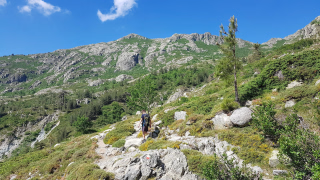
The original GR20 North self-guided hike with luggage transfer
In summary
-
Sports
-
Duration9 days
-
LevelExpert
-
DestinationCorsica / Haute-Corse
-
AgeFrom 16 - 78 years
-
CO₂-Emissions124.35 kg CO2
-
Type of stayIndependent traveler
In a few words
Embark on a 9-day trek of exceptional beauty on the northern section of the GR20 , between Vizzavona and Calenzana , in the heart of Corsica 's wild mountains. This legendary route immerses you in a spectacular alpine atmosphere , where the trail, often perched at high altitude , winds through mineral ridges, rocky gaps, and high-altitude lakes.
As you progress, you'll discover some of the island's most iconic sites: the magnificent lakes of Melu and Capitellu , the famous Capitellu breach , the vast meadows of Lake Ninu , and the breathtaking panoramas dominated by Paglia Orba and Pointe des Éboulis . If conditions permit, the ascent of Monte Cintu (2710 m) , Corsica's highest peak, will crown this adventure.
The route crosses powerful and varied landscapes where scree slopes, airy ridges and glacial valleys alternate, offering a total immersion in one of the most mythical treks in Europe .
For added comfort during this demanding adventure, you will have access to your support bag when the route allows.
This challenging and demanding trek is for experienced hikers , accustomed to technical terrain and with a sure footing , ready to take on the challenge of the legendary GR20 north .
The highlights
-
Respecting the original route of the GR20 North
-
From Vizzavona to Calenzana
-
Self-guided tour with roadbook
Photos


Sport
Level
Hiking / Trekking
The expert's opinion
This self-guided trip is for the very experienced and athletic hiker. You enjoy significant elevation gains and always have some energy left to accelerate in case of an emergency (storms, etc.). This route is for experienced hikers, accustomed to multi-day treks with substantial elevation gain, carrying a backpack, and living in very basic conditions.
CARRYING:
When transporting your luggage to the accommodation is not possible, we will limit your luggage to your personal belongings (including your sleeping bag). Food and, if necessary, camping equipment will be transported by our support team.
In figures
Hiking
- Average duration/day: 6h
- Average distance/day: 10 km
- Average daily elevation gain: 744 m
- Average daily descent: 833 m
- Exposed Passages: Yes
Management
Program
-
Vizzavona – the Onda
- Transportation TER / Metro / Tram - 01h15 - 40km
- Activity Hiking
- Duration of the activity 6h40
- Distance 12 km
- Positive elevation gain 1220 m
- Negative elevation 710 m
- Exposed passages Yes
- Accommodation Refuge
- Breakfast not included
- Lunch included
- Dinner included
Arrival in Ajaccio very early in the morning. Transfer to Vizzavona. Ascent along the Cascades des Anglais to cross Punta Muratellu (2141m). The descent towards Onda is steep, but the view of the island's highest peaks rewards our efforts.
Night at the Onda refuge.
Walking time: 6h40 / Elevation gain: +1220m / Elevation loss: -710m / Distance: 11.8 km
Day 1 -
L'Onda – Petra Piana
- Activity Hiking
- Duration of the activity 5h15
- Distance 10 km
- Positive elevation gain 900 m
- Negative elevation 490 m
- Exposed passages Yes
- Accommodation Refuge
- Breakfast included
- Lunch included
- Dinner included
Depending on the weather conditions, you can choose between the route along the ridges via the Pinzi Corbini (2021 m) or the ascent of the Manganellu valley with the possibility of swimming in the numerous pools along the way.
Night in a tent at the Petra Piana refuge.
Day 2 -
Petra Piana – Vaccaghja
- Activity Hiking
- Duration of the activity 6h
- Distance 11 km
- Positive elevation gain 630 m
- Negative elevation 890 m
- Exposed passages Yes
- Accommodation Refuge
- Breakfast included
- Lunch included
- Dinner included
A short morning climb to the Col de la Haute Route at 2206 m. An airy route along the ridges overlooking the lakes of Melu and Capitellu to reach the Bocca ae Porte pass at 2225 m. Overnight stay at the Manganu refuge or the Vaccaghja sheepfolds.
Day 3 -
Vaccaghja - Vergio
- Activity Hiking
- Duration of the activity 5h30
- Distance 14 km
- Positive elevation gain 350 m
- Negative elevation 550 m
- Exposed passages Yes
- Accommodation Cottage
- Breakfast included
- Lunch included
- Dinner included
You continue your journey, traversing a vast high-altitude beech forest along a contour line. A stop at Lake Ninu, one of the "pearls" of the Corsican mountains, a haven for wild horses. Overnight stay at the Castel di Vergio guesthouse.
Access to assistance baggage.
Day 4 -
Vergio - Balloon
- Activity Hiking
- Duration of the activity 6h
- Distance 13 km
- Positive elevation gain 730 m
- Negative elevation 720 m
- Accommodation Refuge
- Breakfast included
- Lunch included
- Dinner included
A change of scenery; you enter the volcanic massif of the Grande Barrière and we go up the upper Golo valley to the Foggiale Pass.
Night spent in a tent at the Ballone sheepfolds.
Day 5 -
Balloon - Ascu
- Activity Hiking
- Duration of the activity 8h30
- Distance 9 km
- Positive elevation gain 1240 m
- Negative elevation 1200 m
- Exposed passages Yes
- Accommodation Cottage
- Breakfast included
- Lunch included
- Dinner included
The most challenging day of the trip includes the ascent to the summit of Eboulis (2606 m) on the ridge of Monte Cintu, the highest peak in Corsica (2710 m). A summit of Monte Cintu is possible if all conditions are favorable (weather, physical condition, etc. – 1 hour 40 minutes round trip).
Night at the Ascu Stagnu guesthouse.
Access to the support bag.
Day 6 -
Ascu - Carozzu
- Activity Hiking
- Duration of the activity 5h
- Distance 4 km
- Positive elevation gain 640 m
- Negative elevation 790 m
- Accommodation Refuge
- Breakfast included
- Lunch included
- Dinner included
A short, steep climb takes you to the Muvrella pass. You leave the world of the peaks behind and plunge into the canyon to the Spasimata footbridge; the Mediterranean atmosphere gradually takes hold.
Night spent in a tent at the Carozzu refuge.
Walking time : 5 hours / Elevation gain: +640m / Elevation loss: -790m / Distance: 4.4 km
Day 7 -
Carozzu - Ortu di Piobbu
- Activity Hiking
- Duration of the activity 5h
- Distance 6 km
- Positive elevation gain 920 m
- Negative elevation 780 m
- Exposed passages Yes
- Accommodation Refuge
- Breakfast included
- Lunch included
- Dinner included
Climb to the Col de l'Innominata before reaching the ridges and enjoying the magnificent views they offer. You cross one last pass before descending to the refuge.
Night in tents at the Ortu di Piobbu refuge.
Day 8 -
Ortu di Piobbu - Calenzana
- Transportation 00h15 - 7km
- Activity Hiking
- Duration of the activity 5h
- Distance 11 km
- Positive elevation gain 60 m
- Negative elevation 1360 m
- Breakfast included
- Lunch included
- Dinner not included
The terrain remains rugged at the start of this descent towards the sea. You leave the mountains behind and the Gulf of Calvi comes into view more and more clearly. You finish your journey on an old mule track.
Arrival in Calenzana then transfer to Calvi and end of the stay.
Day 9
Note
We chose to hike the GR 20 from south to north, the opposite of the conventional direction. By starting with the easiest section (the south), the effort is gradual, increasing your chances of reaching the end. Departure is only possible on Saturdays from May 30th to September 19th inclusive to take advantage of luggage transfer (Days 4 and 6).
Accommodation
Access
Meet on Saturday at 7am in front of the SNCF train station in Ajaccio for the transfer Ajaccio - Vizzavona (1h15 min).
Dispersion on Sunday (day 9) in the afternoon at the SNCF train station in Calvi.
Our team will take care of your support bag upon arrival. You must therefore arrive ready to hike: hiking boots on your feet, full water bottle, complete backpack, and closed support bag.
Please note: The end of the stay is scheduled for the afternoon (between 3:00 pm and 4:00 pm in Calvi / 3 hours by road from Ajaccio and 5 hours by train), please take this into account when organizing your trip if you have to leave Corsica on the same day.
Go to the starting point
Price details
The price includes
- The travel log and the GPS application
- Accommodation in mountain huts, guesthouses, sheepfolds or tents
- Full board from lunch on Day 1 to lunch on Day 9
- Transfer at the start of your stay from Ajaccio to Vizzavona
- Transfer at the end of your stay from Calenzana to Calvi
- Luggage transport for support to accommodations with road access (Days 4 and 6)
The price does not include
- Transportation to and from the meeting point.
- Personal expenses, drinks and cereal bars
- Transfers not included in the program (withdrawal, injury, fatigue...)
- Anything not listed under "Price includes"
Options
- Flex fare and insurance
Practical information
Specific formalities
Specifics
Before your departure, check with the embassy or consulate regarding the entry and stay requirements for your destination country. You can also find this information on the France Diplomatie website ( https://www.diplomatie.gouv.fr/fr/dossiers-pays/ ).
In the case of flights with stopovers operated by different airlines, also check the entry requirements of the countries you are transiting through.
It is your responsibility to ensure you are in compliance, particularly regarding the validity of your identity documents (for example, some countries require your passport to be valid for at least six months after your return) , visa requirements, necessary vaccinations, and health recommendations. And don't forget to consider any customs restrictions and other potential requirements of your destination or transit country.
ℹ️ Information may change up to the departure date, remember to regularly check official websites.
Equipment
Equipment to bring
The support bag : This is your "follow-me" bag. You'll find it in the evening at your accommodations, provided there's road access. It's a duffel bag or sports bag. Besides your spare clothes, it contains any extras you'll be glad to have on hand some evenings. No items should be attached to the outside of the bag. It will be transported by our support team to accommodations accessible by road. Please be sure to pack light and only bring the essentials.
Opt for one support bag per person (and not one bag for 2): "lightening" is common during the trip; you must still have room to store your sleeping bag when it is not needed for the stage.
The picnic : 1 individual airtight container of approximately 0.5 liters, such as a "Tupperware" type container, to hold a mixed salad, cutlery (knife, fork) and a cup.
Small equipment
- Water bottle or hydration pack (approximately two liters): we strongly advise you to bring a filter bottle, a filter straw or a filter adapter for your hydration pack (such as LifeStraw or Camelbak)
- A pair of telescopic poles (recommended)
Sunglasses, sunscreen, and a hat
- Toilet paper
- Earplugs
- A small toiletry bag, with a towel (made of lighter microfiber)
- A headlamp with new batteries
-A pair of sneakers or sandals for the evening
Pharmacy : You must bring a personal kit containing your own medical prescriptions as well as a supplementary pharmacy containing: large elastoplast, double skin for blister prevention, disinfectant, aspirin/paracetamol, sterile dressings and compresses.
Clothing to bring
The clothes
- A windproof, waterproof and breathable GORE-TEX type jacket
- Protection against rain (rain cape or waterproof and breathable jacket)
- A fleece jacket or light down jacket
- Trousers, shorts, t-shirt(s) (avoid cotton and favour breathable materials).
- Change of clothes
- A swimsuit and a microfiber towel (lighter)
- Thin gloves and a light hat.
Sleeping : A good quality sleeping bag (comfort temperature: +5°) that is compact and lightweight is essential for this trip involving nights in a guesthouse, mountain refuge or tent.
Footwear : Choose hiking boots with good ankle support and lug soles that are flexible. Footwear is one of the most important pieces of equipment for your hike. Above all, they must be comfortable, lightweight, waterproof, and breathable. Good ankle support is essential.
Don't set off in brand new shoes. Wear them at least two or three times beforehand on hikes. Likewise, make sure your "old shoes" won't fall apart on the first climb.