In summary
-
Sports
-
Duration6 days
-
LevelConfirmed
-
DestinationRhône / Lyon
-
AgeFrom 16 - 90 years
-
CO₂-Emissions50.01 kg CO2
-
Type of stayIndependent traveler
In a few words
This journey begins on the Cluny Way, leaving the Loire Valley and entering the Monts du Forez . Further upstream, you'll encounter the Loire gorges before reaching Le Puy and one of the four major French routes to Santiago de Compostela, the Via Podiensis . At St Georges-Haute-Ville, you'll find yourself at the crossroads of two ancient pilgrimage routes: pilgrims arrived here either from Cluny or from Lyon. The route then climbs into the Monts du Forez, passing the fortified villages of Marols and Montarcher . The path then splits again into two branches to reach Le Puy-en-Velay. One route follows the plateau, tracing the ancient Roman Via Bolena that connected Lyon to Bordeaux ; the other, the one we recommend, leads to the Loire gorges. These routes have preserved numerous monuments, churches, chapels, priories , and more, bearing witness to the passage of pilgrims over the centuries. As an alternative, we suggest following the Bolène route, which remains on the plateau and offers stages with less elevation gain.
The highlights
-
A varied and interesting hiking trail away from the crowds
-
The volcanoes of St Romain, Le Puy and Monsupt
-
The hilltop villages of the Monts du Forez
Photos


Sport
Level
Hiking / Trekking
In figures
Hiking
- Average duration/day: 6h
- Average distance/day: 24 km
- Average daily elevation gain: 650 m
- Average daily descent: 602 m
Management
Program
-
Montbrison
- Accommodation Bed and Breakfast
- Breakfast not included
- Lunch not included
- Dinner not included
There is very little accommodation available in St Romain, so it is likely that you will be accommodated in Montbrison.
Arrival in the late afternoon. Accommodation in a guest house (B&B). Dinner at your leisure (numerous restaurants available).
Day 1 -
Montbrison - Marols
- Activity Hiking
- Duration of the activity 6h
- Distance 22 km
- Positive elevation gain 550 m
- Negative elevation 120 m
- Accommodation Bed and Breakfast
- Breakfast included
- Lunch not included
- Dinner included
You leave directly from Montbrison following the path that comes from Cluny.
At St Georges-Haute-Ville, you rejoin the Lyon road. You will then gradually begin the ascent into the Monts du Forez.
The countryside is lush and the villages are breathtakingly beautiful. Like the pilgrims who came from Cluny to the Romanesque chapel of Monsupt (13th century), take the time to contemplate the Forez plain. Your path leads you across the bridge spanning the Mare (don't worry, small protective crosses are engraved on its parapets) and you arrive at Saint Jean Soleymieux and its 11th-century crypt. You then continue to your next stop in Marols, burned down by the turbulent Baron des Adrets in 1562. This charming little village has since regained its tranquility, and many artists and craftspeople exhibit their work here.
This stage can be shortened by taking the train to St Romain le Puy (7 minutes – €2.50 payable locally). This reduces the distance by 4 km and 1 hour 15 minutes.
Day 2 -
Marols - Leignecq
- Activity Hiking
- Duration of the activity 5h15
- Distance 20 km
- Positive elevation gain 670 m
- Negative elevation 540 m
- Accommodation Bed and Breakfast
- Breakfast included
- Lunch not included
- Dinner included
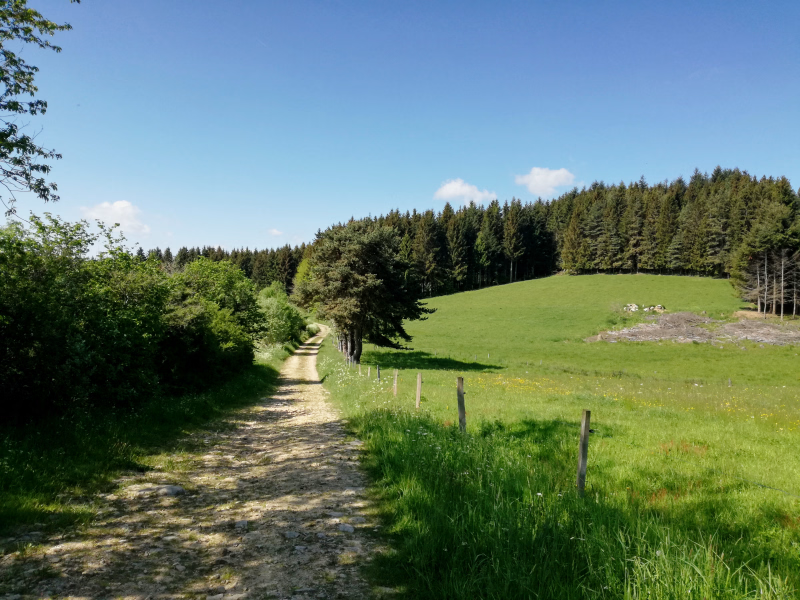
You follow a beautiful path through the forest and reach the highest point of your route at 1165 meters. At Montarcher , a former stronghold belonging to the Counts of Forez, you can admire the panoramic view. Just beyond, the route leaves the ancient Via Bolena , which, since the time of the Celts and Romans, has connected Lyon to Aquitaine. You now take the GR765 East (shared with the GR3), following the peaceful course of the Andrable River, and arrive at Leignecq , a hilltop village that was once fortified.
From Montarcher, it is possible to follow the GR765 West (see the "Variant" below).
Day 3 -
Leignecq - Retournac
- Activity Hiking
- Duration of the activity 7h
- Distance 28 km
- Positive elevation gain 640 m
- Negative elevation 1090 m
- Accommodation Bed and Breakfast
- Breakfast included
- Lunch not included
- Dinner included
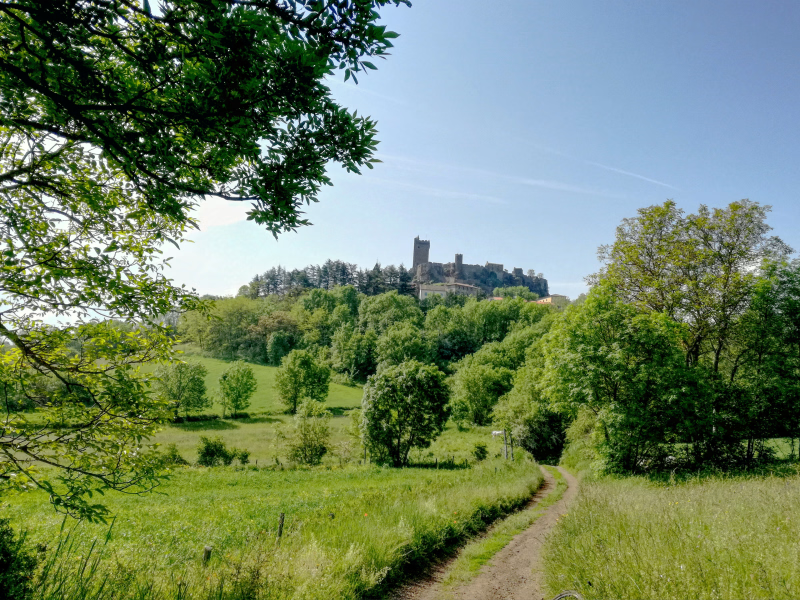
It is important to leave early for this long and hilly stage. Your accommodation provider can take you to Valprivas to shorten the journey (-10 km, -2 hours 30 minutes, transfer at your own expense to be paid locally). You reach Valprivas and its castle. You then leave the gentle hills of the Monts du Forez to descend and cross the Andrable River . This stream marks the boundary of the Forez region, and today you enter the Haute-Loire department. The landscapes change, the terrain becomes steeper: a good climb up the other bank leads to Châles before plunging back into the Ance Valley . The final ascent takes you to Sarlanges before arriving in Retournac, in the heart of the Loire Gorges . A visit to the Lace Museum is a must. Accommodation is available in Jussac (4 km, 1 hour).
Day 4 -
Retournac - Vorey sur Arzon
- Activity Hiking
- Duration of the activity 5h30
- Distance 21 km
- Positive elevation gain 630 m
- Negative elevation 600 m
- Accommodation 2-star hotel
- Breakfast included
- Lunch not included
- Dinner included
Your path meanders like the Loire River, which has carved its course through this volcanic terrain. In the heart of this natural landscape, your journey will lead you to picturesque villages like Chamalières (with its magnificent 12th-century church) and the remains of fortresses overlooking the Loire. The most remarkable are those of Artias (12th century) and Roche-en-Régnier . You can stop in Vorey-sur-Arzon, on the banks of the Loire, or in Saint-Vincent (+6 km, +1 hour 30 minutes). If you are staying in Saint-Vincent, you can shorten your day by taking the train from Retournac to Chamalières or from Vorey-sur-Arzon to Saint-Vincent.
Day 5 -
Vorey sur Arzon - Le Puy en Velay
- Activity Hiking
- Duration of the activity 7h
- Distance 27 km
- Positive elevation gain 760 m
- Negative elevation 660 m
- Breakfast included
- Lunch not included
- Dinner not included
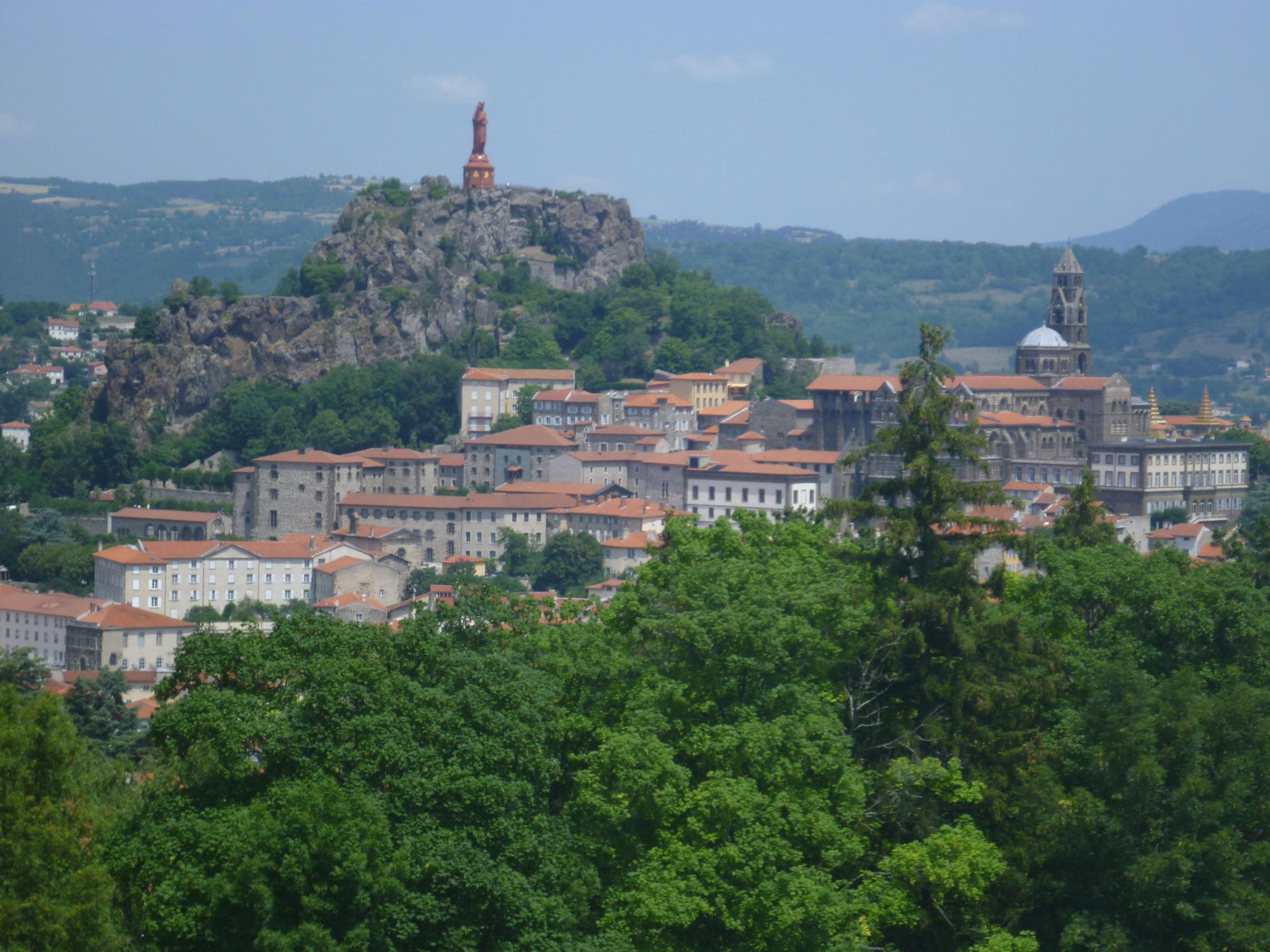
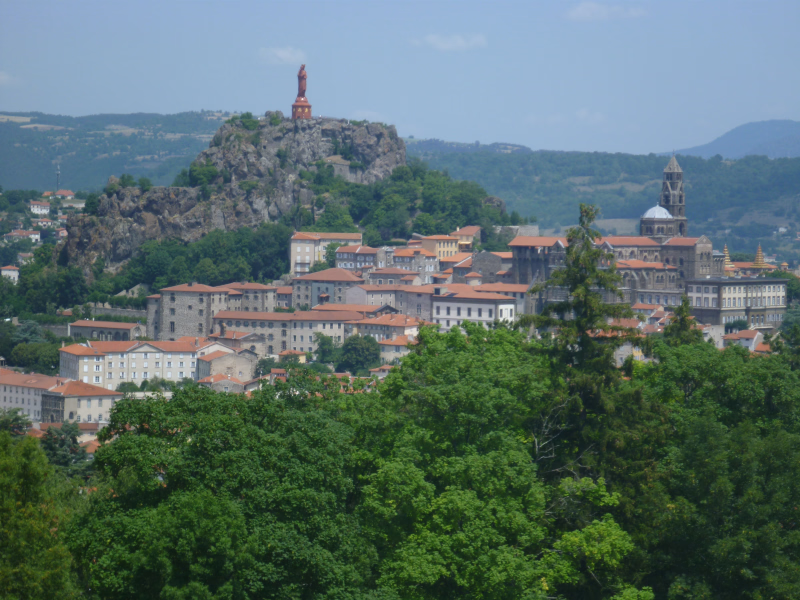
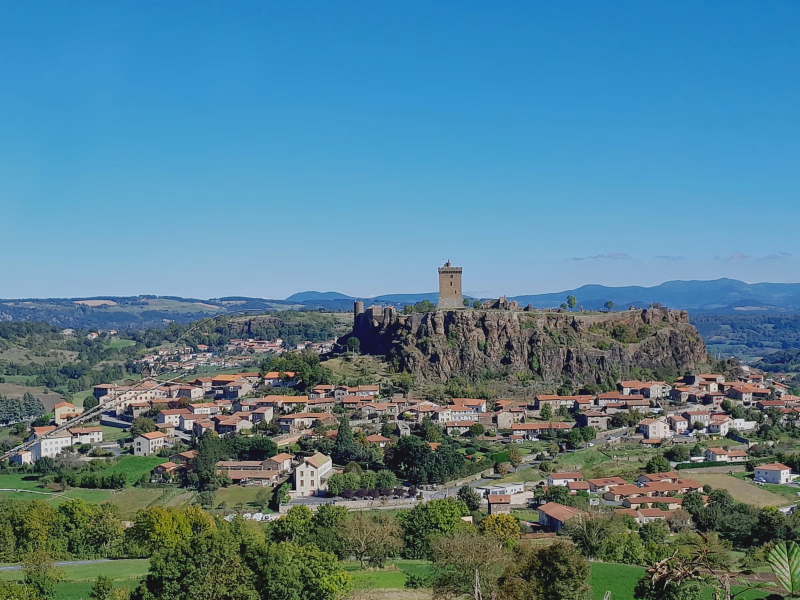
You finish with another long stage. You can shorten it by taking the train from Vorey-sur-Arzon to Lavoûte-sur-Loire (-11 km, -2 hours 30 minutes). In Lavoûte-sur-Loire , the path rejoins the river, which forms a magnificent loop. Within this loop, the Château de Lavoûte-Polignac stands on its rocky promontory. The route then crosses the Emblavez basin, covered with fields, meadows, and hamlets, and reaches the spectacular Château de Polignac (that family again), perched on its rocky outcrop. The last section of the path leads to Le Puy-en-Velay , the "City of the Virgin," and the starting point of the Via Podiensis. A visit is a must, with its historic quarter and cathedral at its heart, a UNESCO World Heritage Site. The trip ends in the late afternoon.
Day 6
Note
The times were calculated based on a pace of 300 meters of elevation gain per hour uphill, 500 meters of elevation loss per hour downhill, and 4 km per hour on flat terrain, in order to allow for a comparison of the different hikes on the same basis. They only include actual walking time; all meal breaks, rest stops, or periods of quiet contemplation must be added.
We may need to modify your itinerary if the planned accommodations are unavailable during your travel dates. The alternative accommodations offered will be of a similar category and their location will have minimal impact on your route. Rest assured, these changes are always made in your best interest, for your safety and comfort!
Accommodation
You can choose to extend your trip with the "extra night" option .
You can choose to extend your trip with the "extra night" option .
Access
Return train : Le Puy-en-Velay train station. Avoid traveling on weekends or public holidays, as SNCF train services are much more disrupted on these days. Return bus: Le Puy-en-Velay train station. Return car: St Romain Le Puy.
Go to the starting point
Access by car : St Romain Le Puy or Montbrison.
Price details
The price includes
- Organization fees
- Food and accommodation on a half-board basis (except for the first day in guest rooms)
- The provision of a complete hiking file
- The provision of the guidebook
The price does not include
- Luggage transport
- Dinner on Day 1
- Lunchtime meals
- Wine during meals
- Drinks and personal expenses
- Possible visits.
- Individual equipment
- The journeys to and from the reception location.
- Luggage transport
- The different types of insurance
- Anything not listed under "Price includes"
- The “solo supplement” if you are travelling alone
- All options not included in the price
Options
- Single room : CHF132.65 / person
- Luggage transfer for 1 person : CHF411.66 / person
- Luggage transfer for 2 to 3 people : CHF155.52 / person
- Luggage transfer for 4 or more people : CHF86.91 / person
- Return transfer Le Puy - Montbrison by taxi : CHF292.74 / reservation
- Additional night after stay - Single room : CHF91.48 / person
- Additional night after stay - Double room : CHF64.04 / person
- Flex fare and insurance
Practical information
Specific formalities
Specifics
In the case of flights with stopovers operated by different airlines, also check the entry requirements of the countries you are transiting through.
It is your responsibility to ensure that you are in compliance, particularly regarding the validity of your identity documents (
For example, some countries require your passport to be valid for at least six months after your return date. Consider visa requirements, necessary vaccinations, and health recommendations. And don't forget to take into account any customs restrictions and other potential requirements of your destination or transit country.
ℹ️ Information may change up to the departure date, remember to regularly check official websites.
⚠️ For this stay, you must also bring your health insurance card.
Equipment
Equipment to bring
Equipment :
- 1 backpack of 35/40 litres with a flexible frame, equipped with a waist belt.
- A large plastic bag to protect the inside of the backpack.
- 1 pair of excellent quality sunglasses with side protection.
- A water bottle (1.5 liters minimum).
- 1 Opinel-type pocket knife.
- 1 small pouch (preferably waterproof) to put your money, identity card, health insurance card and assistance contract in.
- Toilet paper + 1 lighter to burn it.
- Sunscreen + lip balm.
- Airtight plastic container (minimum capacity 0.5 litre) + cup + cutlery.
- 1 survival blanket.
- Camera, binoculars (optional).
- A pair of poles is recommended.
Clothing to bring
For the upper body, the 3-layer principle allows you to manage almost all situations:
- A long-sleeved undershirt made of breathable material (hollow fiber).
- A warm fleece fur jacket.
- A windproof, waterproof and breathable Gore-Tex type jacket.
When hiking in calm, sunny weather, a base layer may be sufficient. In rain, snow, or wind, simply add a waterproof jacket. In very cold weather or during breaks, a fleece jacket is an essential addition.
Choose quick-drying clothes, so avoid cotton. Opt for wool (merino wool underwear is comfortable and doesn't develop unpleasant odors), silk, and synthetic fibers that will keep you dry and warm for as long as possible.
Remember to dress warmly before you get cold, but especially to remove layers before you get too hot. Sweat is a hiker's enemy, as it dampens clothing that quickly becomes icy during breaks. Therefore, it's very rare to undertake a climb wearing a fleece jacket.
The ideal list : (to be adapted according to the hike and the season)
- 1 sun hat or cap.
- 1 scarf or neck warmer.
- Short-sleeved T-shirts in breathable material preferred (1 for 2 to 3 days of walking).
- 1 long-sleeved undershirt in breathable material or a shirt.
- 1 fleece fur jacket.
- 1 windproof, waterproof and breathable Gore-Tex type jacket with hood.
- 1 rain cape or a bivvy bag if you own the jacket above.
- 1 pair of loose-fitting trekking trousers.
- 1 pair of shorts or bermudas.
- Hiking socks (1 pair for 2 to 3 days of hiking). Opt for wool or hiking-specific socks. Be careful with cotton as it can cause blisters.
- 1 pair of high-top hiking boots with good ankle support and waterproof soles (like Vibram). Remember to test new shoes and those that haven't been used for a long time beforehand.
- Underwear.
- At the beginning and end of the season (May - June and September - October), it may be useful to also have gaiters, gloves and a hat.
They traveled with us