Glacier hiking on the Haute Route: Chamonix - Zermatt
In summary
-
Sports
-
Duration7 days
-
LevelAdvance
-
DestinationChamonix-Mont-Blanc / Mont Blanc Massif - France
-
AgeFrom 18 - 90 years
-
CO₂-Emissions38.32 kg CO2
-
Type of stayIn a group
-
Languages
 French
In a few words
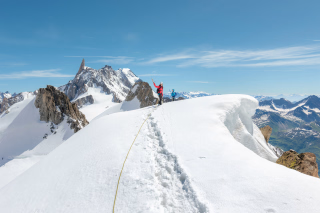
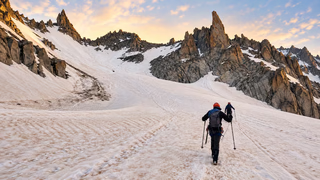
The "Haute Route" between Chamonix and Zermatt is renowned as the most beautiful glacier hike in the Alps. Embark on this adventure! From Mont Blanc to the Matterhorn, you'll traverse some of the most magnificent 4,000-meter peaks over six unforgettable stages. This high-mountain trek takes you on a breathtaking high-altitude route, linking glaciers and mountain passes above 3,000 meters, and bringing you close to the most stunning summits of the Alps (Grand Combin, Dent Blanche, Pigne d'Arolla). You'll begin in the Mont Blanc massif with the Tour and Trient glaciers. The highest point will be Tête Blanche at 3,710 meters , before concluding with a spectacular descent to Zermatt .
The highlights
-
An unmissable raid in the heart of the most beautiful 4000m peaks of Valais
-
A safe route across the glacier, accessible to experienced hikers.
-
Nights in traditional and comfortable Swiss mountain huts
Photos


Sport
Level
Mountaineering
In figures
Hiking
- Average duration/day: 6h
- Average daily elevation gain: 900 m
- Average daily descent: 450 m
Management
French
You will be accompanied by a high mountain guide who will provide you with the technical elements necessary for progression on the glacier: walking in crampons and rope work.
Program
-
From the village of Le Tour (1453m) to the Albert 1er refuge
- Activity Hiking
- Duration of the activity 5h
- Positive elevation gain 1200 m
- Accommodation Refuge
- Breakfast not included
- Lunch not included
- Dinner included
Presentation of the hike and fitting of individual equipment followed by bag check. Departure from the village of Le Tour (1453m), from the Charamillon car park, to reach the Albert 1er refuge (2702m) where we will spend the night.
Day 1 -
The Col Supérieur du Tour, the Trient Glacier and the village of Champex
- Activity Hiking
- Duration of the activity 7h
- Positive elevation gain 750 m
- Negative elevation 1000 m
- Accommodation Refuge
- Breakfast included
- Lunch included
- Dinner included
We set off from the refuge around 7 a.m. with the village of Champex as our destination. To get there, we crossed the Swiss border at the Col Supérieur du Tour. Then we traversed the Trient Glacier to reach the Col d'Orny . A trail led us to the Breya chairlift, at the end of the Aiguilles d'Arpette, which allowed us to descend to Champex .
Overnight stay in a gîte in Champex.
Day 2 -
Ascent to the Chanrion cabin (2462m)
- Activity Hiking
- Duration of the activity 5h
- Positive elevation gain 600 m
- Accommodation Refuge
- Breakfast included
- Lunch included
- Dinner included
Transfer by vehicle from Champex to the Mauvoisin dam. Today's objective is the ascent to the Chanrion hut (2462m). A beautiful and varied stage where we catch glimpses of stunning peaks: the Grand Combin and Mont Gelé.
Night at the Chanrion cabin.
Day 3 -
The Otemma Glacier and the ascent to the Cabane des Vignettes (3158m)
- Activity Hiking
- Duration of the activity 7h
- Positive elevation gain 850 m
- Negative elevation 150 m
- Accommodation Refuge
- Breakfast included
- Lunch included
- Dinner included
The Otemma Glacier is larger than the famous Mer de Glace: its surface area is 22 km² and it is 10 km long. As we travel across the glacier, we'll catch a glimpse of the Pigne d'Arolla, a favorite among mountaineers. We'll then ascend to the Cabane des Vignettes, perched at 3158 m atop a cliff, where we'll spend the night.
Day 4 -
Bertol's hut (3311m) and the viewpoint overlooking the Matterhorn
- Activity Hiking
- Duration of the activity 7h
- Positive elevation gain 1150 m
- Negative elevation 1000 m
- Accommodation Refuge
- Breakfast included
- Lunch included
- Dinner included
Bishop's Pass (3392 m), Collon Pass (3087 m), then the Upper Arolla Glacier. We leave the glacial valleys behind and take a path that will lead us in 2 hours to the Bertol Hut (3311 m). Once there, a unique view of the Matterhorn will unfold before us. The hut's location (3311 m), perched on its rocky spur, is spectacular.
Night at Bertol's cabin.
Day 5 -
Ascent to Tête Blanche and descent from Stockji towards Schönbiel
- Activity Hiking
- Duration of the activity 8h
- Positive elevation gain 650 m
- Negative elevation 1000 m
- Accommodation Refuge
- Breakfast included
- Lunch included
- Dinner included
A splendid stage awaits us today. We ascend to Tête Blanche (3724 m), enjoying superb views of the Dent d'Hérens, the Dent Blanche, the Matterhorn, and the Zermatt valley. Then we descend the Stockji glacier to reach the Schönbiel hut (2694 m) for the night.
Day 6 -
Descent to Zermatt (1616 m)
- Activity Hiking
- Duration of the activity 4h
- Positive elevation gain 1100 m
- Breakfast included
- Lunch not included
- Dinner not included
Magnificent descent to Zermatt along the north face of the Matterhorn, one of the most difficult walls in the Alps.
Arrival in Zermatt around noon, visit of the village. For those wishing to return to Chamonix, the return trip is by minibus (taxi), arriving in Chamonix in the late afternoon (taxi fare to be paid on site).
Day 7
Note
This itinerary is provided as a guide only: depending on weather and operational conditions, your tour guide may modify this itinerary for your safety and that of the group.
Access
📍 The meeting point for departure is the Concept ProShop equipment store in Chamonix.
On the return, for those who wish to return to Chamonix, the return trip is by taxi (to be paid on site) for an arrival in Chamonix in the late afternoon.
Go to the starting point
🚂 Terminus of classic trains at Saint-Gervais-les-Bains le Fayet station, then change for the Le Fayet-Martigny tourist train, stop at Chamonix "Aiguille du Midi".
The Concept ProShop store is located a 5-minute walk from the train station.
🚘 Take the A40 and follow signs for Cluses, Servoz, Les Houches and Chamonix. Park in the Grépon car park (free for the first hour): at the far end of the car park take the underpass and the Concept ProShop store is at the exit just to your left.
During the raid, vehicles will be parked in the Charamillon car park in the village of Le Tour (free car park).
Price details
The price includes
- The technical organization of the stay
- Half-board accommodation from the evening of Day 1 to the morning of Day 7
- Lunch picnics from day 2 to day 6
- The ski lifts necessary for the normal running of the program
- The transfer of Champex to the Mauvoisin Dam
- Supervision by a high mountain guide
- The collective equipment necessary for safety
- Accommodation according to the chosen package
The price does not include
- Round-trip transportation to the meeting point
- Individual technical equipment (see technical specifications section)
- Picnic on Day 1 and lunch on Day 7 in Zermatt
- Return trip Zermatt-Chamonix by minibus (approximately 550 CHF to be divided by the number of people wanting return transport)
- Drinks and mineral water during your stay, including during meals
- Individual snacks (cereal bars, dried fruit, chocolate bars, etc...snacks as you wish)
- The tourist tax
Options
- Flex fare and insurance
- Meals according to the chosen package
Practical information
Specific formalities
Specifics
Before your departure, check with the embassy or consulate regarding the entry and stay requirements for your destination country. You can also find this information on the France Diplomatie website ( https://www.diplomatie.gouv.fr/fr/dossiers-pays/ ).
In the case of flights with stopovers operated by different airlines, also check the entry requirements of the countries you are transiting through.
It is your responsibility to ensure you are in compliance, particularly regarding the validity of your identity documents (for example, some countries require your passport to be valid for at least six months after your return) , visa requirements, necessary vaccinations, and health recommendations. And don't forget to consider any customs restrictions and other potential requirements of your destination or transit country.
ℹ️ Information may change up to the departure date, remember to regularly check official websites.
Equipment
Equipment provided on site
- Group equipment is provided (ropes)
- Slippers are available at the mountain huts.
Equipment to bring
- A sleeping bag liner is mandatory (blankets are provided in the shelters).
- An ice axe, crampons, a harness equipped with two locking carabiners, a helmet
- One or two telescopic hiking poles
- A pair of gaiters
- A small toiletry bag
- One sunscreen cream (face and lips) + one after-sun cream
- A headlamp, with spare batteries
- A water bottle with a minimum capacity of 1.5 liters, lightweight and insulated
- A pocket knife, preferably multi-purpose, or Opinel type
- Toilet paper + lighter
- Two to three plastic bags (100 liters) to protect belongings in the backpack in case of rain
If necessary, the following individual technical equipment can be rented: mountaineering boots, ice axe, crampons, harness, helmets, carabiners, poles, headlamp, backpack
Clothing to bring
You will be carrying all your equipment for the week . It's important not to carry too much weight, so only pack the essentials (but enough). Your guide will help you finalize your pack on the first day. Ultimately, your pack should not exceed 10 to 12 kg, including water and food for the day.
- Underwear, both top and bottom. This is your first layer of insulation, so take good care of it.
- Thin technical fibers, such as Carline or Polartec, are very effective, warm, flexible, comfortable, lightweight, and dry very quickly.
- 1 warm fleece
- 1 warm down jacket or anorak
- 1 Gore-Tex type waterproof jacket
- Beanie or balaclava
- Hat (or cap) for sun protection and/or scarf
- 1 pair of trekking trousers or warm tights
- 1 waterproof Gore-Tex pants or ski pants
- 1 pair of tights
- 1 pair of fleece or wool gloves
- 1 pair of "thermal" gloves (very warm mittens)
- Nylon or Goretex overgloves
- Optional for those who are more sensitive to the cold: a pair of liner gloves
- Mountaineering boots (not trekking boots) that allow for the attachment of crampons (overhangs at the front and back of the boot).
- Warm socks, one thin pair and one thicker pair
This list is generic and intended to cover all the weather conditions you might encounter in the high mountains. It should be adapted to the specific conditions expected during your stay. Always pack warm clothing, even when temperatures are high in the valley.
They traveled with us