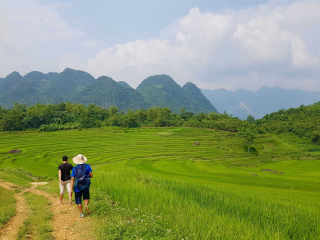
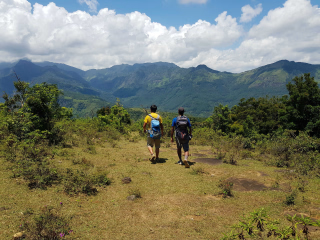
The giants of the Karakoram
In summary
-
Sports
-
Duration16 days
-
LevelIntermediate
-
DestinationAsia / Pakistan
-
AgeFrom the age of 18
-
CO₂-Emissions5382.22 kg CO2
-
Type of stayIn a group
-
Languages
 French
 English
In a few words
Let yourself be guided into the heart of a spectacular and little-known Pakistan, nestled between the giants of the Karakoram . This extraordinary journey offers a deep immersion at the pace of accessible hikes , alternating between fertile valleys, glaciers , high plateaus and traditional villages.
Your route takes you through breathtaking landscapes, from the wild expanses of Deosai to the oases of Hunza . You'll discover striking contrasts, from turquoise lakes and desert dunes to legendary roads. One of the highlights is the stop at Fairy Meadows , offering an unparalleled view of the iconic Nanga Parbat .
The true added value of this adventure lies in the presence of Karine, your French guide . Having lived in the country for many years, this passionate specialist will share her intimate knowledge of the region. Thanks to her expertise and close ties to the Baltic and Hunzakut cultures , each warm encounter takes on a more human and authentic dimension. An exceptional journey to explore one of the world's most beautiful mountain ranges from a unique perspective.
The highlights
-
Accessible hikes in the heart of the Hunza and Indus valleys
-
Exploring the Deosai plateau and its high-altitude landscapes
-
The supervision was provided by Karine, a specialist in the region.
Photos


Sport
Level
Hiking / Trekking
The expert's opinion
This trip includes several accessible hikes, with an average duration of about 2 hours, on trails that do not present any particular technical difficulties.
The hike on day 11, to the Nanga Parbat base camp, is more strenuous but remains totally optional.
Please note that road conditions can vary greatly depending on the region and circumstances, which can make some transfers long and sometimes tiring. Our team of experienced drivers does everything possible to ensure your safety and comfort, but these logistical constraints can occasionally increase the overall difficulty of the journey.
In figures
Hiking
- Average duration/day: 2h30
- Average daily elevation gain: 172 m
- Average daily descent: 86 m
Management
French
English
- The stay on site is supervised by Karine.
A historical guide, Karine is passionate about the wilderness. It was while reading the accounts of Himalayan explorers from the beginning of the last century that she first found herself in Pakistan 25 years ago, working on a photo essay about Chinese Turkestan. There, she discovered a fascinating country and a region with particularly breathtaking landscapes: Gilgit-Baltistan, in the Karakoram mountain range. At the foot of the world's highest mountains, nature offers an exceptional spectacle, from glaciers to alpine meadows overflowing with flowers. Yet, as Karine says, "it is above all the warm welcome and kindness of the people that make Pakistan a unique country, with a millennia-old culture that remains intact!"
- We are also accompanied by a local English-speaking guide.
Program
-
Paris - Islamabad
- Transportation Plane - 07h30 - 8900km
- Breakfast included
- Lunch not included
- Dinner not included
Flight to Islamabad.Day 1 -
Islamabad
- Accommodation 2-star hotel
- Breakfast included
- Lunch included
- Dinner included
Arrival in Islamabad. You will be met at the airport by our local team and transferred to your hotel. The day is dedicated to visiting the new city of Islamabad, established in 1961, and the Shah Faisal and Daman-e-Koh mosques, offering panoramic views of the capital. We then travel to the old city of Rawalpindi for a stroll through its eclectic and colorful bazaars. It's a pleasure to wander there, with the aromas of grilled kebabs and the delicate scent of cardamom tea tantalizing your senses. Dinner in town and overnight at the hotel.Day 2 -
Islamabad - Skardu
- Activity Hiking
- Duration of the activity 1h
- Accommodation 2-star hotel
- Breakfast included
- Lunch included
- Dinner included
Early morning transfer to the airport for a domestic flight to Skardu (one hour flight). Weather permitting, we'll admire the spectacular Nanga Parbat massif (8,125 m) from the air! Arrival in Skardu, the capital of Baltistan (the land of the Balti), also known as "Little Tibet." The Balti people practiced Bön religion and Tibetan Buddhism before converting to Shia Islam in the 14th and 15th centuries. They still speak Old Tibetan. Our day will be dedicated to exploring Skardu and its surroundings. After lunch, we'll hike to Kharpocho Fort, built in the 16th century by Ali Sher Khan Anchan. The fort, perched above the city of Skardu, offers breathtaking views of the valley and the Indus River as it winds its way through sandbanks, creating dune deserts. Beyond the poplar trees of the valley, the steep peaks of the Karakoram range stand out in the background. We will spend the night in a hotel on the banks of the Indus River. Note: The flight between Islamabad and Skardu is subject to weather conditions. In case of cancellation, we will have to wait for more favorable conditions to take another flight.Day 3 -
Khaplu
- Transportation Minibus - 03h - 149km
- Accommodation 2-star hotel
- Breakfast included
- Lunch included
- Dinner included
It's about a three-hour drive to Khaplu, a charming little village nestled on the banks of the Shyok River. At the foot of the mountains, traditional stone houses are surrounded by fertile, verdant wheat fields. We'll visit the former royal palace, built in 1840 by Raja Yagbo (King) of Khaplu, and the Chaqchin Mosque, which belongs to the Nurbakh Sufi order, a Shiite Sufi brotherhood established in Kashmir and Baltistan. From there, we can admire breathtaking views of Khaplu, the Shyok Valley, and some of the jagged peaks of the Karakoram range. Weather permitting, we'll cross the magnificent Sailing Bridge to reach a village offering a view of Masherbrum Peak, also known as K1 (7,821m). The first Westerners to explore the region in 1856 mistakenly believed that Masherbrum was the highest peak in the Karakoram, hence the name “K1” given to it. Overnight at the hotel.Day 4 -
Shigar - Katpana Desert - Skardu
- Activity Hiking
- Duration of the activity 1h
- Accommodation 2-star hotel
- Breakfast included
- Lunch included
- Dinner included
We take a short drive to the ancient principality of Shigar, founded by the Amacha dynasty. We visit the beautiful mosques of Amburiq and Khilingrong, crafted from intricately carved stone and wood. Next, we visit Shigar Fort, the former residence of the Rajas of Shigar in the 17th century, restored by the Aga Khan Foundation and now a boutique hotel. We have lunch in the fort before visiting the Astana (mausoleum) of Sayed Mir Yahya and the Khanqah (meeting and prayer hall), which testifies to the influence of Sufism (the mystical branch of Islam) in the Baltistan region since the 16th century. We then continue our journey to the Katpana Desert, where we hike for about an hour across the dunes. We then proceed to Skardu for dinner and an overnight stay at a hotel.Day 5 -
Skardu - Deosai National Park (4100 m) - Tarshing
- Transportation Minibus - 07h - 300km
- Accommodation Bed and Breakfast
- Breakfast included
- Lunch included
- Dinner included
A short drive and a stop at Satpara Lake, followed by a visit to the magnificent Manthal Buddha, carved in the 7th century from a massive granite boulder. An exceptional drive then takes us to Deosai National Park (4,100 m). The stunning Deosai Plain is among the highest plateaus in the world, set in a truly magnificent landscape. The views are breathtaking, encompassing snow-capped mountains and flower-filled plains inhabited by marmots and Himalayan brown bears. En route, we stop at Sheosar Lake, where we admire the massive silhouette of Nanga Parbat (8,125 m). We then pass through numerous villages with beautiful terraced fields on the slopes. Suddenly, the south face of Nanga Parbat appears, towering over the houses of Tarshing.Day 6 -
Tarshing - Hike to Herlichoffer base camp (3500 m)
- Activity Hiking
- Duration of the activity 3h
- Accommodation Bed and Breakfast
- Breakfast included
- Lunch included
- Dinner included
We begin the day with a short jeep ride (approximately 45 minutes). After passing through the village and the Tarshing Glacier, we ascend through the fields and hamlets of Rupal. The hike then begins, leading to the pleasant meadows of Herlickoffer Camp (3,500 m), a beautiful walk through wheat fields that contrast with the impressively steep faces of Chongra and Raikot peaks. The summit of Nanga Parbat towers above the camp, presenting us with the highest wall on Earth: the sheer 4,500-meter face of Nanga Parbat's south face impresses even the most seasoned mountaineers. We enjoy a picnic lunch at base camp and then hike back to Rupal.Day 7 -
Tarshing – Karimabad, Hunza Valley
- Transportation Minibus - 06h - 300km
- Accommodation 2-star hotel
- Breakfast included
- Lunch included
- Dinner included
We'll drive (approximately 6 hours) to Hunza, the capital of Hunza, a former principality annexed by Pakistan in 1974 and situated in a breathtaking setting. The inhabitants of the Hunza Valley, the Hunzakuts, are Ismaili Shiites, followers of the Aga Khan (a progressive branch of Islam). The Hunza Valley, once an inaccessible enclave at the foot of the rocky peaks of the Karakoram range, appeared to early explorers as a Shangri-La: a mythical representation of the Garden of Eden. The Hunzakuts have managed to preserve a way of life in harmony with an often challenging, yet stunningly beautiful, environment. The valley, which enjoys exceptional sunshine, allows us to savor apricots, peaches, and apples grown on fruit trees planted at altitudes of over 2,500 meters! Dinner and overnight stay at the hotel.Day 8 -
Hunza Valley
- Accommodation 2-star hotel
- Breakfast included
- Lunch included
- Dinner included
A day dedicated to exploring the splendid Hunza Valley, known locally as "the happy valley." We'll visit the forts of Baltit (built according to the principles of Tibetan architecture) and Altit, former palaces of the Mir (king of Hunza), perched on stunning viewpoints. The valley is surrounded by several peaks over 7,000 meters high, including Rakaposhi (7,788 m), Mount Ultar (7,380 m), Diran (7,266 m), and Spantik (7,027 m). We'll take a short hike along the irrigation canals that water the crops of the Karimabad oasis. Then, we'll visit the colorful Karimabad bazaar, where we can discover the rich local handicrafts. We'll also visit a traditional carpet factory. In the early evening, we travel by jeep to Duikar, the eagle's nest, to watch the sunset over Golden Peak and admire a panoramic view of the Hunza Valley. Dinner at a local's home.Day 9 -
Karimabad – Passu
- Activity Hiking
- Duration of the activity 1h30
- Accommodation 2-star hotel
- Breakfast included
- Lunch included
- Dinner included
We begin the day with a short jeep ride to the village of Gulmit, located in the upper Hunza Valley and inhabited mainly by Wakhi people who migrated from the nearby Pamir Mountains. We visit a small local museum. Next, we stop at Lake Attabad, with its magnificent turquoise waters rippling through the valley for over 20 km. We then visit the famous Husseini Suspension Bridge. Afterward, we continue to Lake Borith, where we can observe migratory birds. From the salt lake, we hike for about an hour and a half to admire the Passu Glacier. The pristine Passu Valley lies at the foot of the towering peaks of the Passu and Batura ranges. The Batura Glacier is known for being one of the longest in the Karakoram (56 km).Day 10 -
Passu - Fairy Meadows (3300 m)
- Activity Hiking
- Duration of the activity 3h
- Positive elevation gain 600 m
- Accommodation Lodge
- Breakfast included
- Lunch included
- Dinner included
After breakfast, we depart for a long jeep journey (approximately 6 hours) following the Hunza River, then the Indus. A splendid drive along the famous Karakoram Highway. Built on the route of the ancient and legendary Silk Road, the Karakoram Highway is the highest road in the world! Along the way, we stop at the confluence of the Gilgit and Indus Rivers. This is a unique place, as it marks the meeting point of the three highest mountain ranges on Earth: the Karakoram, the Himalayas, and the Hindu Kush. We continue to the Raikot Bridge. A jeep transfer then takes us along a spectacular mountain road, clinging to the side of the cliff, to the village of Tato (2,300 m). From here, we put on our hiking boots and set off on a three-hour trek to reach Fairy Meadows, at an altitude of 3,300 meters. A magnificent panorama unfolds before us, with the immense north face of Nanga Parbat (8125 m), the 9th highest peak on the planet, as a backdrop! Night in a wooden cabin.Day 11 -
Round-trip hike to Nanga Parbat base camp (3960 m)
- Activity Hiking
- Duration of the activity 7h
- Positive elevation gain 600 m
- Negative elevation 600 m
- Accommodation Lodge
- Breakfast included
- Lunch included
- Dinner included
We begin our hike through the forest to Beyal Camp (3,500 m). This lush green site offers a chance to discover the diversity of Himalayan flora. Then, we walk along the moraine of the main glacier to base camp, perched at 3,960 m. There are splendid views of the glacier and the Nanga Parbat massif. A legendary cornerstone of the Himalayan range, Nanga Parbat is both the queen mountain and the man-eating mountain (The Killer Mountain), a reference to the tragedies experienced by major expeditions at the beginning of the last century. We hike back to Fairy Meadows. Overnight at the same location. Note: This is an optional day hike. For those who wish, it is possible to end the day's hike at Beyal Camp, a 3-hour round trip. On this day, you also have the option of relaxing and admiring the breathtaking view of the world's ninth-highest peak from Fairy Meadows.Day 12 -
Fairy Meadows – Gilgit
- Activity Hiking
- Duration of the activity 2h
- Accommodation 2-star hotel
- Breakfast included
- Lunch included
- Dinner included
After breakfast, we hike (approximately 2 hours) to Tato. Then, we transfer by jeep (one hour) to the Raikot Bridge, where we cross the Indus River. From there, we continue our journey (approximately 1.5 hours) to Gilgit. We explore Gilgit, a crossroads of the high valleys of western Pakistan and a major border market between China and Pakistan, dominated by the majestic silhouette of Mount Rakaposhi (7,788 m). We visit the Kargah Buddha, dating from the 7th century, and the colorful bazaar. With luck, we might witness a polo match, played here in a tribal style.Day 13 -
Gilgit – Islamabad
- Accommodation 2-star hotel
- Breakfast included
- Lunch included
- Dinner included
Early morning transfer to Gilgit Airport for your flight to Islamabad. Check-in at the hotel and free time to explore Islamabad in the afternoon. Please note: Flights between Gilgit and Islamabad are subject to weather conditions. In case of cancellation, we will have to wait for more favorable conditions to book an alternative flight.Day 14 -
Islamabad
- Accommodation 2-star hotel
- Breakfast included
- Lunch included
- Dinner included
Morning dedicated to visiting Taxila. A UNESCO World Heritage Site, Taxila was one of the most famous cities of antiquity when Alexander's armies discovered the Indus River. More than six centuries have left their mark on this site, where the ruins of ancient cities stand alongside votive and religious complexes, scattered within a radius of about thirty kilometers. Taxila reached its peak between the 1st and 5th centuries AD. Visit the sites of Jaulian (an ancient Buddhist monastery), Sirkap (a city built by the Greco-Bactrian king Demetrius around 180 BC), and the museum, which will delight art and history enthusiasts with its collection of Greco-Buddhist art from Gandhara and its artifacts illustrating daily life. Note: In case of flight cancellation the day before, the visit to Taxila may be canceled.Day 15 -
Departure and return to France
- Transportation Plane - 07h30 - 8900km
- Breakfast included
- Lunch not included
- Dinner not included
Transfer to Islamabad International Airport for the return flight to France.Day 16
Note
Accommodation
Access
Travel within the country
- Domestic flights between Islamabad and Skardu, Gilgit and Islamabad, on Pakistan International Airlines, in economy class.
- Ground transfers in private vehicles, minibuses and off-road vehicles (depending on road conditions) reserved for our groups.
Local luggage transport
Luggage transport by vehicle. During hikes, you only carry your day's belongings.
Go to the starting point
International transport
We use scheduled flights between Paris and Islamabad. You will primarily fly with Gulf carriers and Turkish Airlines, which have the best service to Pakistan. Depending on availability at the time of your booking, we may also offer other airlines. There are no direct flights to Islamabad, so you will have at least one stopover. We prioritize overnight flights whenever possible: departing on Saturday, you will arrive at your destination on Sunday. Departures from some regional cities are also possible.
Price details
The price includes
- International and domestic flights
- Land transport by private vehicle
- The tour was led by Karine, head of the Atalante agency in Pakistan, and supplemented by a local English-speaking guide.
- The support from the local Pakistani team was excellent, with meticulous attention to detail.
- The accommodations as indicated in the itinerary
- Meals, with the exception of meals marked as "free"
- Any entrance fees to sites and national parks
- A traditional outfit (shalwar kameez)
- Access to a specialist altitude medical service 24/7 (in case of emergency only)
The price does not include
- Visa fees
- Drinks and mineral water
- Your personal expenses
- Fees for sites or excursions not included in the program
- Tips for the home team
Options
- Flex fare and insurance
Practical information
Specific formalities
Specifics
Before your departure, check with the embassy or consulate regarding the entry and stay requirements for your destination country. You can also find this information on the France Diplomatie website ( https://www.diplomatie.gouv.fr/fr/dossiers-pays/ ).
In the case of flights with stopovers operated by different airlines, also check the entry requirements of the countries you are transiting through.
It is your responsibility to ensure you are in compliance, particularly regarding the validity of your identity documents (for example, some countries require your passport to be valid for at least six months after your return) , visa requirements, necessary vaccinations, and health recommendations. And don't forget to consider any customs restrictions and other potential requirements of your destination or transit country.
ℹ️ Information may change up to the departure date, remember to regularly check official websites.
Equipment
Equipment to bring
- Sleeping bag sheet
- Sleeping bag (comfort temperature approximately 0°C). Blankets are provided on site. However, if you prefer to use your own sleeping bag, you are welcome to bring it. Especially if the trip takes place in October, it can be cold at altitude.
- Book, notepad, deck of cards etc. (to keep busy at the end of the day)
- Plastic bags to keep belongings dry (in case of rain)
- Telescopic trekking poles (optional)
- Sunglasses (category 4 recommended)
- Headlamp and spare batteries
- Quick-drying towel
- Water bottle or hydration pack of at least two liters
- Toiletries (opt for natural and biodegradable products)
- Toilet paper + lighter (to burn it after use)
Clothing to bring
Your attire must strictly adhere to local customs and traditions. Tight-fitting clothing, low-cut t-shirts, and shorts are not recommended. Opt for loose-fitting garments that cover your arms and legs. The traditional "Shalwar Qameez" is a comfortable choice for city wear.
For departures in October, warm clothing is particularly essential due to colder temperatures at altitude, especially in the evening and at night.
Clothing needed/recommended for hiking days:
- Cap or hat
- Warm hat
- Neck warmer or scarf
- Synthetic material T-shirts
- Thermal underwear for evenings and days at high altitude
- Fleece jacket
- Jacket suitable for mountain trekking: windproof, waterproof and breathable
- Thick down jacket for the evening
- Hiking pants
- Hiking boots suitable for the mountains: sturdy and comfortable
- Sandals for the evening
- Hiking socks
- Gloves
Note: Feel free to donate your old hiking equipment to your guide. Our local agency will then distribute it to the local team, supplementing the work equipment we provide them.