In summary
-
Sports
-
Duration9 days
-
LevelIntermediate
-
DestinationMiddle East / Oman
-
AgeFrom the age of 18
-
CO₂-Emissions3303.48 kg CO2
-
Type of stayIn a group
-
Languages
 French
 English
 Arabic
In a few words
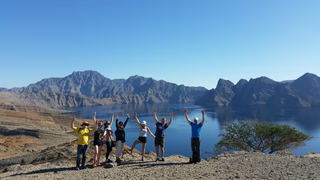
Located in the southeast of the Arabian Peninsula, bordered by 1,700 km of coastline on the Indian Ocean, the vast Rub' al Khali desert to the east, and its mountain range to the north, the Sultanate of Oman, a concentration of villages and lush palm groves, opens the doors to a different side of the Middle East . The gentle pace of life, the hospitality of the Omani people, the tolerance stemming from a long history of maritime trade with Asia and Africa, and the diversity of its landscapes make Oman a prime winter destination . This discovery trip, designed as an extended journey, takes us from Jebel Shams, which rises to 3,009 m, to the wadis with their turquoise and crystal-clear waters , including a brief immersion in the Wahiba Sands desert dunes. This itinerary, punctuated by rural villages and varied visits, allows us to experience an authentic and unspoiled Oman.
The highlights
-
A varied journey through mountains, villages, canyons, palm groves, desert and beach
-
The panoramic view of Jebel Shams, the highest point of the Arabian Peninsula
-
Visiting the traditional cities of Oman, Al Hamra, Bahla, and Nizwa
Photos


Sport
Level
Hiking / Trekking
In figures
Hiking
- Average duration/day: 2h30
- Average distance/day: 8 km
- Average daily elevation gain: 43 m
Management
French
English
Arabic
Program
-
Flight to Muscat.
- Transportation Plane - 07h - 5610km
- Breakfast not included
- Lunch not included
- Dinner not included
Flight to Muscat. Depending on your arrival time (some flights are more nighttime than daytime), you will be met at the airport and transferred to your hotel, or you will depart directly for your tour. Meals are not included in the city.Day 1 -
Great Mosque - Bilad Seet - Misfat Palm Grove
- Transportation Car - 03h30
- Activity Hiking
- Duration of the activity 2h
- Distance 5 km
- Accommodation Bed and Breakfast
- Breakfast included
- Lunch included
- Dinner included
This morning we visit the Sultan Qaboos Grand Mosque, inaugurated in 2002, built using both modern and traditional craftsmanship. We then head west towards the Nakhal region, admiring its palm groves. After a picnic lunch, we ascend to the traditional village of Bilad Sayt, surrounded by its gardens and palm groves, contrasting with the brown cliffs of the Jebel. Following a pleasant hike through the village, we continue to the Misfat Al Abreyeen palm grove and spend the night in a traditional house.Day 2 -
Misfat – Jebel Shams (the mountain of the sun) - Grand Canyon
- Transportation Car - 01h30
- Activity Hiking
- Duration of the activity 5h
- Distance 10 km
- Positive elevation gain 100 m
- Accommodation Bivouac / Tent
- Breakfast included
- Lunch included
- Dinner included
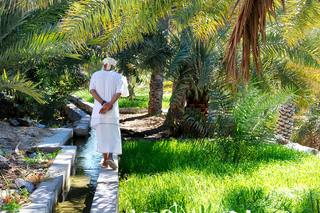
This morning, we're taking the time to explore the village of Misfat Al Abreyeen, situated at an altitude of approximately 1000 meters. We'll hike along its palm grove and through its falajs, under a canopy of greenery. The falajs are underground water supply networks used for crop irrigation; this ancient system, dating back 4500 years, is a UNESCO World Heritage Site. We'll stroll through the narrow streets of Misfat village to admire its traditional old houses. We'll then travel to the Jebel Shams plateau at an altitude of approximately 2000 meters. Starting from the village of Al Khitaym, we'll hike along a trail perched above the Grand Canyon of Oman. Panoramic views await, and at the end of the path, we'll be surprised to discover a cave village, a relic of another era.Day 3 -
Al Hamra Village - Jabrin Castle - Nizwa.
- Transportation Car - 02h
- Activity Hiking
- Duration of the activity 2h
- Distance 10 km
- Accommodation 2-star hotel
- Breakfast included
- Lunch included
- Dinner included
A day discovering Omani heritage and society. Early in the morning, we depart for the town of Al Hamra and visit a traditional house: Bait al Safah. We then continue to the small town of Balha, renowned for its pottery. Lunch will be at a local restaurant. The early afternoon is dedicated to visiting the magnificent Jabrin Castle, with its distinctive painted ceilings. We then continue our journey to Nizwa, check into our hotel, and explore this ancient capital of Oman, which flourished in the 6th and 7th centuries.Day 4 -
Nizwa Fort - Bidiyah - Wahiba Desert.
- Transportation Car - 03h30
- Activity Hiking
- Duration of the activity 2h
- Distance 5 km
- Accommodation Bivouac / Tent
- Breakfast included
- Lunch included
- Dinner included
This morning we visited Nizwa Fort. It's a large fortress that overlooks the entire city and offers a beautiful view of the surrounding mountains. It's surrounded by a fascinating traditional market to explore; this is where the Khanjars (daggers), the emblem of the country, are made. We then head south towards the town of Bidiyah, on the edge of the desert. We continue along a dirt track to immerse ourselves in the vast ochre dunes and set up camp. We hike in the dunes as the sun sets.Day 5 -
Wahiba Desert - Wadi Bani Khaled.
- Transportation Car - 03h
- Activity Hiking
- Duration of the activity 3h
- Distance 5 km
- Accommodation Bivouac / Tent
- Breakfast included
- Lunch included
- Dinner included
An early start, a stroll through the dunes to enjoy the beautiful morning light, then we travel by 4x4 to the foothills of the Eastern Hajar Mountains and the Bani Khaled Valley, a truly exceptional natural site. Our hike will take us through Wadi Bani Khaled along a route winding between boulders, following the wadi's waters, until we reach beautiful pools perfect for a swim. We'll enjoy a picnic by the water before the gentle climb back up. We continue our journey to our campsite.Day 6 -
Sur City - Wadi Tiwi
- Transportation Car - 02h
- Activity Hiking
- Duration of the activity 2h
- Distance 10 km
- Positive elevation gain 100 m
- Accommodation Bivouac / Tent
- Breakfast included
- Lunch included
- Dinner included
This morning, we explore the town of Sur, its fish market, and the dhow (or "dhow") workshop, where traditional Middle Eastern boats are built. Then we travel along the coast of the Arabian Sea to the village of Tiwi. Wadi Tiwi provides the idyllic setting for our hike today. We drive to the wadi and its villages, then follow trails and falajs, a hike punctuated by swimming and a shaded picnic. We camp by the sea.Day 7 -
Wadi Tiwi - Return to Muscat.
- Transportation Car - 02h
- Activity Hiking
- Duration of the activity 3h
- Distance 10 km
- Positive elevation gain 100 m
- Breakfast included
- Lunch included
- Dinner not included
This morning we set off for a beautiful hike in Wadi Shab, with its canyons of ochre cliffs, white rocks, and turquoise and green pools. We return to Muscat. We stroll through the Muttrah district, enjoying the colorful and friendly atmosphere of the souks, or take a walk along the Corniche. Dinner is at your leisure before the transfer to the airport for your evening flight home.Day 8 -
Arrival in France.
- Transportation Plane - 07h - 5610km
- Breakfast included
- Lunch not included
- Dinner not included
Early morning arrival in France.Day 9
Note
Accommodation
Access
Go to the starting point
Price details
The price includes
- The round-trip flight Paris / Muscat.
- Local transfers.
- Entrances to the sites.
- Accommodation in a double room.
- Full board except in Muscat.
- The team of drivers.
- A French-speaking tour guide.
The price does not include
- Visa fees.
- Personal expenses.
- The drinks.
- Meals in Muscat (2 meals and approximately €15 per meal).
- A tip for your tour guide and local team (at your discretion).
Options
- Outbound transfer : CHF82.33 / reservation
- Return transfer : CHF82.33 / reservation
- Double room : CHF82.33 / unit
- Double room : CHF82.33 / unit
- Flex fare and insurance
Practical information
Specific formalities
Specifics
Before your departure, check with the embassy or consulate regarding the entry and stay requirements for your destination country. You can also find this information on the France Diplomatie website ( https://www.diplomatie.gouv.fr/fr/dossiers-pays/ ).
In the case of flights with stopovers operated by different airlines, also check the entry requirements of the countries you are transiting through.
It is your responsibility to ensure you are in compliance, particularly regarding the validity of your identity documents (for example, some countries require your passport to be valid for at least six months after your return) , visa requirements, necessary vaccinations, and health recommendations. And don't forget to consider any customs restrictions and other potential requirements of your destination or transit country.
ℹ️ Information may change up to the departure date, remember to regularly check official websites.
Equipment
Equipment provided on site
- Individual and group cooking equipment and group bivouac equipment are provided by us.
Equipment to bring
- Category 3 sunglasses.
- Sunscreen cream for face and lips.
- 1.5L bottle
- Packet of tissues.
- Hand sanitizing gel or disinfectant wipes.
- Mosquito repellent spray for skin and clothing.
- A roll of toilet paper.
- A lighter.
- A comfortable sleeping bag, suited to your size, preferably mummy-shaped (closer to the body and with a closable hood) with a side zipper for easy opening. It's essential to choose a sleeping bag with a temperature rating that depends on the time of year and the region you're visiting. We recommend selecting a sleeping bag rated at least 10°C lower than the lowest average temperature you'll encounter (for example, if you're traveling in February in the Nizwa region, you'll need a sleeping bag rated at 5°C - 15°C). A sleeping bag rated at -10°C will also be comfortable at 0°C or 10°C; simply open it to allow air to circulate. Conversely, if you already have a sleeping bag rated at 10°C, for example, a fleece sleeping bag liner will provide an additional 5 degrees of warmth.
- Cotton or silk sleeping bag liner.
- Headlamp + spare batteries (always useful).
- Lightweight bath towel.
- Knife (don't forget to put it in your checked baggage on the plane).
- Toiletry bag and towel.
Clothing to bring
- Hiking boots with high or low tops, as you prefer, but with good soles. Avoid new shoes, as blisters could ruin your trip: if necessary, try to break them in before you leave.
- Lightweight shoes or sandals are recommended for walking through towns and villages, during transfers, or in the evenings at camp. Sandals, which allow for good ventilation, are ideal when the weather permits. These shoes should be brought in addition to your hiking boots.
- Shoes or sandals that can go in the water, for wadi crossings, like old sneakers.
- Lightweight socks for daytime and warm (wool or looped) socks for evenings at altitude.
- Trousers made of cotton or lightweight material.
- Swimsuit (if you have a swimsuit with shorts and a lycra for swimming in the "wadis", bring them).
- Shirts or t-shirts with sleeves covering the shoulders.
- Polar.
- Gore-tex type jacket for rain, wind and cold.
- Hat or cap, and/or a shemagh: the first two offer the advantage of also protecting your face from the sun, which the shemagh (long veil scarf) does not do: the latter is on the other hand very useful for protecting yourself from the cold, the heat, the sand and the wind.
For evenings and early mornings spent bivouacking at altitude in winter (from mid-November to mid-March), you will also need:
- A warm jacket such as a down jacket or thick fleece in addition to the Goretex jacket.
- Cap.
- Gloves.
They traveled with us