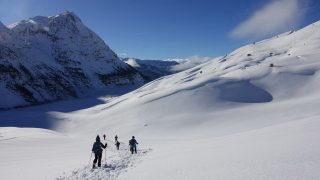
New Year's Eve spent high in the Queyras
In summary
-
Sports
-
Duration4 days
-
LevelConfirmed
-
DestinationQueyras Massif / Hautes-Alpes
-
AgeFrom the age of 18
-
CO₂-Emissions40.59 kg CO2
-
Type of stayIn a group
In a few words
Charm of a mountain hamlet and snowshoeing in the Queyras
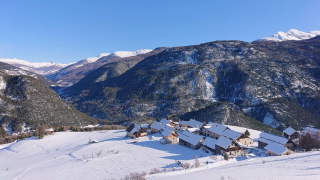
With its typical wooden houses, ancient fountains, irrigation canals, and chapel, Souliers is one of the most authentic and sun-drenched hamlets in the Queyras. Here, life still follows the rhythm of the seasons and agriculture, offering a true journey back in time to the heart of a village where mutual support and tradition remain alive. A veritable open-air museum of mountain dwellings, Souliers perfectly embodies the subtle blend of agriculture and sustainable tourism.
You will be welcomed by Alix and Victor to their cozy mountain refuge, Le Grand Rochebrune, one of the first gîtes d'étape (stopover guesthouses) in the Queyras region. Built in the 1970s using local materials, stone and larch wood, it offers all the charm of a bygone era in the mountains. Its large south-facing terrace invites you to soak up the sun and enjoy breathtaking views of the valley and snow-capped peaks.
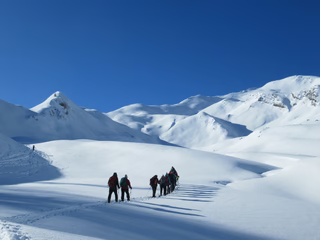
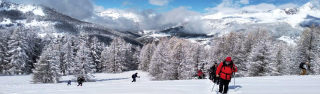
Your experienced guide will lead you on the most beautiful snowshoeing trails, through pristine landscapes and breathtaking panoramas. They will share their knowledge of the snow, the wildlife, the history, and the local architecture, while teaching you simple techniques to fully enjoy this fun and accessible activity.
The highlights
-
A magnificent place to stay in the heart of a typical Queyras hamlet: Souliers
-
Discover a vibrant and preserved village, a true symbol of local heritage.
-
A refined New Year's Eve meal with warm and gourmet notes from the Queyras region
Photos


Sport
Level
Snowshoeing
The expert's opinion
The hikes offered take place on mountain trails with elevation gains of 600 to 800 meters, both uphill and/or downhill, without any particular technical difficulties. Expect approximately 5 to 6 hours of walking per day.
You walk with a light bag containing your belongings needed for the day (picnic, warm clothing, water bottle…).
You don't need to be an expert hiker to enjoy this trip. You just need to be in good physical shape and not be afraid of working up a sweat!
In figures
Snowshoes
- Average duration/day: 5h
- Average daily elevation gain: 467 m
- Average daily descent: 384 m
Management
Our team is made up of mountain enthusiasts, happy to help you discover the Queyras in winter!
You will be accompanied by a qualified professional, an expert in snowy terrain. He will guide you safely and share his love of nature with you: reading animal tracks, observing winter landscapes, local stories and anecdotes…
Always attentive to your comfort and pace, he will advise you on your equipment, ensure your safety, and put you at ease. With him, every outing becomes an opportunity to fully enjoy the mountains, discover their hidden treasures, and experience a true moment of disconnection.
Program
-
Welcome
- Accommodation Cottage
- Breakfast not included
- Lunch not included
- Dinner included
Meeting on Day 1 at 7:30 pm at the gîte in La Chalp d'Arvieux.
Welcome and presentation of the stay by your guide. Distribution of equipment.
Night in a dormitory.
Day 1 -
La Chalp d'Arvieux - Souliers (1820 m)
- Activity Snowshoes
- Duration of the activity 5h
- Positive elevation gain 450 m
- Negative elevation 150 m
- Accommodation Cottage
- Breakfast included
- Lunch included
- Dinner included
We gently ascend to reach Lac de Roue (1,850 m), a stunning spot reminiscent in some ways of the typical landscape of the Canadian Rockies. A beautiful walk along the balcony overlooking the small Souliers valley leads us to this tiny, perched hamlet, renowned for its traditional architecture and abundant sunshine! Around fifteen inhabitants live here year-round, deeply attached to their land!
Day 2 -
Crossing the Glaisette ridges (2,350 m)
- Activity Snowshoes
- Duration of the activity 5h
- Positive elevation gain 500 m
- Negative elevation 500 m
- Accommodation Cottage
- Breakfast included
- Lunch included
- Dinner included
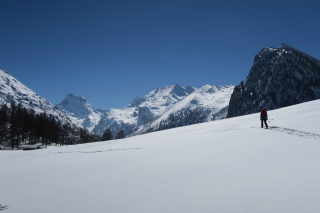
A superb traverse of the panoramic ridges overlooking the Izoard Valley and the Souliers Valley, with views of the Rochebrune peak, a dolomitic limestone pyramid reaching 3320m, and all the peaks of the Queyras. Chamois frequent these secluded spots. The descent alternates between beautiful alpine pastures and mixed forests of larch and pine.
For New Year's Eve, Victor offers a refined and elegant meal, while retaining the warm and inviting atmosphere of our mountains. It includes an aperitif and sparkling wine to finish the meal.Day 3 -
Souliers (1,850 m) - La Chalp d'Arvieux via the Crête de Catinat
- Activity Snowshoes
- Duration of the activity 5h
- Positive elevation gain 450 m
- Negative elevation 500 m
- Breakfast included
- Lunch included
- Dinner not included
We easily reach the magnificent Lac de Roue, perched at an altitude of 1,850 meters. This enchanting site evokes the iconic landscapes of the Canadian Rockies. We continue our journey along a vast ridge offering breathtaking views of the valley, before descending towards La Chalp for a fun and exhilarating descent!
Departure on Thursday at the accommodation around 4 p.m.
Day 4
Note
Please consider this program a flexible itinerary! Due to variables such as weather, snow conditions, or other factors beyond our control, we may occasionally make adjustments. However, rest assured, our guide is an expert on the mountain range, knowing its every secret, and will strive to guarantee you an exceptional experience.
Accommodation
In a gîte, dormitory-style accommodation (shared room) is available.
On day 1, you will be accommodated in La Chalp d'Arvieux in the heart of a family and authentic accommodation.
Days 2 and 3: Alix and Victor warmly welcome you to the Le Grand Rochebrune gîte in Souliers. Nestled in a south-facing valley at an altitude of 1,800 m, this isolated hamlet is located in the heart of the Queyras Regional Park, in the commune of Château Ville-Vieille.
Its unique location, isolated from other villages, with a splendid view of the Font Sancte and the Chambeyron peak, gives it a very special charm. Le Grand Rochebrune is one of the first gîtes d'étape (refuges) in the Queyras region, built in the 1970s by the Humbert family using local materials, stone and larch, which gives it its rustic appearance. It takes its name from the summit that overlooks it, the Pic de Rochebrune, which rises to 3,321 meters.
On its large south-facing terrace, you can relax, soak up the sun, enjoy the panoramic views of the mountain ridges and alpine pastures, and savor delicious homemade pastries. The bright, wooden dormitories (12 beds) are sure to charm you.
Access
Welcome
See you on Monday, December 29th at 7:30 pm at La Chalp d'Arvieux or at the Mont-Dauphin Guillestre train station at 6:30 pm if you arrive by train.
Welcome and presentation of the stay by your guide. Distribution of equipment.
Dispersion
Separation at La Chalp on Thursday, January 1st (day 4) around 4pm after the hike.
For participants using the train, transfer with the local bus (included in your stay, depending on train schedules ask us for shuttle schedules) to Montdauphin-Guillestre station (5:00 pm).
If you are staying in Arvieux for the evening
Please let us know when you register if you would like an extra night. We will accommodate you at our partner's or in nearby accommodation, depending on availability.
Go to the starting point
Travel by train to Montdauphin-Guillestre Station
Arrive easily from Paris by day or night train. Check the timetables on SNCF Connect. For travelers coming from the south, take the Marseille-Briançon line. Enjoy the simplicity of rail travel to discover this superb destination.
From the train station to the meeting point
Option included in the price, upon reservation
Your guide or an agency representative will meet you at the station at 6:30 PM for the transfer to the meeting point.
Please note that to organize this transport and ensure you have your place, you must book your transfer with us no later than one week before the date of your stay.
As places are limited, any changes must be reported no later than 72 hours before your arrival (i.e., Thursday evening at the latest).
From the north, take the Lautaret pass via Briançon (RN 94) or Grenoble (RN 94/D902). Alternatively, from Grenoble, take the A51 motorway towards Gap, then the RN94 towards Guillestre (D902).
From the south, go via Valence or Sisteron, continue towards Gap, then Embrun, and finally Guillestre. Once in Guillestre, follow the signs for "Queyras" via the D902 and the D947.
To access the Hautes-Alpes department, you can consult the website: https://inforoute.hautes-alpes.fr
We remind users of GPS navigation systems that some of the routes indicated are impassable in winter! Indeed, the major Alpine passes are not cleared of snow in winter and therefore remain closed to traffic. For example, it is impossible to reach the Queyras region from Briançon via the Col d'Izoard between November and May.
If you are driving a diesel vehicle, we advise you to fill up as you approach the Queyras region, where you will find "winter-grade" fuel. Diesel from service stations far from the mountains is rarely suitable for the cold night temperatures at altitude!
Price details
The price includes
- Full board
- Accommodation in a shared dormitory-style guesthouse
- The "New Year's Eve" package includes an aperitif and sparkling wine at the end of the meal.
- Supervision by a state-certified mountain professional
- Luggage transport
- The provision of safety equipment, snowshoes and poles
- Round-trip transfers from the train station to the meeting point
The price does not include
- Drinks and wine during meals
- Insurance
Options
- Additional night with half-board before the stay - in a dormitory : CHF50.31 / unit
- Additional night with half-board before the stay - in a double or twin room : CHF118.92 / unit
- Additional night with half-board after the stay - in a dormitory : CHF50.31 / unit
- Additional night with half-board before the stay - in a double or twin room : CHF118.92 / unit
- Flex fare and insurance
Practical information
Specific formalities
Specifics
During the hike, you must have the following documents in your possession:
• Valid identity card or passport.
• Health insurance card.
• Your travel insurance leaflet received upon registration (if you purchased this insurance through our offices) or your personal insurance (contract number + telephone number).
Equipment
Equipment provided on site
For effective winter hiking, we equip you with a pair of TSL snowshoes suited to your size and walking poles for added stability. The snowshoes, fitted with crampons, ensure good grip on hard-packed snow and optimal comfort regardless of snow conditions.
Safety is our top priority. We provide you with an avalanche transceiver (DVA) to wear, as well as a collapsible shovel and a folding probe to pack in your bag. On the first day, your guide will train you on how to use them during a quick and simple practical exercise.
With this complete equipment and the expertise of your guide, you can enjoy the winter mountains with complete peace of mind.
Equipment to bring
LUGGAGE CARRYING
For a stress-free stay, we arrange for your luggage to be transferred between each accommodation by taxi. You will leave behind anything you don't need during the day (change of clothes, toiletries, etc.).
Namely:
• Only 1 soft-sided piece of luggage per person (travel bag type),
• Maximum weight: 8 kg,
• Hard-shell suitcases are prohibited.
These guidelines help the carrier's job, especially in winter when snow limits access to accommodations. Overly heavy or bulky luggage cannot be handled.
Thanks to this service, you can hike light! All you need to bring is a 35-38L backpack for the day, to hold your picnic, some warm clothes, a thermos and the safety equipment provided by your guide (shovel and probe).
EQUIPMENT :
• 35/38 litre backpack with waist belt.
• Waterproof hiking boots with good ankle support and Vibram soles. (Absolutely avoid boots and après-ski boots, which are not suitable for snowshoeing.)
• 1 pair of high gaiters that cover your shoes and lower leg well
• Thermos or water bottle
• Cup, knife and fork for picnics.
• Race supplies to replenish energy along the way.
• Small waterproof pouch for your valuables such as: money, ID card, bank card, health insurance card, assistance contract. You can leave the rest of your documents and car keys at the hotel during your stay.
• Emergency survival blanket.
• Toilet paper with a sealed bag to wrap it up and throw it in the first available bin.
Race food / Snacks
You must provide your own food for the hike. The nutritional value of the various snacks consumed during the hike should not be overlooked. These snacks can consist of dried fruits (figs, dates, dried apricots, or prunes), cereal bars (feel free to browse the internet for inspiration and homemade recipes – it can be a fun activity during your preparation!), marzipan, quince paste, etc.
For the evening at the accommodation
Simplify your life by packing only the essentials. For a week of hiking, a few changes of clothes are more than enough. As for toiletries, opt for the essentials, choosing compact sizes, samples, and travel kits, especially if you have to carry your backpack.
Remember that a sleeping bag liner is mandatory as the beds are already equipped with duvets or blankets. Make sure your luggage doesn't exceed 8 kg to facilitate transfers and ensure your comfort throughout your adventure.
Personal pharmacy
Your first aid kit should be kept to a minimum. In your backpack, only carry your essential personal medications, compresses, elastic bandages, disinfectant, etc.
Clothing to bring
Recommended clothing for hiking:
For the upper body, adhering to the three-layer principle is essential to guarantee your comfort and safety throughout your journey:
• Breathable short-sleeved T-shirt: Choose a breathable T-shirt made of hollow fiber to wick away sweat when you are active.
• Fleece jacket: This fleece jacket keeps you warm in cool weather by providing extra thermal insulation.
• Waterproof and breathable windproof jacket (such as Gore-Tex or equivalent): This outer layer effectively protects you against inclement weather such as rain, snow or wind, keeping your body dry and sheltered from the elements.
For your lower body, choose trousers designed for winter walking that are warm and incorporate a waterproof membrane such as Gore-Tex or equivalent. Many major retailers offer this type of product, which is perfectly suited to the conditions.
Adapt your clothing according to the weather and the level of activity. Choose quick-drying clothes, avoid cotton which retains moisture, and opt for materials like wool, silk, and synthetic fibers to stay dry and warm.
Avoid anoraks and ski suits, which are too hot and bulky.
In addition to the 3 layers, your winter outfit for snowshoeing:
• 1 beanie.
• 1 pair of warm gloves (bring 1 spare pair)
• 1 protective cover for the backpack against bad weather (often integrated into the bags)
• 1 pair of trousers suitable for winter walking incorporating a waterproof membrane (jeans are not allowed as they freeze when wet!)
• 1 pair of warm underwear or leggings (these can also be used for the evening in the refuge)
• 2 pairs of high, warm hiking socks suitable for walking
• 1 pair of category 3 to 4 sunglasses
They traveled with us