Mythical mountain passes and hospices of the Swiss Alps on snowshoes
In summary
-
Sports
-
Duration6 days
-
LevelConfirmed
-
DestinationSwiss / Valais
-
AgeFrom the age of 18
-
CO₂-Emissions32.55 kg CO2
-
Type of stayIn a group
-
Languages
 French
In a few words
Prepare for an extraordinary adventure, a total immersion in the majestic Swiss Alps, between the Simplon Pass and the Great St. Bernard Pass. This snowshoeing trip is an invitation to discover breathtaking landscapes and historic accommodations, places that every mountain enthusiast should explore at least once.
Alpine Colossi Within Your Reach
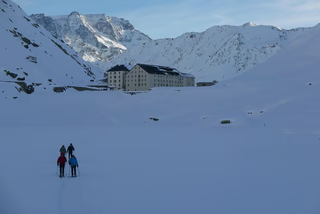
It is on these iconic mountain passes, the Simplon (2000 m) and the Great St. Bernard (2469 m), that the canons of the Great St. Bernard congregation have, for centuries, perpetuated their tradition of hospitality. From these exceptional locations, we will take you on a timeless week.
From the Simplon Hospice, our snowshoes will take you to the foot of imposing peaks like the Fletschhorn (3927 m) and the Breithorn. After a transfer to Bourg Saint-Pierre, the snowshoe ascent to the Great St. Bernard Hospice will undoubtedly be one of the highlights of your stay. Once there, extraordinary views of the Grandes Jorasses and Mont Blanc await you – a truly breathtaking spectacle.
An Authentic High-Altitude Adventure
Although this trip doesn't present any major technical difficulties, it takes place at altitude. This means we'll be mindful of weather conditions, the specifics of mountain accommodation, and the need to carry our equipment. But rest assured, every effort will be rewarded by the discovery of the Alps.
The highlights
-
A stay in two iconic hospices, exceptional places steeped in history
-
Exceptional view of the Mont Blanc massif and three countries: Switzerland, Italy and France.
-
Easy access by train from Paris, with pick-up service
Photos


Sport
Level
Snowshoeing
The expert's opinion
The trip is classified as level 3: strenuous. The walking pace is slow and steady, emphasizing discovery over the sporting aspect.
Although the hike presents no technical difficulties, it takes place at altitude, with the associated weather constraints. The route runs above the tree line, offering a typical high-mountain atmosphere.
Average elevation gain: 600 m Maximum elevation gain: 750 m
Average length: 11 km Maximum length: 13 km
Average time: 4 hours 45 minutes Maximum: 5 hours 30 minutes
In figures
Snowshoes
- Average duration/day: 4h30
- Average distance/day: 11 km
- Average daily elevation gain: 530 m
- Average daily descent: 510 m
- Maximum altitude: 2724 m
Management
French
Our guide is a state-certified and qualified snowshoeing instructor with in-depth knowledge of the mountain ranges. He also holds a certificate issued by the Swiss authorities allowing him to lead snowshoe hikes in Switzerland.
As a mountain professional, he is committed to:
- Ensuring the smooth running of your hike in complete safety: choice of route, pace of progress, logistics, health, adaptation to weather conditions and snow conditions.
- To promote group dynamics and cohesion.
- To introduce you to the mountain environment and to passionately share your knowledge of nature.
- Being available and attentive to your needs throughout your stay.
Program
-
Welcome
- Accommodation Refuge
- Breakfast not included
- Lunch not included
- Dinner included
Meet at 5:00 PM at Brig train station (Switzerland).
Please indicate your access method during registration.
After a transfer to the Simplon Hospice, located at an altitude of 2,000 meters, you will settle into the dormitories before sharing dinner served at 7:00 p.m.
The evening will continue with a presentation of the trip by your guide.
Night at the Simplon Hospice.
Day 1 -
First steps
- Activity Snowshoes
- Duration of the activity 4h30
- Distance 10 km
- Positive elevation gain 300 m
- Negative elevation 300 m
- Maximum altitude 1998 m
- Accommodation Refuge
- Breakfast included
- Lunch included
- Dinner included
This first day on snowshoes offers a gentle warm-up through the summer pasture hamlets that dot the plain of the pass.
For the first shared picnic, it is always appreciated if everyone brings a specialty from their region of origin, in order to begin the stay in a spirit of conviviality and cultural exchange.
Along the way, we pass the old Stockalper family castle, which served as a temporary hospice during the construction of the road between 1801 and 1805. This road, like the current hospice, was built on the initiative of Napoleon.
Night at the Simplon Hospice.
Walking time: 4 hours 30 minutes
Distance: 10 km
Elevation gain/loss: +300 m / -300 m
Day 2 -
The ascent of the Staldhorn
- Activity Snowshoes
- Duration of the activity 5h
- Distance 11 km
- Positive elevation gain 500 m
- Negative elevation 500 m
- Maximum altitude 2462 m
- Accommodation Refuge
- Breakfast included
- Lunch included
- Dinner included
This day is dedicated to the ascent of the Staldhorn (2,462 m). After going around the Stone Eagle, we cross the charming hamlet of Hopsche (2,030 m).
The climb, steady and gradual, offers magnificent views of the Simplon pass, the Breithorn (3,438 m) and Monte Leone (3,553 m).
Several routes are possible for the descent, depending on the conditions and the group.
Night at the Simplon Hospice.
Walking time: 5 hours
Distance: 11 km
Elevation gain/loss: +500 m / -500 m
Day 3 -
The Great St. Bernard Pass
- Activity Snowshoes
- Duration of the activity 3h30
- Distance 8 km
- Positive elevation gain 750 m
- Negative elevation 250 m
- Maximum altitude 2602 m
- Accommodation Refuge
- Breakfast included
- Lunch included
- Dinner included
After breakfast, we set off towards Bourg-Saint-Bernard (1,950 m), where we leave the vehicles and drop off any belongings not needed for the last three days. Each person then carries their personal belongings for the ascent to the hospice.
The route takes us through the Combe des Morts, so named in memory of the many travelers of the 18th and 19th centuries who died there during storms, before reaching the Great St. Bernard Pass (2,469 m) and its famous hospice, where we stop.
With a lighter pack, it is possible to continue the ascent to the pass (2,700 m) below Petit Mont Mort, offering superb panoramas on the Italian side.
Night at the Hospice of the Great St. Bernard.
Walking time: 3 hours 30 minutes
Distance: 8 km
Elevation gain/loss: +750 m / -250 m
Day 4 -
The Italian Side and Unique Panoramas
- Activity Snowshoes
- Duration of the activity 5h
- Distance 12 km
- Positive elevation gain 600 m
- Negative elevation 600 m
- Maximum altitude 2724 m
- Accommodation Refuge
- Breakfast included
- Lunch included
- Dinner included
We switch to the Italian side to explore vast spaces ideal for snowshoeing.
After a short descent, the climb towards the Fenêtre de Ferret (2,698 m) opens the doors to the Swiss Val Ferret.
We then continue to a small promontory at 2,823 meters altitude, offering a magnificent view of the Grandes Jorasses and the Mont Blanc massif.
The return is via Tête de Fonteinte (2,775 m) and Fenêtre d'En Haut (2,724 m).
Night at the Hospice of the Great St. Bernard.
Walking time: 5 hours
Distance: 12 km
Elevation gain/loss: +600 m / -600 m
Day 5 -
The end of your stay
- Activity Snowshoes
- Duration of the activity 5h
- Distance 10 km
- Positive elevation gain 500 m
- Negative elevation 900 m
- Maximum altitude 2635 m
- Breakfast included
- Lunch included
- Dinner not included
For this last day, we first begin a short descent before following the ascent through a beautiful valley, which leads us to the Col Ouest de Barasson (2,635 m).
We then reach the border ridge, once again offering superb views of the Italian side. The return journey is via the Combe des Morts back to the vehicles.
Expected arrival at Martigny station (Switzerland) around 4:00 PM.
Walking time: 5 hours
Distance: 10 km
Elevation gain/loss: +500 m / -900 m
Day 6
Note
We may need to make slight adjustments to the planned itinerary, either for organizational reasons (overbooked accommodations, splitting groups, trail conditions, avalanche risks, etc.) or based on the guide's decisions (weather, group level, etc.). These changes are always made in your best interest, to guarantee your safety and comfort.
The times indicated are based on a pace of 250 meters of elevation gain per hour uphill, 500 meters per hour downhill, and 3.5 kilometers per hour on flat terrain. They allow for comparison of different hikes on the same basis and only concern actual walking time; meal times, breaks, or time spent admiring the scenery should be added. For snowshoeing, these times remain approximate: experienced hikers on hard snow will find them slightly overestimated, while less experienced hikers on fresh snow will find them underestimated.
Snow cover:
We are, first and foremost, hikers, and if there is a lack of snow, especially towards the end of the season, the trip will still take place. The winter atmosphere and light will be there, even if you might occasionally need to carry your snowshoes to reach the snow. Since we started organizing this hike, it's rare that we've needed to carry our snowshoes for more than a few moments.
Accommodation
Simplon Hospices: guarded and heated, in 10-person dormitories with hot showers, for 3 nights. Lounges and other common areas are accessible, allowing you to fully enjoy this place with its impressive architecture.
The beds are equipped with duvets or blankets. We recommend bringing some cereal bars, dried fruit, or snacks, as the meals are simple. A sleeping bag liner and your own towels are necessary.
Hospices of the Great St. Bernard Pass: staffed and heated, in 12-person dormitories with hot showers, for 2 nights. After dinner, it's not uncommon to be invited to watch a film about the canons. Several areas are open to the public: the museum about the mountain and the history of the hospices, a lounge with a library, and the hospice's treasure displayed in several rooms. The canons participate in daily life: waking up to music, washing accompanied by Ravel's Bolero… More than just accommodation, this hospice is a place steeped in history and values, where you truly feel welcome. The beds are equipped with duvets or blankets.
Access
Welcome :
Day 01, meet at 5:30pm in front of Brig train station (Switzerland).
Please specify your mode of access when registering, so that we can organize shuttles to the starting point of the hike.
In case of delay on the same day, please contact the agency on 04 51 20 50 50.
Arrival by train: Brig train station (Switzerland)
Chambéry train station option (Savoie): Meet at 11:00 am in front of the station. Bring a picnic lunch.
Return transfer: by minibus, €40 per person, to be booked when registering.
Arrival by car:
Brig train station (Switzerland) www.viamichelin.fr
You are entering a mountain area: winter equipment is essential (snow tires and/or chains). Remember to practice fitting them before you leave.
To get to Brig, at the end of Valais:
- From Geneva: along Lake Geneva and then the Rhône.
- From Milan: via the Simplon pass (open all year round).
- From Germany: usually via Basel, Bern, Thun, Kandersteg, with cars being loaded onto the train approximately every 30 minutes to cross the Lötschberg Tunnel (duration: 12 minutes) - www.bit.ly/navetteLoetschberg
Important: An annual vignette (CHF 40, or approximately €41) is required to travel on all Swiss motorways. It is available at border crossings, service stations, post offices, and police stations.
Dispersion:
Day 06, arrival at 4:00 PM in front of Martigny station (Switzerland) or around 8:00 PM at Chambéry station (Savoie).
Go to the starting point
Welcome :
Day 01, meet at 5:30pm in front of Brig train station (Switzerland).
Please specify your mode of access when registering, so that we can organize shuttles to the starting point of the hike.
Arrival by train: Brig train station (Switzerland)
Chambéry train station option (Savoie): Meet at 11:00 am in front of the station. Bring a picnic lunch.
Return transfer: by minibus, €40 per person, to be booked when registering.
Dispersion:
Day 06, arrival at 4:00 PM in front of Martigny station (Switzerland), or around 8:00 PM at Chambéry station (Savoie).
Return transfer: by minibus, €40 per person, to be booked when registering.
Home: Brig train station (Switzerland).
Route: www.viamichelin.fr
You are entering a mountain area: winter equipment is essential (snow tires and/or chains). Remember to practice fitting them before you leave.
To get to Brig, at the end of Valais:
- From Geneva: along Lake Geneva and then the Rhône.
- From Milan: via the Simplon pass (open all year round).
- From Germany: usually via Basel, Bern, Thun, Kandersteg, with cars being loaded onto the train approximately every 30 minutes to cross the Lötschberg Tunnel (duration: 12 minutes) - www.bit.ly/navetteLoetschberg
Important: An annual vignette (CHF 40, or approximately €41) is required to travel on all Swiss motorways. It is available at border crossings, service stations, post offices, and police stations.
Dispersion:
Martigny train station (Switzerland)
You can reach Martigny station from the Bourg-Saint-Bernard car park with your vehicle.
Price details
The price includes
- Organization and supervision costs.
- Full board food and accommodation.
- The loan of snowshoes and poles, as well as safety equipment.
- A support vehicle for transfers
The price does not include
- Drinks and personal expenses.
- Personal equipment.
- The journeys to and from the reception location.
- The different types of insurance.
- Everything that is not listed under "The price includes".
Options
- Round-trip transfer from Chambéry train station : CHF36.59 / person
- Flex fare and insurance
Practical information
Specific formalities
Specifics
Documents to bring with you during the hike:
- Valid identity card or passport.
- Travel insurance: bring the leaflet received when you registered if you purchased the offered insurance, or your personal insurance information (contract number and telephone number).
Warning: Unlike in France, rescue operations in Switzerland are very expensive. Check that your insurance policy includes search and rescue coverage with a sufficient limit. Bank card insurance often covers assistance and repatriation, but some basic cards, and even some premium cards, do not cover search and rescue costs.
- French national health insurance card (Carte Vitale) and European Health Insurance Card.
- Currency: Euros are generally accepted in Switzerland, but it is advisable to have Swiss francs for certain payments.
Driving on Swiss motorways:
It is mandatory to purchase the motorway vignette (40 CHF, valid all year round), available at border crossings.
Equipment
Equipment provided on site
We offer robust and lightweight snowshoes, equipped with plate bindings and anti-slip tips, adaptable to all mountain or trekking shoes, as well as poles and specific hiking safety equipment:
- TSL Snowshoes
- Rigid poles, stronger than telescopic poles
- Safety equipment: avalanche transceiver, shovel, probe
This equipment is provided free of charge. If you already have your own equipment, you may use it provided it is in perfect working order. In this case, please let us know when you register, specifying what you will be bringing, so that we can better assess the equipment needs for the entire group.
Equipment to bring
Equipment :
- 1 backpack of 35/40 litres with a flexible frame, equipped with a waist belt and allowing the snowshoes to be attached.
- A large plastic bag to protect the inside of the backpack.
- 1 pair of excellent quality sunglasses with side protection.
- 1 thermos or a preferably insulated water bottle (1.5 liters minimum).
- 1 Opinel-type pocket knife.
- 1 small pouch (preferably waterproof) to put your money, identity card, health insurance card and assistance contract in.
- Sunscreen + lip balm.
- Airtight plastic container (minimum capacity 0.5 l) + cup + cutlery.
- Camera, binoculars (optional).
For the evening at the accommodation:
- A sleeping bag liner. Duvets are unnecessary.
- 1 swimsuit (optional).
- 1 pair of comfortable trousers.
- 1 pair of lightweight casual shoes.
- Toiletries.
- 1 quick-drying bath towel.
- Earplugs or ear pads (optional).
- 1 headlamp or flashlight.
Personal pharmacy:
- Your usual medications.
- Elastic adhesive strip, Elastoplast type, 8 cm wide.
- Sets of adhesive bandages + disinfectant compresses.
- Double skin (like Compeed or SOS blisters).
- Tweezers.
Clothing to bring
Clothes :
For the upper body, the 3-layer principle allows you to manage almost all situations:
- A long-sleeved undershirt made of breathable material (hollow fiber).
- A warm fleece fur jacket.
- A windproof, waterproof and breathable Gore-Tex type jacket.
When hiking in calm, sunny weather, a base layer may be sufficient. In rain, snow, or wind, simply add a waterproof jacket. In very cold weather or during breaks, a fleece jacket is an essential addition.
Choose quick-drying clothes, so avoid cotton. Opt for wool (merino wool underwear is comfortable and doesn't develop unpleasant odors), silk, and synthetic fibers that will keep you dry and warm for as long as possible.
Remember to dress warmly before you get cold, but especially to remove layers before you get too hot. Sweat is a hiker's enemy, as it dampens clothing that quickly becomes icy during breaks. Therefore, it's very rare to undertake a climb wearing a fleece jacket.
Avoid anoraks and ski suits, which are too warm and bulky.
The ideal list: (to be adapted according to the hike and the season)
- 1 sun hat or cap.
- 1 scarf or neck warmer.
- 1 beanie.
- 1 pair of mittens with possibly silk gloves and an extra pair of gloves.
- Short-sleeved T-shirts made of breathable material are preferred.
- 1 long-sleeved undershirt in breathable material or a shirt.
- 1 fleece fur jacket.
- 1 windproof, waterproof and breathable Gore-Tex type jacket with hood.
- 1 rain cape or a bivvy bag if you own the jacket above.
- 1 pair of loose-fitting trekking trousers.
- 1 pair of waterproof and breathable overtrousers, Gore-Tex type.
- Hiking socks (1 pair for 2 to 3 days of hiking). Opt for wool or hiking-specific socks. Be careful with cotton as it can cause blisters.
- One pair of high-top hiking boots with good ankle support and waterproof soles (like Vibram). Remember to test new shoes and those that haven't been worn for a long time beforehand. Boots and après-ski boots are absolutely forbidden.
- 1 pair of gaiters.
- 1 ski mask against fog