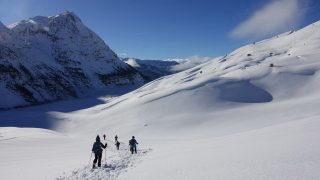
From Queyras to the Italian Alps: a spectacular adventure
In summary
-
Sports
-
Duration5 days
-
LevelConfirmed
-
DestinationQueyras Massif / Hautes-Alpes
-
AgeFrom the age of 18
-
CO₂-Emissions62.96 kg CO2
-
Type of stayIn a group
-
Languages
 French
In a few words
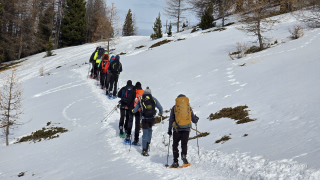
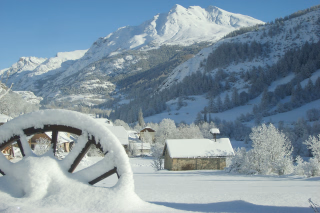
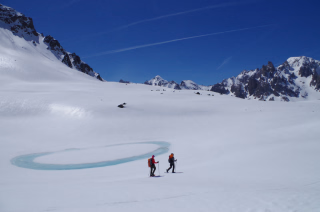
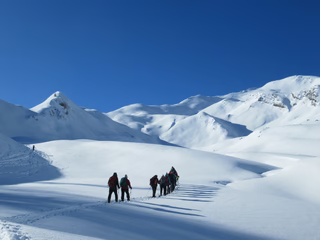
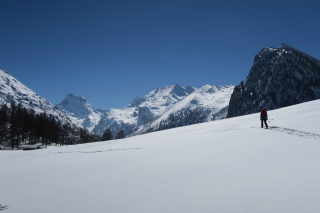
Discover a unique itinerary linking the Saint-Véran Valley in France to the Cesana Torinese Valley in Italy, in the heart of the breathtaking Alpine landscapes. This trip will take you to explore the unspoiled valleys of Queyras and Fonts de Cervières, culminating in the crossing of the Col de l'Izoard. You will be charmed by the warm welcome at the Mautino refuge and by the beauty of the Italian hamlets nestled on the sunny slopes. Following the "Haute Trace des Escartons" (High Route of the Escartons), you will traverse lands steeped in history, between France and Italy, all on snowshoes for an unforgettable experience. Your guide will share with you the stories of this region, once ruled by the Republic of the Escartons.
The highlights
-
A 5-day trek on the legendary Haute Trace des Escartons route
-
Wild and varied landscapes, between France and Italy
-
1 night in an Italian mountain refuge
Photos


Sport
Level
Snowshoeing
The expert's opinion
The hikes offered take place on mountain trails with elevation gains of 600 to 800 meters, both uphill and/or downhill, without any particular technical difficulties. Expect approximately 5 to 6 hours of walking per day.
You walk with a backpack containing your necessary belongings for the week + safety equipment (shovel and snow probe).
The terrain covered remains accessible to all and your guide is there to gently introduce you to the pleasures of snowshoeing.
In figures
Snowshoes
- Average duration/day: 5h30
- Average distance/day: 17 km
- Average daily elevation gain: 500 m
- Average daily descent: 690 m
Management
French
Our team is made up of mountain enthusiasts, happy to help you discover the Queyras and Italy in winter!
You will be accompanied by a qualified professional, an expert in snowy terrain. He will guide you safely and share his love of nature with you: reading animal tracks, observing winter landscapes, local stories and anecdotes…
Always attentive to your comfort and pace, he will advise you on your equipment, ensure your safety, and put you at ease. With him, every outing becomes an opportunity to fully enjoy the mountains, discover their hidden treasures, and experience a true moment of disconnection.
Program
-
Saint-Véran (2,042 m) and the Aigues valley - Ville-Vieille (1,450 m)
- Transportation Minibus - 00h50 - 37km
- Activity Snowshoes
- Duration of the activity 5h30
- Distance 17 km
- Positive elevation gain 200 m
- Negative elevation 950 m
- Accommodation Cottage
- Breakfast not included
- Lunch included
- Dinner included
Meet us on Sunday at 8:30 am at the Montdauphin - Guillestre SNCF train station
Welcome by your guide then transfer by bus to the Queyras (35 km).
Arrival at the cottage and presentation of the stay.
Saint-Véran (2,042 m) and the Aigues valley - Ville-Vieille (1,450 m)
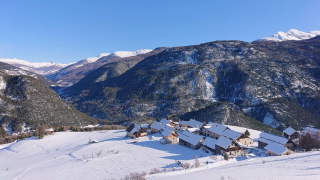
A short introductory visit to the typical village of Saint-Véran, followed by a magnificent balcony trail leading us to discover the hamlets and villages perched in the Aigues Valley: Pierre Grosse (1,915 m), Molines (1,740 m), La Rua (1,750 m), Les Prats (1,600 m) before descending to Ville-Vieille (1,450 m). A short bus transfer takes us to the small hamlet of La Chalp d'Arvieux (1,730 m).
Day 1 -
Chalp d'Arvieux (1,685 m) - Col d'Izoard (2,360 m) - Cervières (1,600 m)
- Transportation Minibus - 00h15 - 9km
- Activity Snowshoes
- Duration of the activity 5h30
- Distance 15 km
- Positive elevation gain 700 m
- Negative elevation 750 m
- Accommodation Cottage
- Breakfast included
- Lunch included
- Dinner included
Short bus transfer to the small hamlet of La Chalp d’Arvieux (1,730 m)
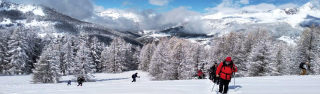
Crossing this legendary pass on snowshoes and the breathtaking beauty of the "Casse Déserte" in winter is truly unforgettable! A quick stop at the charming Refuge Napoléon to sample their famous homemade pastries, and then we're off to the beautiful clearings of the Péméan forest to reach the typical village of Cervières. Overnight stay in a mountain lodge or hotel.
Day 2 -
From Cervières to Mautino (Italy) via the upper Cervières valley
- Activity Snowshoes
- Duration of the activity 5h30
- Distance 20 km
- Positive elevation gain 600 m
- Negative elevation 350 m
- Accommodation Refuge
- Breakfast included
- Lunch included
- Dinner included
A superb crossing to Italy and the charming Mautino refuge. A short climb leads to the gateway of the upper Fonts valley, whose unspoiled nature and numerous alpine hamlets are sure to captivate. Depending on conditions, your guide may take you to the summit of Cîme Saurel (2,451 m) or to explore the many valleys along the border ridge before crossing the Bousson pass, marked by old boundary stones. This vast high-altitude pass, with its distinctly Nordic atmosphere, leads to our friend Marco's place, where he knows how to make his guests feel very welcome!
For this leg of the journey, you will take your belongings for the night, and you will find your luggage the next day in Thures.
Day 3 -
From Mautino to Val di Thura
- Activity Snowshoes
- Duration of the activity 5h30
- Distance 15 km
- Positive elevation gain 500 m
- Negative elevation 700 m
- Accommodation Cottage
- Breakfast included
- Lunch included
- Dinner included
Depending on snow conditions, we can either reach the Val di Thuras via the Colle di Chabaud (2,250 m) or via the Colle di Bégino and Monte Corbioun (2,430 m). Both options offer breathtaking panoramas! A beautiful descent through a larch forest then leads us to the charming hamlets of Chabaud, Ruilles, and Thuras (1,650 m), each with its own typical architecture.
Day 4 -
Thura (1,650 m) - Cima Chalvet (2,422 m) or Cima del Bosco (2,376 m) - Bousson (1,450 m)
- Transportation Minibus - 01h15 - 60km
- Activity Snowshoes
- Duration of the activity 5h30
- Distance 15 km
- Positive elevation gain 500 m
- Negative elevation 700 m
- Breakfast included
- Lunch included
- Dinner not included
A magnificent hike to end this Italian-inspired stay in style! Once again, the conditions and the group's level will determine the day's objective, but this hike above the hamlet on the sunny slope is a must-do and popular with ski tourers and snowshoers. The descent towards Bousson alternates between sections through forests and beautiful clearings.
Taxi transfer from Italy to Guillestre train station for 3:30 pm.
For participants arriving by train, it will be possible to arrange a drop-off at Briançon station.
Day 5
Note
Depending on the weather, snow conditions, possible overbooking of accommodation or for any other reasons beyond our control, we may exceptionally have to modify this program.
NOTE: In the event of heavy snowfall, crossing the Col d'Izoard will be impossible for safety reasons, and your guide may decide to arrange a minibus transfer to Cervières (1 hour 15 minutes / 65 km). The ascent of the Col d'Izoard will then be done as an out-and-back hike via the easier and less dangerous northern slope. In this exceptional case, the group will be asked to contribute to the additional taxi fare of €25 per person.
Accommodation
You will spend 4 nights in a gîte d'étape (stopover accommodation) in a shared room or a small dormitory for 4 to 8 people , with sanitary facilities either in the rooms or on the landing.
A night in a mountain refuge , comfortably furnished and well heated, with the possibility of taking a hot shower .
Access
WELCOME
Option included in the price, upon reservation
Your guide will meet you at Montdauphin-Guillestre station at 8:30 am for the transfer to the meeting point.
DISPERSION
Thursday at Mont-Dauphin Guillestre station at 3:30 pm
Go to the starting point
Arrival by train
Travel by train to Montdauphin-Guillestre Station
Arrive easily from Paris by day or night train. Check the timetables on SNCF Connect. For travelers coming from the south, take the Marseille-Briançon line. Enjoy the simplicity of rail travel to discover this superb destination.
Arrived by car
Go directly to the train station
Possibility of leaving your vehicle in a car park near the station during your stay.
From the north, take the Lautaret pass via Briançon (RN 94) or Grenoble (RN 94/D902). Alternatively, from Grenoble, take the A51 motorway towards Gap, then the RN94 towards Guillestre (D902).
From the south, go via Valence or Sisteron, continue towards Gap, then Embrun, and finally Guillestre. Once in Guillestre, follow the signs for "Queyras" via the D902 and the D947.
Mountain landscapes await you on this road trip to Queyras!
"Road conditions" for the Hautes-Alpes department
Regardless of the route you take to reach the Hautes-Alpes in winter, special equipment (snow tires, snow chains or snow socks…) is mandatory from November 1st to March 30th. Practice putting them on before you leave.
To access the Hautes-Alpes department, you can consult the website: https://inforoute.hautes-alpes.fr
Price details
The price includes
- The transfer of the Montdauphin station to Saint-Véran
- Full board in a gîte d'étape (stopover accommodation) format
- Supervision by a state-certified mountain guide
- Safety equipment (avalanche transceiver + shovel + probe)
- The provision of snowshoes and poles
- The return journey from Italy to Guillestre station
The price does not include
- Drinks and wine during meals
- Luggage transfer
- Exceptional contribution towards the taxi transfer from Arvieux to Cervières (€25/person) in case it is impossible to cross the Col d'Izoard for safety reasons (if the avalanche risk is too high).
- Insurance
Options
- Flex fare and insurance
Practical information
Specific formalities
Specifics
During the hike, you must have the following documents in your possession:
• Valid identity card or passport.
• Health insurance card.
• Your travel insurance leaflet received upon registration (if you purchased this insurance through our offices) or your personal insurance (contract number + telephone number).
Equipment
Equipment provided on site
- For effective winter hiking, we equip you with a pair of TSL snowshoes suited to your size and walking poles for added stability. The snowshoes, fitted with crampons, ensure good grip on hard-packed snow and optimal comfort regardless of snow conditions.
- Safety is our top priority. We provide you with an avalanche transceiver (DVA) to wear, as well as a collapsible shovel and a folding probe to pack in your bag. On the first day, your guide will train you on how to use them during a quick and simple practical exercise.
- With this complete equipment and the expertise of your guide, you can enjoy the winter mountains with complete peace of mind.
Equipment to bring
LUGGAGE TRANSPORT
SELF-PORTATION (You carry your own belongings) - No luggage transfer
A route consistent with our values
For this crossing between France and Italy, we opted for an organization consistent with our values: no luggage transfers. On this route, the vehicle trips required to transport bags would represent several times the distance covered on snowshoes, with a significant environmental impact.
Carrying your own pack is also part of the spirit of a true mountain trek. It's a different way of traveling: more independent, more committed, closer to the rhythm of nature. Rest assured, it's not about setting off loaded down like a mountaineer! Meals are taken in the mountain huts and accommodations along the route, so you won't have to carry any food or cooking equipment.
Your guide will help you pack your bag to find the right balance between comfort and lightness. Because in the mountains, organization is part of the pleasure: learning to choose the essentials, optimizing your equipment, and feeling that everything you carry has its purpose are all integral parts of the experience.
Your bag's bottom
• 35/38 litre backpack with waist belt.
• Waterproof hiking boots with good ankle support and Vibram soles. (Absolutely avoid boots and après-ski boots, which are not suitable for snowshoeing.)
• 1 pair of high gaiters that cover your shoes and lower leg well
• Thermos or water bottle
• Cup, knife and fork for picnics.
• Race supplies to replenish energy along the way.
• Small waterproof pouch for your valuables such as: money, ID card, bank card, health insurance card, assistance contract. You can leave the rest of your documents and car keys at the hotel during your stay.
• Emergency survival blanket.
• Toilet paper with a sealed bag to wrap it up and throw it in the first available bin.
For the evening at the accommodations
There is no luggage transfer, so you must pack a change of clothes for the evening and your sleeping bag liner for the night. If you follow our advice, your bag should not exceed 7 to 8 kg (see the list below).
• 1 spare T-shirt
• 1 pair of lightweight trousers (tights can be used as trousers in the evening)
• 1 pair of spare socks
• 1 small hand towel + toiletries
• Headlamp
• A fitted sheet for the night (mandatory). A sleeping bag is unnecessary.
• There is no need to bring shoes (slippers, espadrilles…) for the evening as the refuge provides clogs.
Clothing to bring
Recommended clothing for hiking:
For the upper body, adhering to the three-layer principle is essential to guarantee your comfort and safety throughout your journey:
• Breathable short-sleeved T-shirt: Choose a breathable T-shirt made of hollow fiber to wick away sweat when you are active.
• Fleece jacket: This fleece jacket keeps you warm in cool weather by providing extra thermal insulation.
• Waterproof and breathable windproof jacket (such as Gore-Tex or equivalent): This outer layer effectively protects you against inclement weather such as rain, snow or wind, keeping your body dry and sheltered from the elements.
For your lower body, choose trousers designed for winter walking that are warm and incorporate a waterproof membrane such as Gore-Tex or equivalent. Many major retailers offer this type of product, which is perfectly suited to the conditions.
Adapt your clothing according to the weather and the level of activity. Choose quick-drying clothes, avoid cotton which retains moisture, and opt for materials like wool, silk, and synthetic fibers to stay dry and warm.
Avoid anoraks and ski suits, which are too hot and bulky.
In addition to the 3 layers, your winter outfit for snowshoeing:
• 1 beanie.
• 1 pair of warm gloves (bring 1 spare pair)
• 1 protective cover for the backpack against bad weather (often integrated into the bags)
• 1 pair of trousers suitable for winter walking incorporating a waterproof membrane (jeans are not allowed as they freeze when wet!)
• 1 pair of warm underwear or leggings (these can also be used for the evening in the refuge)
• 2 pairs of high, warm hiking socks suitable for walking
• 1 pair of category 3 to 4 sunglasses
They traveled with us